Event submissions
Published

This submission belongs to the session S4. Biopolymers: Design, Fabrication, Characterization and Applications of the event The First International Conference on “Green” Polymer Materials 2020
Published date
04 Nov, 2020
Citation
Auksė Navaruckienė, Greta Motiekaitytė, Jolita Ostrauskaitė, Vanillin Acrylate-Based Photocross-Linked Polymers: Synthesis and Investigation of Properties, in Proceedings of The First International Conference on “Green” Polymer Materials 2020, 5 November–25 November 2020, MDPI: Basel, Switzerland, doi: 10.3390/CGPM2020-07205
Share
Email
Facebook
Twitter
LinkedIn
Vanillin Acrylate-Based Photocross-Linked Polymers: Synthesis and Investigation of Properties
'%3e%3cpath%20d='M12.6647%2010.9104C12.4176%2010.325%2012.0589%209.7933%2011.6088%209.34485C11.16%208.89511%2010.6283%208.53653%2010.0432%208.28891C10.038%208.28629%2010.0327%208.28498%2010.0275%208.28236C10.8437%207.69282%2011.3743%206.73252%2011.3743%205.64907C11.3743%203.85423%209.92005%202.40002%208.12522%202.40002C6.33038%202.40002%204.87618%203.85423%204.87618%205.64907C4.87618%206.73252%205.40677%207.69282%206.22296%208.28367C6.21772%208.28629%206.21248%208.2876%206.20724%208.29022C5.62031%208.53783%205.09365%208.89287%204.64167%209.34616C4.19192%209.79496%203.83334%2010.3266%203.58573%2010.9117C3.34247%2011.4846%203.21128%2012.0987%203.19925%2012.721C3.1989%2012.735%203.20135%2012.7489%203.20646%2012.7619C3.21157%2012.7749%203.21924%2012.7868%203.22901%2012.7968C3.23877%2012.8068%203.25045%2012.8148%203.26334%2012.8202C3.27623%2012.8256%203.29007%2012.8284%203.30406%2012.8284H4.09012C4.14776%2012.8284%204.19362%2012.7825%204.19493%2012.7262C4.22113%2011.7148%204.62726%2010.7676%205.34519%2010.0497C6.08802%209.30686%207.07452%208.89811%208.12522%208.89811C9.17592%208.89811%2010.1624%209.30686%2010.9052%2010.0497C11.6232%2010.7676%2012.0293%2011.7148%2012.0555%2012.7262C12.0568%2012.7839%2012.1027%2012.8284%2012.1603%2012.8284H12.9464C12.9604%2012.8284%2012.9742%2012.8256%2012.9871%2012.8202C13%2012.8148%2013.0117%2012.8068%2013.0214%2012.7968C13.0312%2012.7868%2013.0389%2012.7749%2013.044%2012.7619C13.0491%2012.7489%2013.0515%2012.735%2013.0512%2012.721C13.0381%2012.0947%2012.9084%2011.4856%2012.6647%2010.9104ZM8.12522%207.90243C7.52388%207.90243%206.95792%207.66793%206.53214%207.24215C6.10636%206.81636%205.87185%206.2504%205.87185%205.64907C5.87185%205.04773%206.10636%204.48177%206.53214%204.05599C6.95792%203.63021%207.52388%203.3957%208.12522%203.3957C8.72655%203.3957%209.29252%203.63021%209.7183%204.05599C10.1441%204.48177%2010.3786%205.04773%2010.3786%205.64907C10.3786%206.2504%2010.1441%206.81636%209.7183%207.24215C9.29252%207.66793%208.72655%207.90243%208.12522%207.90243Z'%20fill='%235D1EE1'/%3e%3c/g%3e%3c/svg%3e)
Auksė Navaruckienė 1
Greta Motiekaitytė 2
Jolita Ostrauskaitė 3
1. Department of Polymer Chemistry and Technology, Kaunas University of Technology, Radvilenu Rd. 19, LT-50254 Kaunas, Lithuania
2. Master's student
3. Professor
Abstract
Vanillin produced by chemical modification of lignin is considered as natural vanillin and is 250 times cheaper than synthetic vanillin. Due to aromatic structure it could be able to replace widely used petro-based aromatic monomers [1]. Photopolymerization engendered high interest both in academia and in industry due to the considerable practical and economic benefits. Advantages of the photopolymerizition are high reaction speed, low energy consumption, high efficiency, low volatile organic compound emission, and the large number of applications in not only conventional areas such as coatings, inks, and adhesives, but also in high-tech domains, such as microelectronics, optoelectronics, laser imaging, stereolithography, and nanotechnology [2].
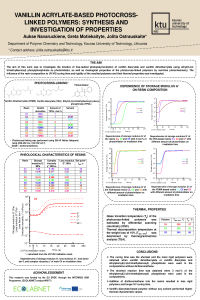
In this study, cross-linked polymers were obtained by photopolymerization of vanillin diacrylate and vanillin dimethacrylate using ethyl(2,4,6-trimethylbenzoyl)phenylphosphinate as photoinitiator. Chemical structure of the polymers was confirmed by IR spectroscopy. The yield of insoluble fraction of the cross-linked polymers, obtained after Soxhlet extraction in acetone for 24 h, was in the range of (77-96) %. Differential scanning calorimetry (DSC) and thermogravimetrical analysis (TGA) was used to study thermal characteristics of the photocross-linked polymers. The glass transition temperature, obtained from DSC curves, was in the range of (63-87) °C. The temperature of 10 % mass loss, obtained from TGA curves, was in the range of (330-350) °C. Mechanical properties of the resulted polymers were investigated by three point bending test and compression test. Vanillin diacrylate-based polymers demonstrated low deformation during compression, 4.95 % when the force of 5 N was applied. The specimen bend of 30 % was 3.65 N.
Photorheometry was used to monitor the evolution of photocross-linking process. The UV/Vis real-time photorheometry curing tests were performed on a MCR302 rheometer from Anton Paar equipped with the plate/plate measuring system. It was determined that photopolymerization was the fastest when vanillin dimethacrylate was used as monomer. The addition of solvent into the resins slowed down the photocross-linking process and less rigid polymers were obtained. The gel point was reached the fastest when 3 mol.% of ethyl(2,4,6-trimethylbenzoyl)phenylphosphinate was used in all resin series.
The vanillin diacrylate-based polymers without any solvent possessed higher values of cross-linking density, yield of insoluble fraction, and thermal stability in comparison to the vanillin dimethacrylate-based polymers, although the photocross-linking of vanillin dimethacrylate was faster than that of vanillin diacrylate.
Acknowledgements
Financial support from the EU ERDF, through the INTERREG BSR Programme, (ECOLABNET project #R077) is gratefully acknowledged.
References
[1] M. Fache, B. Boutevin, and S. Caillol, Sustainable Chem. Eng. 2016, 4, 35−46.
[2] Y. Yagci, S. Jockusch, and N.J. Turro, Macromolecules 2010, 43, 6245-6260.
Keywords
Vanillin diacrylate
vanillin dimethacrylate
photopolymerization
Manuscript
sciforum-036367 (2).pdf
Poster
sciforum-036367 poster.pdf
Synthesis and Properties of Poly(alkylene vanillate) Polyesters, A New Class of Bio-Based Polymers
A Generic Combined Matrix- and Lattice-Based Kinetic Monte Carlo Modeling Tool to Tune Surface-Initiated Polymerization