Event submissions
Published

This submission belongs to the session S3. Green Polymers: Durability & Aging, Degradation & Biodegradation of the event The First International Conference on “Green” Polymer Materials 2020
Published date
05 Nov, 2020
Citation
Aleksander Hejna, Coffee Silverskin as a Potential Bio-Based Antioxidant for Polymer Materials: Brief Review , in Proceedings of The First International Conference on “Green” Polymer Materials 2020, 5 November–25 November 2020, MDPI: Basel, Switzerland, doi: 10.3390/CGPM2020-07220
Share
Email
Facebook
Twitter
LinkedIn
Coffee Silverskin as a Potential Bio-Based Antioxidant for Polymer Materials: Brief Review

Aleksander Hejna 1
1. Gdańsk University of Technology
Abstract
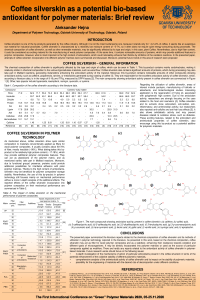
Coffee silverskin is one of the by-products generated by the coffee industry. Although it is not the most burdensome one, because it stands only for ~4.2 wt% of coffee, it seems like an auspicious raw material for industrial processes. Coffee silverskin is characterized by a relatively low moisture content of ~5-7%, so it often does not require quite energy-consuming drying processes. The chemical composition of coffee silverskin, as well as other renewable materials, may be significantly affected by its type and origin, in this case, plant Coffea. Nevertheless, due to high fiber content, it could be considered as exciting material for the manufacturing of wood polymer composites. At the same time, it contains noticeable amounts of proteins, which may provide additional features to polymer composites. However, what is most important is the high content of antioxidants, which could noticeably enhance their lifetime by inhibition of the oxidation reactions. In the presented paper, attempts of coffee silverskin incorporation into different polymer matrices were summarized and discussed. Moreover, potential future trends in this area of research were proposed.
Keywords
Coffee silverskin
polymer composites
filler
antioxidant activity
Manuscript
sciforum-037108.pdf
Poster
Poster.pdf
Inhibition of Polymer Photodegradation by Incorporation of Coffee Silverskin
“Green” Poly(butylene succinate-co-dilinoleic succinate) Copolymers Synthesized Using Candida Antarctica Lipase B (CAL-B) as Biocatalyst