Event submissions
Published

This submission belongs to the session S4. Biopolymers: Design, Fabrication, Characterization and Applications of the event The First International Conference on “Green” Polymer Materials 2020
Published date
05 Nov, 2020
Citation
Panagiotis A. Klonos, Lazaros Papadopoulos, Zoi Terzopoulou, Apostolos Kyritsis, George Z. Papageorgiou, Dimitris N. Bikiaris, Tuning the Crystallizability of Renewable Poly(alkylene 2,5-furan-dicarboxylate)s by In-Situ Adding Various Nanosized Nucleation Agents, in Proceedings of The First International Conference on “Green” Polymer Materials 2020, 5 November–25 November 2020, MDPI: Basel, Switzerland, doi: 10.3390/CGPM2020-07224
Share
Email
Facebook
Twitter
LinkedIn
Tuning the Crystallizability of Renewable Poly(alkylene 2,5-furan-dicarboxylate)s by In-Situ Adding Various Nanosized Nucleation Agents

Panagiotis A. Klonos 1,2

Lazaros Papadopoulos 1

Zoi Terzopoulou 1
'%3e%3cpath%20d='M12.6647%2010.9104C12.4176%2010.325%2012.0589%209.7933%2011.6088%209.34485C11.16%208.89511%2010.6283%208.53653%2010.0432%208.28891C10.038%208.28629%2010.0327%208.28498%2010.0275%208.28236C10.8437%207.69282%2011.3743%206.73252%2011.3743%205.64907C11.3743%203.85423%209.92005%202.40002%208.12522%202.40002C6.33038%202.40002%204.87618%203.85423%204.87618%205.64907C4.87618%206.73252%205.40677%207.69282%206.22296%208.28367C6.21772%208.28629%206.21248%208.2876%206.20724%208.29022C5.62031%208.53783%205.09365%208.89287%204.64167%209.34616C4.19192%209.79496%203.83334%2010.3266%203.58573%2010.9117C3.34247%2011.4846%203.21128%2012.0987%203.19925%2012.721C3.1989%2012.735%203.20135%2012.7489%203.20646%2012.7619C3.21157%2012.7749%203.21924%2012.7868%203.22901%2012.7968C3.23877%2012.8068%203.25045%2012.8148%203.26334%2012.8202C3.27623%2012.8256%203.29007%2012.8284%203.30406%2012.8284H4.09012C4.14776%2012.8284%204.19362%2012.7825%204.19493%2012.7262C4.22113%2011.7148%204.62726%2010.7676%205.34519%2010.0497C6.08802%209.30686%207.07452%208.89811%208.12522%208.89811C9.17592%208.89811%2010.1624%209.30686%2010.9052%2010.0497C11.6232%2010.7676%2012.0293%2011.7148%2012.0555%2012.7262C12.0568%2012.7839%2012.1027%2012.8284%2012.1603%2012.8284H12.9464C12.9604%2012.8284%2012.9742%2012.8256%2012.9871%2012.8202C13%2012.8148%2013.0117%2012.8068%2013.0214%2012.7968C13.0312%2012.7868%2013.0389%2012.7749%2013.044%2012.7619C13.0491%2012.7489%2013.0515%2012.735%2013.0512%2012.721C13.0381%2012.0947%2012.9084%2011.4856%2012.6647%2010.9104ZM8.12522%207.90243C7.52388%207.90243%206.95792%207.66793%206.53214%207.24215C6.10636%206.81636%205.87185%206.2504%205.87185%205.64907C5.87185%205.04773%206.10636%204.48177%206.53214%204.05599C6.95792%203.63021%207.52388%203.3957%208.12522%203.3957C8.72655%203.3957%209.29252%203.63021%209.7183%204.05599C10.1441%204.48177%2010.3786%205.04773%2010.3786%205.64907C10.3786%206.2504%2010.1441%206.81636%209.7183%207.24215C9.29252%207.66793%208.72655%207.90243%208.12522%207.90243Z'%20fill='%235D1EE1'/%3e%3c/g%3e%3c/svg%3e)
Apostolos Kyritsis 2

George Z. Papageorgiou 3

Dimitris N. Bikiaris 1
1. Department of Chemistry, Laboratory of Polymer Chemistry and Technology, Aristotle University of Thessaloniki, GR-541 24, Thessaloniki, Greece
2. Department of Physics, National Technical University of Athens, Zografou Campus, 15780, Athens, Greece
3. Laboratory of Industrial and Food chemistry, Chemistry Department, University of Ioannina, 45110 Ioannina, Greece
Abstract
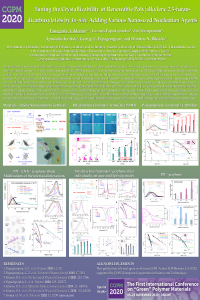
Poly(alkylene 2,5 furan-dicarboxylate)s (PAFs) belong in a relatively new class of bio-based polyester prepared from renewable resources aiming at use in food packaging applications, owing to their excellent mechanical and gas barrier performance. Both properties are severely connected to crystallinity. Thus, the enhancement of the latter is attempted here by the in situ introduction in the PAF matrices of a variety of inorganic nanofillers, graphene nanoplatelets, carbon and halloysite nanotubes, nanoclays and silica nanoparticles. The nanofillers are used in the bulk/initial state as well as upon surface modifications, moreover, in the forms of mixtures and hybrid particles. For the structural and crystallization investigation, we employ the following combination of techniques Fourier transform infra-red spectroscopy, calorimetry, X-ray diffraction, polarized optical microscopy and broadband dielectric spectroscopy. The direct effects of the fillers on the rate and the amount of crystallization are correlated with the semicrystalline morphology, with molecular mobility and, in some cases, with the mechanical performance. The employed fillers facilitate crystallization acting as additional nuclei, with the strength of this facilitation increasing systematically with the aspect ratio of the fillers. Contrariwise, upon surface modification and development of strong polymer-particle interactions the nucleation action is hindered, which is demonstrated in PAFs for the first time. Overall the results suggest that such materials serve quite well as tailor-made nanocomposites for targeted applications.
Keywords
poly(alkylene 2,5-furan-dicarboxylate)
polymer crystallization
nanocomposites
Manuscript
sciforum_036452_original_Poceeding_manuscript_KLONOS_2020 - done.pdf
Poster
Poster KLONOS CGPM_2020.pdf
A New Textile Economy: Synthesis and Characterization of Phenolic Type Resin with Protein from Waste Textiles Suitable for Wood-Based Panels
Tridimensional Alginate Films with Cat’s Claw (Uncaria tomentosa) Extract or Aloe Vera (Aloe barbadensis) Gel for Potential Use as Wound Dressings