Event submissions
Published

This submission belongs to the session A. Liquid Crystals of the event The 2nd International Online Conference on Crystals
Published date
05 Nov, 2020
Citation
BARNALI BARMAN, MALAY KUMAR DAS, Study of physical properties associated with some binary mixtures of chiral ferroelectric liquid crystalline compounds, in Proceedings of The 2nd International Online Conference on Crystals, 10 November–20 November 2020, MDPI: Basel, Switzerland, doi: 10.3390/IOCC_2020-07234
Share
Email
Facebook
Twitter
LinkedIn
Study of physical properties associated with some binary mixtures of chiral ferroelectric liquid crystalline compounds
'%3e%3cpath%20d='M12.6647%2010.9104C12.4176%2010.325%2012.0589%209.7933%2011.6088%209.34485C11.16%208.89511%2010.6283%208.53653%2010.0432%208.28891C10.038%208.28629%2010.0327%208.28498%2010.0275%208.28236C10.8437%207.69282%2011.3743%206.73252%2011.3743%205.64907C11.3743%203.85423%209.92005%202.40002%208.12522%202.40002C6.33038%202.40002%204.87618%203.85423%204.87618%205.64907C4.87618%206.73252%205.40677%207.69282%206.22296%208.28367C6.21772%208.28629%206.21248%208.2876%206.20724%208.29022C5.62031%208.53783%205.09365%208.89287%204.64167%209.34616C4.19192%209.79496%203.83334%2010.3266%203.58573%2010.9117C3.34247%2011.4846%203.21128%2012.0987%203.19925%2012.721C3.1989%2012.735%203.20135%2012.7489%203.20646%2012.7619C3.21157%2012.7749%203.21924%2012.7868%203.22901%2012.7968C3.23877%2012.8068%203.25045%2012.8148%203.26334%2012.8202C3.27623%2012.8256%203.29007%2012.8284%203.30406%2012.8284H4.09012C4.14776%2012.8284%204.19362%2012.7825%204.19493%2012.7262C4.22113%2011.7148%204.62726%2010.7676%205.34519%2010.0497C6.08802%209.30686%207.07452%208.89811%208.12522%208.89811C9.17592%208.89811%2010.1624%209.30686%2010.9052%2010.0497C11.6232%2010.7676%2012.0293%2011.7148%2012.0555%2012.7262C12.0568%2012.7839%2012.1027%2012.8284%2012.1603%2012.8284H12.9464C12.9604%2012.8284%2012.9742%2012.8256%2012.9871%2012.8202C13%2012.8148%2013.0117%2012.8068%2013.0214%2012.7968C13.0312%2012.7868%2013.0389%2012.7749%2013.044%2012.7619C13.0491%2012.7489%2013.0515%2012.735%2013.0512%2012.721C13.0381%2012.0947%2012.9084%2011.4856%2012.6647%2010.9104ZM8.12522%207.90243C7.52388%207.90243%206.95792%207.66793%206.53214%207.24215C6.10636%206.81636%205.87185%206.2504%205.87185%205.64907C5.87185%205.04773%206.10636%204.48177%206.53214%204.05599C6.95792%203.63021%207.52388%203.3957%208.12522%203.3957C8.72655%203.3957%209.29252%203.63021%209.7183%204.05599C10.1441%204.48177%2010.3786%205.04773%2010.3786%205.64907C10.3786%206.2504%2010.1441%206.81636%209.7183%207.24215C9.29252%207.66793%208.72655%207.90243%208.12522%207.90243Z'%20fill='%235D1EE1'/%3e%3c/g%3e%3c/svg%3e)
BARNALI BARMAN 1
MALAY KUMAR DAS 2
1. Research Scholar
2. University Professor
Abstract
Study of physical properties associated with some binary mixtures of chiral ferroelectric liquid crystalline compounds
Barnali Barman*, Malay Kumar Das
Department of Physics, University of North Bengal, 734 013, Siliguri, West Bengal, India
*E-mail ID: barnalibarman1991@gmail.com
Abstract
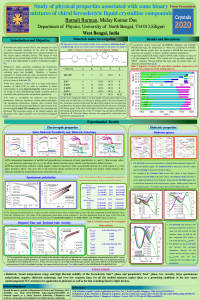
Among the various advanced technological materials in the modern era; Liquid Crystals (LCs) has become one of the most important self-organizing molecular materials with their growing applications in the various field of science. The research associated with the Ferroelectric Liquid Crystals (FLCs) has become a subject of most intense area during the past few decades owing to their valuable intrinsic fundamental properties.At present their successful utilization in flat television screens, fast electro-optical switching devices etc. makes them extremely demandable in the commercial field. The fulfilment of this promise depends greatly on an improved understanding on the physical properties of the FLC materials. However no single materials can exhibit all the desired properties for different applications. In order to fulfil all the requirements of the device manufacturer; preparation of suitable binary mixtures is one of the most simple and elegant way in the field of LC Research. Keeping this in mind some mixtures have prepared by using pure chiral FLC compounds [1,2,3] and investigated in the light of the static dielectric permittivity (ε), dielectric anisotropy (∆ε), spontaneous polarization (Ps), response time (τ), torsional bulk viscosity (h) and dielectric spectroscopy. The temperature variation of Ps of the studied mixtures provides a preliminary idea about the order of the associated phase transitions namely SmA*-SmC* and N*-SmC*. The activation energy of all the mixtures have been determined from the best fitted Arrhenius plot. This assignment mainly contributes to the preparation and investigation of some smart multifunctional FLC mixtures aimed for optoelectronic and photonic applications.
References
[1]A.Bubnov,M.Kaspar,V.Novotna,V.Hamplova,M.Glogarova,N.Kapernaum,F.Giesselmann; Liq. Cryst.2008, 35, 1329-1337.doi.org/10.1080/02678290802585525.
[2]B.Barman, B.Das, M.K.Das, V. Hamplová, A.Bubnov, Journal of Molecular Liquids.2019, 283.472-781. doi.org/10.1016/j.molliq.2019.03.071.
[3]M.K.Das,B.Barman,B.Das,V.Hamplová,A.Bubnov,Crystals.2019,9,473;doi:10.3390/cryst9090473.
Keywords
Static dielectric permittivity
Dielectric anisotropy
Spontaneous polarization
Critical exponent (β)
Response time
Torsional bulk viscosity
Activation energy.
Manuscript
561.pdf
Poster
Presentation pdf.pdf
Cocrystals of Modafinil-Nicotinic acid:A Novel Cocrystal for Enhanced Bioavailability
Hirshfeld surface analysis and energy framework for crystals of quinazoline methylidene bridged compounds