Event submissions
Published

This submission belongs to the session E. Round Table on Natural Products of the event 6th International Electronic Conference on Medicinal Chemistry
Published date
05 Nov, 2020
Citation
Ifeoma Felicia Chukwuma, Nene Orizu Uchendu, Izuchukwu John, Lawrence Sunday Ezeanyika, Chromolaena odorata leaves extract attenuated testosterone-induced benign prostatic hyperplasia in male albino rats, in Proceedings of 6th International Electronic Conference on Medicinal Chemistry, 1 November–30 November 2020, MDPI: Basel, Switzerland, doi: 10.3390/ECMC2020-07241
Share
Email
Facebook
Twitter
LinkedIn
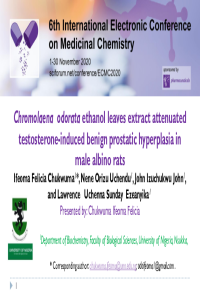
Chromolaena odorata leaves extract attenuated testosterone-induced benign prostatic hyperplasia in male albino rats
'%3e%3cpath%20d='M12.6647%2010.9104C12.4176%2010.325%2012.0589%209.7933%2011.6088%209.34485C11.16%208.89511%2010.6283%208.53653%2010.0432%208.28891C10.038%208.28629%2010.0327%208.28498%2010.0275%208.28236C10.8437%207.69282%2011.3743%206.73252%2011.3743%205.64907C11.3743%203.85423%209.92005%202.40002%208.12522%202.40002C6.33038%202.40002%204.87618%203.85423%204.87618%205.64907C4.87618%206.73252%205.40677%207.69282%206.22296%208.28367C6.21772%208.28629%206.21248%208.2876%206.20724%208.29022C5.62031%208.53783%205.09365%208.89287%204.64167%209.34616C4.19192%209.79496%203.83334%2010.3266%203.58573%2010.9117C3.34247%2011.4846%203.21128%2012.0987%203.19925%2012.721C3.1989%2012.735%203.20135%2012.7489%203.20646%2012.7619C3.21157%2012.7749%203.21924%2012.7868%203.22901%2012.7968C3.23877%2012.8068%203.25045%2012.8148%203.26334%2012.8202C3.27623%2012.8256%203.29007%2012.8284%203.30406%2012.8284H4.09012C4.14776%2012.8284%204.19362%2012.7825%204.19493%2012.7262C4.22113%2011.7148%204.62726%2010.7676%205.34519%2010.0497C6.08802%209.30686%207.07452%208.89811%208.12522%208.89811C9.17592%208.89811%2010.1624%209.30686%2010.9052%2010.0497C11.6232%2010.7676%2012.0293%2011.7148%2012.0555%2012.7262C12.0568%2012.7839%2012.1027%2012.8284%2012.1603%2012.8284H12.9464C12.9604%2012.8284%2012.9742%2012.8256%2012.9871%2012.8202C13%2012.8148%2013.0117%2012.8068%2013.0214%2012.7968C13.0312%2012.7868%2013.0389%2012.7749%2013.044%2012.7619C13.0491%2012.7489%2013.0515%2012.735%2013.0512%2012.721C13.0381%2012.0947%2012.9084%2011.4856%2012.6647%2010.9104ZM8.12522%207.90243C7.52388%207.90243%206.95792%207.66793%206.53214%207.24215C6.10636%206.81636%205.87185%206.2504%205.87185%205.64907C5.87185%205.04773%206.10636%204.48177%206.53214%204.05599C6.95792%203.63021%207.52388%203.3957%208.12522%203.3957C8.72655%203.3957%209.29252%203.63021%209.7183%204.05599C10.1441%204.48177%2010.3786%205.04773%2010.3786%205.64907C10.3786%206.2504%2010.1441%206.81636%209.7183%207.24215C9.29252%207.66793%208.72655%207.90243%208.12522%207.90243Z'%20fill='%235D1EE1'/%3e%3c/g%3e%3c/svg%3e)
Ifeoma Felicia Chukwuma 1
Nene Orizu Uchendu 1
Izuchukwu John 2
Lawrence Sunday Ezeanyika 3
1. Department of Biochemistry, Faculty of Biological Sciences, University of Nigeria, Nsukka, Nigeria
2. Department of Biochemistry, Faculty of Biological Sciences, University of Nigeria, Nsukka. Nigeria
3. Department of Biochemistry, University of Nigeria, Nsukka, Nigeria.
Abstract
ABSTRACT
BACKGROUND: Benign prostatic hyperplasia (BPH), characterized by the proliferation of the stromal and epithelial cells is one of the frequent diseases in aging males.
OBJECTIVE: The aim of this study was to investigate the effect of ethanol extract of Chromolaena odorata on testosterone-induced benign prostatic hyperplasia in male albino rats.
METHODS: BPH was induced in the male albino rats by subcutaneous injection of testosterone to experimental groups (B-F) for 28 days. Group A was not induced (baseline), group B untreated (positive control) received carboxymethyl cellulose for fifteen (15) consecutive days after induction while group C received 1 mg/kg body weight of finasteride (standard control), and groups D-F different doses (100, 200, 400 mg/kg b. w) of the extract each for 21 days after which blood samples were collected from all the animals and used for determination of prostatic activity, liver functions and oxidative activity using standard methods.
RESULTS: Group C, as well as groups D-F, had significant (p < 0.05) decrease in serum levels of testosterone, dihydrotestosterone and prostrate sensitive antigen, aspartate aminotransferase and alanine aminotransferase when compared with the BPH untreated group B. There was however a significant (p < 0.05) decrease in malondialdehyde level and an increase in superoxide dismutase and catalase activities in all the groups treated with different doses of the extract.
CONCLUSION: The results from this study showed that C. odorata leaves extract attenuated testosterone-induced BPH possibly through the prevention of oxidative stress making it promising phytotherapy in the management of BPH in males.
Keywords
antioxidants
benign prostatic hyperplasia
Chromolaena odorata
oxidative stress
Poster
PDF POWER POINT- ABSTRACT-034841.pdf
Antimicrobial, antioxidant, and GC-MS analysis of hexane extract of the leaves of Solanum erianthum
Study of the mechanism of digestive action of a decoction prepared with paico (Dysphania multifida)