Event submissions
Published

This submission belongs to the session E. Round Table on Natural Products of the event 6th International Electronic Conference on Medicinal Chemistry
Published date
05 Nov, 2020
Citation
Shadma Wahab, Fractionation, chromatographic screening and quantification of bioactive compounds from the imperative medicinal plant Salvia officinalis, in Proceedings of 6th International Electronic Conference on Medicinal Chemistry, 1 November–30 November 2020, MDPI: Basel, Switzerland, doi: 10.3390/ECMC2020-07248
Share
Email
Facebook
Twitter
LinkedIn
Fractionation, chromatographic screening and quantification of bioactive compounds from the imperative medicinal plant Salvia officinalis
'%3e%3cpath%20d='M12.6647%2010.9104C12.4176%2010.325%2012.0589%209.7933%2011.6088%209.34485C11.16%208.89511%2010.6283%208.53653%2010.0432%208.28891C10.038%208.28629%2010.0327%208.28498%2010.0275%208.28236C10.8437%207.69282%2011.3743%206.73252%2011.3743%205.64907C11.3743%203.85423%209.92005%202.40002%208.12522%202.40002C6.33038%202.40002%204.87618%203.85423%204.87618%205.64907C4.87618%206.73252%205.40677%207.69282%206.22296%208.28367C6.21772%208.28629%206.21248%208.2876%206.20724%208.29022C5.62031%208.53783%205.09365%208.89287%204.64167%209.34616C4.19192%209.79496%203.83334%2010.3266%203.58573%2010.9117C3.34247%2011.4846%203.21128%2012.0987%203.19925%2012.721C3.1989%2012.735%203.20135%2012.7489%203.20646%2012.7619C3.21157%2012.7749%203.21924%2012.7868%203.22901%2012.7968C3.23877%2012.8068%203.25045%2012.8148%203.26334%2012.8202C3.27623%2012.8256%203.29007%2012.8284%203.30406%2012.8284H4.09012C4.14776%2012.8284%204.19362%2012.7825%204.19493%2012.7262C4.22113%2011.7148%204.62726%2010.7676%205.34519%2010.0497C6.08802%209.30686%207.07452%208.89811%208.12522%208.89811C9.17592%208.89811%2010.1624%209.30686%2010.9052%2010.0497C11.6232%2010.7676%2012.0293%2011.7148%2012.0555%2012.7262C12.0568%2012.7839%2012.1027%2012.8284%2012.1603%2012.8284H12.9464C12.9604%2012.8284%2012.9742%2012.8256%2012.9871%2012.8202C13%2012.8148%2013.0117%2012.8068%2013.0214%2012.7968C13.0312%2012.7868%2013.0389%2012.7749%2013.044%2012.7619C13.0491%2012.7489%2013.0515%2012.735%2013.0512%2012.721C13.0381%2012.0947%2012.9084%2011.4856%2012.6647%2010.9104ZM8.12522%207.90243C7.52388%207.90243%206.95792%207.66793%206.53214%207.24215C6.10636%206.81636%205.87185%206.2504%205.87185%205.64907C5.87185%205.04773%206.10636%204.48177%206.53214%204.05599C6.95792%203.63021%207.52388%203.3957%208.12522%203.3957C8.72655%203.3957%209.29252%203.63021%209.7183%204.05599C10.1441%204.48177%2010.3786%205.04773%2010.3786%205.64907C10.3786%206.2504%2010.1441%206.81636%209.7183%207.24215C9.29252%207.66793%208.72655%207.90243%208.12522%207.90243Z'%20fill='%235D1EE1'/%3e%3c/g%3e%3c/svg%3e)
Shadma Wahab 1
1. king Khalid University
Abstract
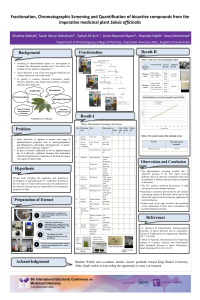
Background: Salvia officinalis (in Arabic, Meramea) is native to the Mediterranean region. It has a rich record of medicinal and culinary applications. It is one of the most popular medicinal and culinary herbs used in the Arab world. The current study aimed to fractionate, screen and quantify the phytochemicals from the hydroalcoholic crude extract of S.officinalis collected from the Asir region of Saudi Arabia. Methods: The coarsely powdered leaves were extracted by maceration technique using 95% ethanol and concentrated using a rotary evaporator. The dried ethanol extract fractionated by using hexane, ethyl acetate, chloroform and methanol. All the fractions were dried and subjected to preliminary phytochemical screening and thin layer chromatographic studies for flavonoids. Flavonoids in methanol fraction were estimated by aluminium chloride method. Results: The result of phytochemical screening study revealed the presence of phenolic compounds, alkaloids, flavonoids in the methanol and ethyl acetate fractions while glycoside was absent in these fractions. TLC analysis showed the presence of rutin and quercetin. The total flavonoid content was estimated as 3.17% by aluminium chloride method. Conclusions: The phytochemical screening revealed that S. officinalis collected from the Asir region of Saudi Arabia possess different classes of chemical compounds which may be associated with various pharmacological properties of this plant. The TLC analysis confirmed the presence of rutin and quercetin in the methanol fraction. Quantitative estimation proved that the leaf contains a promising amount of flavonoids which may be the basis that sage has found rising application in food formulations.
Keywords
chromatographic screening
flavonoid
fractionation
quantification
Salvia officinalis
Poster
Dr Shadma Poster .pdf
Phytochemicals for cancer treatment: An update on plant-derived anti-cancer compounds and their mechanisms of action
Rapid and synchronized dormancy-broken Kyoho grape seed endosperm without extraction or concentration shows significant effect on both anti-cancer and pro-immunity