Event submissions
Published

This submission belongs to the session E. Round Table on Natural Products of the event 6th International Electronic Conference on Medicinal Chemistry
Published date
05 Nov, 2020
Citation
Edward Muntean, Camelia Urda, Isoflavones in red clover tea infusions, in Proceedings of 6th International Electronic Conference on Medicinal Chemistry, 1 November–30 November 2020, MDPI: Basel, Switzerland, doi: 10.3390/ECMC2020-07251
Share
Email
Facebook
Twitter
LinkedIn
Isoflavones in red clover tea infusions

Edward Muntean 1,2
'%3e%3cpath%20d='M12.6647%2010.9104C12.4176%2010.325%2012.0589%209.7933%2011.6088%209.34485C11.16%208.89511%2010.6283%208.53653%2010.0432%208.28891C10.038%208.28629%2010.0327%208.28498%2010.0275%208.28236C10.8437%207.69282%2011.3743%206.73252%2011.3743%205.64907C11.3743%203.85423%209.92005%202.40002%208.12522%202.40002C6.33038%202.40002%204.87618%203.85423%204.87618%205.64907C4.87618%206.73252%205.40677%207.69282%206.22296%208.28367C6.21772%208.28629%206.21248%208.2876%206.20724%208.29022C5.62031%208.53783%205.09365%208.89287%204.64167%209.34616C4.19192%209.79496%203.83334%2010.3266%203.58573%2010.9117C3.34247%2011.4846%203.21128%2012.0987%203.19925%2012.721C3.1989%2012.735%203.20135%2012.7489%203.20646%2012.7619C3.21157%2012.7749%203.21924%2012.7868%203.22901%2012.7968C3.23877%2012.8068%203.25045%2012.8148%203.26334%2012.8202C3.27623%2012.8256%203.29007%2012.8284%203.30406%2012.8284H4.09012C4.14776%2012.8284%204.19362%2012.7825%204.19493%2012.7262C4.22113%2011.7148%204.62726%2010.7676%205.34519%2010.0497C6.08802%209.30686%207.07452%208.89811%208.12522%208.89811C9.17592%208.89811%2010.1624%209.30686%2010.9052%2010.0497C11.6232%2010.7676%2012.0293%2011.7148%2012.0555%2012.7262C12.0568%2012.7839%2012.1027%2012.8284%2012.1603%2012.8284H12.9464C12.9604%2012.8284%2012.9742%2012.8256%2012.9871%2012.8202C13%2012.8148%2013.0117%2012.8068%2013.0214%2012.7968C13.0312%2012.7868%2013.0389%2012.7749%2013.044%2012.7619C13.0491%2012.7489%2013.0515%2012.735%2013.0512%2012.721C13.0381%2012.0947%2012.9084%2011.4856%2012.6647%2010.9104ZM8.12522%207.90243C7.52388%207.90243%206.95792%207.66793%206.53214%207.24215C6.10636%206.81636%205.87185%206.2504%205.87185%205.64907C5.87185%205.04773%206.10636%204.48177%206.53214%204.05599C6.95792%203.63021%207.52388%203.3957%208.12522%203.3957C8.72655%203.3957%209.29252%203.63021%209.7183%204.05599C10.1441%204.48177%2010.3786%205.04773%2010.3786%205.64907C10.3786%206.2504%2010.1441%206.81636%209.7183%207.24215C9.29252%207.66793%208.72655%207.90243%208.12522%207.90243Z'%20fill='%235D1EE1'/%3e%3c/g%3e%3c/svg%3e)
Camelia Urda 2
1. University of Agricultural Sciences and Veterinary Medicine Cluj Napoca, Romania
2. Research & Development Station for Agriculture, Turda, Romania
Abstract
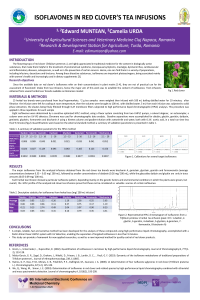
Red clover (Trifolium pretense L.) is highly appreciated in traditional medicine for its content in biologically active substances, that make it helpful in the treatment of premenstrual syndrome, menopausal symptoms, mastalgia, dysmenorrhea, cardiovascular and inflammatory diseases, osteoporosis, as well as in prevention of certain cancers. Among these bioactive substances, isoflavones are important phytoestrogens, being associated mainly with women’s health and increasingly used in dietary supplements. Since the available data on red clover isoflavones refer on their concentrations in plant matrix, they are not of practical use for the assessment of flavonoids intake from tea infusions, hence the major aim of this work was to establish the content of isoflavones from infusions obtained from several herbal teas brands available on Romanian market. A simple, reliable, fast and sensitive method has been developed for the analysis of these compounds using high performance liquid chromatography, accomplished with a Perkin Elmer Flexar UHPLC system with UV detection, enabling the separation of targeted isoflavones in less than 9 minutes. Each herbal tea showed a particular isoflavone pattern, depending mainly on the genetic factors and environmental conditions in which the plants were grown. The major aglycones from ten analyzed brands were biochanin A, genistein, glycitein and formononetin, followed by smaller concentrations of daidzein (0.15-7.09 mg/ 100 mL), while the glycosides daidzin and glycitin are in much smaller amounts (0.01-0.15 mg/ 100 mL). This study should provide a framework for new applied researches, as well as a new improved method for quality control of red clover products.
Keywords
herbal teas
HPLC
isoflavones
phytoestrogens
red clover
Poster
Muntean Edward poster.pdf
Herbal medicine and nervous system diseases in the Rif of Morocco
Plant natural products with anti-thyroid cancer activity