Event submissions
Published

This submission belongs to the session E. Round Table on Natural Products of the event 6th International Electronic Conference on Medicinal Chemistry
Published date
05 Nov, 2020
Citation
Ludis Morales, Angie Carolina Romero, Evaluation of some cellular and mitochondrial parameters in HT1080 cell line in response to the Ginger extract and one of its components: 6-shogaol, in Proceedings of 6th International Electronic Conference on Medicinal Chemistry, 1 November–30 November 2020, MDPI: Basel, Switzerland, doi: 10.3390/ECMC2020-07253
Share
Email
Facebook
Twitter
LinkedIn
Evaluation of some cellular and mitochondrial parameters in HT1080 cell line in response to the Ginger extract and one of its components: 6-shogaol
'%3e%3cpath%20d='M12.6647%2010.9104C12.4176%2010.325%2012.0589%209.7933%2011.6088%209.34485C11.16%208.89511%2010.6283%208.53653%2010.0432%208.28891C10.038%208.28629%2010.0327%208.28498%2010.0275%208.28236C10.8437%207.69282%2011.3743%206.73252%2011.3743%205.64907C11.3743%203.85423%209.92005%202.40002%208.12522%202.40002C6.33038%202.40002%204.87618%203.85423%204.87618%205.64907C4.87618%206.73252%205.40677%207.69282%206.22296%208.28367C6.21772%208.28629%206.21248%208.2876%206.20724%208.29022C5.62031%208.53783%205.09365%208.89287%204.64167%209.34616C4.19192%209.79496%203.83334%2010.3266%203.58573%2010.9117C3.34247%2011.4846%203.21128%2012.0987%203.19925%2012.721C3.1989%2012.735%203.20135%2012.7489%203.20646%2012.7619C3.21157%2012.7749%203.21924%2012.7868%203.22901%2012.7968C3.23877%2012.8068%203.25045%2012.8148%203.26334%2012.8202C3.27623%2012.8256%203.29007%2012.8284%203.30406%2012.8284H4.09012C4.14776%2012.8284%204.19362%2012.7825%204.19493%2012.7262C4.22113%2011.7148%204.62726%2010.7676%205.34519%2010.0497C6.08802%209.30686%207.07452%208.89811%208.12522%208.89811C9.17592%208.89811%2010.1624%209.30686%2010.9052%2010.0497C11.6232%2010.7676%2012.0293%2011.7148%2012.0555%2012.7262C12.0568%2012.7839%2012.1027%2012.8284%2012.1603%2012.8284H12.9464C12.9604%2012.8284%2012.9742%2012.8256%2012.9871%2012.8202C13%2012.8148%2013.0117%2012.8068%2013.0214%2012.7968C13.0312%2012.7868%2013.0389%2012.7749%2013.044%2012.7619C13.0491%2012.7489%2013.0515%2012.735%2013.0512%2012.721C13.0381%2012.0947%2012.9084%2011.4856%2012.6647%2010.9104ZM8.12522%207.90243C7.52388%207.90243%206.95792%207.66793%206.53214%207.24215C6.10636%206.81636%205.87185%206.2504%205.87185%205.64907C5.87185%205.04773%206.10636%204.48177%206.53214%204.05599C6.95792%203.63021%207.52388%203.3957%208.12522%203.3957C8.72655%203.3957%209.29252%203.63021%209.7183%204.05599C10.1441%204.48177%2010.3786%205.04773%2010.3786%205.64907C10.3786%206.2504%2010.1441%206.81636%209.7183%207.24215C9.29252%207.66793%208.72655%207.90243%208.12522%207.90243Z'%20fill='%235D1EE1'/%3e%3c/g%3e%3c/svg%3e)
Ludis Morales 1

Angie Carolina Romero 1
1. Pontificia Universidad Javeriana
Abstract
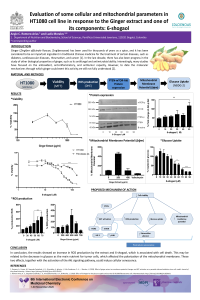
One of the widely used spices in traditional Chinese medicine is ginger. In the last decade, research on tumor activity, both of the extract and its components, has increased significantly. However, to date the molecular mechanisms through which ginger could exert this activity are still not fully understood. The present work evaluated the effect of a ginger extract and 6-shogaol on the survival of the human fibrosarcoma cell line (HT1080) as well as on some cellular and mitochondrial parameters. The viability of the HT1080 tumor cell line and normal fibroblasts was determined by MTT and IP assays at different concentrations of ginger extract and 6-shogaol. Subsequently, ROS production, mitochondrial membrane potential, glucose uptake and protein expression of the PTEN / Akt / mTOR signaling pathway were evaluated. The results showed that ginger extract acts as a pro-oxidant agent and decreases cell viability, which in turn increases the potential of the mitochondrial membrane. Likewise, 6-shogaol exerted a cytotoxic effect on tumor cells associated with an increase in ROS production. Importantly, a differential effect was found in fibroblasts. When using an antioxidant agent, mitigation in ROS production and a positive effect on cell viability were observed. Additionally, a decrease in glucose uptake was observed with increasing 6-shogaol concentrations, and the expression of mTOR-p and Akt-p increased; PTEN was active in all 6-shogaol treatments. In conclusion, the results showed an increase in ROS production by the extract and 6-shogaol, which is associated with cell death. This may be related to the decrease in glucose as the main nutrient for tumor cells, which affected the polarization of the mitochondrial membrane. These two effects, together with the activation of the Akt signaling pathway, could induce cellular senescence.
Keywords
ginger
HT1080
6-shogaol
ROS
Poster
poster congress.pdf
Plant natural products with anti-thyroid cancer activity
Anxiolytic, antidepressant and anti-inflammatory activities of water-soluble extract of beehive in Swiss albino mice