Event submissions
Published

This submission belongs to the session E. Round Table on Natural Products of the event 6th International Electronic Conference on Medicinal Chemistry
Published date
05 Nov, 2020
Citation
Nesrein M. Bendala, Abdurrauf M. Gusbi, Nagib A. Elmarzugi, Preparation of wheat germ oil loaded solid lipid nanoparticles for topical use, in Proceedings of 6th International Electronic Conference on Medicinal Chemistry, 1 November–30 November 2020, MDPI: Basel, Switzerland, doi: 10.3390/ECMC2020-07257
Share
Email
Facebook
Twitter
LinkedIn
Preparation of wheat germ oil loaded solid lipid nanoparticles for topical use
'%3e%3cpath%20d='M12.6647%2010.9104C12.4176%2010.325%2012.0589%209.7933%2011.6088%209.34485C11.16%208.89511%2010.6283%208.53653%2010.0432%208.28891C10.038%208.28629%2010.0327%208.28498%2010.0275%208.28236C10.8437%207.69282%2011.3743%206.73252%2011.3743%205.64907C11.3743%203.85423%209.92005%202.40002%208.12522%202.40002C6.33038%202.40002%204.87618%203.85423%204.87618%205.64907C4.87618%206.73252%205.40677%207.69282%206.22296%208.28367C6.21772%208.28629%206.21248%208.2876%206.20724%208.29022C5.62031%208.53783%205.09365%208.89287%204.64167%209.34616C4.19192%209.79496%203.83334%2010.3266%203.58573%2010.9117C3.34247%2011.4846%203.21128%2012.0987%203.19925%2012.721C3.1989%2012.735%203.20135%2012.7489%203.20646%2012.7619C3.21157%2012.7749%203.21924%2012.7868%203.22901%2012.7968C3.23877%2012.8068%203.25045%2012.8148%203.26334%2012.8202C3.27623%2012.8256%203.29007%2012.8284%203.30406%2012.8284H4.09012C4.14776%2012.8284%204.19362%2012.7825%204.19493%2012.7262C4.22113%2011.7148%204.62726%2010.7676%205.34519%2010.0497C6.08802%209.30686%207.07452%208.89811%208.12522%208.89811C9.17592%208.89811%2010.1624%209.30686%2010.9052%2010.0497C11.6232%2010.7676%2012.0293%2011.7148%2012.0555%2012.7262C12.0568%2012.7839%2012.1027%2012.8284%2012.1603%2012.8284H12.9464C12.9604%2012.8284%2012.9742%2012.8256%2012.9871%2012.8202C13%2012.8148%2013.0117%2012.8068%2013.0214%2012.7968C13.0312%2012.7868%2013.0389%2012.7749%2013.044%2012.7619C13.0491%2012.7489%2013.0515%2012.735%2013.0512%2012.721C13.0381%2012.0947%2012.9084%2011.4856%2012.6647%2010.9104ZM8.12522%207.90243C7.52388%207.90243%206.95792%207.66793%206.53214%207.24215C6.10636%206.81636%205.87185%206.2504%205.87185%205.64907C5.87185%205.04773%206.10636%204.48177%206.53214%204.05599C6.95792%203.63021%207.52388%203.3957%208.12522%203.3957C8.72655%203.3957%209.29252%203.63021%209.7183%204.05599C10.1441%204.48177%2010.3786%205.04773%2010.3786%205.64907C10.3786%206.2504%2010.1441%206.81636%209.7183%207.24215C9.29252%207.66793%208.72655%207.90243%208.12522%207.90243Z'%20fill='%235D1EE1'/%3e%3c/g%3e%3c/svg%3e)
Nesrein M. Bendala 1
Abdurrauf M. Gusbi 2
Nagib A. Elmarzugi 1,2
1. National Nanosciences & Nanotechnology Project, Biotechnology Research Centre, Tripoli, Libya
2. Faculty of Pharmacy, The University of Tripoli, Tripoli, Libya
Abstract
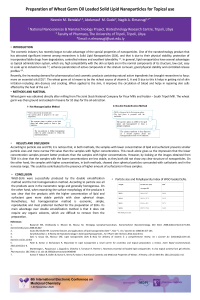
Solid lipid nanoparticles loaded with wheat germ oil (WGO-SLN) were prepared by two different methods: double emulsification and hot homogenization, and with four different formulas. The samples with the lower concentration of lipid and surfactant were excluded from further testing because they were unstable. According to particle size in all tested products, 50% of the particles measured less than 300nm. This indicated that the particles that are in the 1μm size range in all four samples are more likely to be nanoparticle aggregates. The smallest mean particle size with the lowest polydispersity index was for the hot homogenization method. According to surface morphology test, which was done by TEM, both methods using higher concentration of lipid and surfactant presented uniform circular particles, whereas the particles in the lower concentration samples in both methods were not as clear. The results from the entrapment efficiency test indicated that the formulas with higher concentration of surfactant gave significantly higher percentage of entrapment of the oil, 77.36 ± 11.64 % for double emulsification method and 69.56 ± 5.81 % for the hot homogenization method. Whereas the lower concentrations formulas gave lower percentage of entrapment, 20.46 ± 4.43 % for the double emulsification method and 26.73 ± 4.43 % for the hot homogenization method. According to the stability test, the sample prepared with the double emulsification method and the lower concentration of lipid and surfactant was the least stable, and the sample prepared with the hot homogenization method and the higher concentration of lipid and surfactant was the most stable.
Keywords
entrapment efficiency
particle size analysis
solid lipid nanoparticles
surface morphology
wheat germ oil
Poster
WGO SLN ECMC2020.pdf
Bactericidal action of cinnamon, clove and cajeput oils loaded onto CA/PCL wet-spun fibers for a localized, controlled biomolecule delivery
Validation and method development for Identification of phenolic acids in ethanolic extract of Vitex trifolia.L using HPLC