Event submissions
Published

This submission belongs to the session E. Round Table on Natural Products of the event 6th International Electronic Conference on Medicinal Chemistry
Published date
05 Nov, 2020
Citation
Michele Antonelli, Davide Donelli, Fabio Firenzuoli, Schisandra chinensis for dementia: a narrative overview of reviews, in Proceedings of 6th International Electronic Conference on Medicinal Chemistry, 1 November–30 November 2020, MDPI: Basel, Switzerland, doi: 10.3390/ECMC2020-07259
Share
Email
Facebook
Twitter
LinkedIn
Schisandra chinensis for dementia: a narrative overview of reviews

Michele Antonelli 1

Davide Donelli 2
'%3e%3cpath%20d='M12.6647%2010.9104C12.4176%2010.325%2012.0589%209.7933%2011.6088%209.34485C11.16%208.89511%2010.6283%208.53653%2010.0432%208.28891C10.038%208.28629%2010.0327%208.28498%2010.0275%208.28236C10.8437%207.69282%2011.3743%206.73252%2011.3743%205.64907C11.3743%203.85423%209.92005%202.40002%208.12522%202.40002C6.33038%202.40002%204.87618%203.85423%204.87618%205.64907C4.87618%206.73252%205.40677%207.69282%206.22296%208.28367C6.21772%208.28629%206.21248%208.2876%206.20724%208.29022C5.62031%208.53783%205.09365%208.89287%204.64167%209.34616C4.19192%209.79496%203.83334%2010.3266%203.58573%2010.9117C3.34247%2011.4846%203.21128%2012.0987%203.19925%2012.721C3.1989%2012.735%203.20135%2012.7489%203.20646%2012.7619C3.21157%2012.7749%203.21924%2012.7868%203.22901%2012.7968C3.23877%2012.8068%203.25045%2012.8148%203.26334%2012.8202C3.27623%2012.8256%203.29007%2012.8284%203.30406%2012.8284H4.09012C4.14776%2012.8284%204.19362%2012.7825%204.19493%2012.7262C4.22113%2011.7148%204.62726%2010.7676%205.34519%2010.0497C6.08802%209.30686%207.07452%208.89811%208.12522%208.89811C9.17592%208.89811%2010.1624%209.30686%2010.9052%2010.0497C11.6232%2010.7676%2012.0293%2011.7148%2012.0555%2012.7262C12.0568%2012.7839%2012.1027%2012.8284%2012.1603%2012.8284H12.9464C12.9604%2012.8284%2012.9742%2012.8256%2012.9871%2012.8202C13%2012.8148%2013.0117%2012.8068%2013.0214%2012.7968C13.0312%2012.7868%2013.0389%2012.7749%2013.044%2012.7619C13.0491%2012.7489%2013.0515%2012.735%2013.0512%2012.721C13.0381%2012.0947%2012.9084%2011.4856%2012.6647%2010.9104ZM8.12522%207.90243C7.52388%207.90243%206.95792%207.66793%206.53214%207.24215C6.10636%206.81636%205.87185%206.2504%205.87185%205.64907C5.87185%205.04773%206.10636%204.48177%206.53214%204.05599C6.95792%203.63021%207.52388%203.3957%208.12522%203.3957C8.72655%203.3957%209.29252%203.63021%209.7183%204.05599C10.1441%204.48177%2010.3786%205.04773%2010.3786%205.64907C10.3786%206.2504%2010.1441%206.81636%209.7183%207.24215C9.29252%207.66793%208.72655%207.90243%208.12522%207.90243Z'%20fill='%235D1EE1'/%3e%3c/g%3e%3c/svg%3e)
Fabio Firenzuoli 2
1. AUSL-IRCCS Reggio Emilia
2. CERFIT, Careggi University Hospital
Abstract
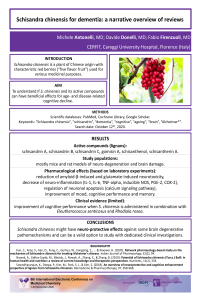
Introduction. Schisandra chinensis is a plant of Chinese origin with characteristic red berries ("five flavor fruit") used for various medicinal purposes. The aim of this review is to understand if S. chinensis and its active compounds can have beneficial effects for age- and disease-related cognitive decline.
Methods. PubMed, Cochrane Library, and Google Scholar were searched for relevant reviews with the following keywords: "Schisandra chinensis", "schisandrin", "dementia", "cognitive", "ageing", "brain", "Alzheimer*". All databases were screened up to October 12th, 2020. Priority was given to literature reviews and network pharmacological studies.
Results. After article screening and selection, two PubMed-indexed reviews and a network pharmacological study were included. Bioactive compounds of S. chinensis are mostly lignans such as schisandrin A, schisandrin B, schisandrin C, gomisin A, schisanthenol, and schisantherin A. The majority of available studies were conducted in mice and rat models reproducing neuro-degeneration and brain damage. Based on laboratory findings, S. chinensis seemed capable of reducing amyloid-β-induced and glutamate-induced neurotoxicity, decreasing neuro-inflammation (IL-1, IL-6, TNF-alpha, inducible NOS, PGE-2, COX-2), regulating neuronal apoptosis (calcium signaling pathway),and improving mood, cognitive performance and memory. Limited clinical evidence suggested that S. chinensis may improve cognitive performance when administered in combination with Eleutherococcus senticosus and Rhodiola rosea.
Discussion. S. chinensis might have neuro-protective effects against some brain degenerative pathomechanisms and can be a valid option to study with dedicated clinical investigations.
Keywords
brain
cognitive impairment
dementia
review
Schisandra chinensis
Poster
Schisandra POSTER.pdf
Validation and method development for Identification of phenolic acids in ethanolic extract of Vitex trifolia.L using HPLC
Irradication of Pseudomans aeruginosa via sodium alginate/gelatin films impregnated with chitosan microcapsules loaded with cinnamon leaf oil