Event submissions
Published

This submission belongs to the session E. Round Table on Natural Products of the event 6th International Electronic Conference on Medicinal Chemistry
Published date
05 Nov, 2020
Citation
Vanessa Silva, Cecília Peirone, Rupesh Kumar Singh, Virgílio Falco, Isabel Pires, Carla Miranda, Luís Maltez, José Eduardo Pereira, Gilberto Igrejas, Patrícia Poeta, In vivo evaluation of antibacterial activity and wound healing power of a gel based on phenolic compounds extracted from by-products of the wine industry, in Proceedings of 6th International Electronic Conference on Medicinal Chemistry, 1 November–30 November 2020, MDPI: Basel, Switzerland, doi: 10.3390/ECMC2020-07264
Share
Email
Facebook
Twitter
LinkedIn
In vivo evaluation of antibacterial activity and wound healing power of a gel based on phenolic compounds extracted from by-products of the wine industry

Vanessa Silva 1,2,3,4
'%3e%3cpath%20d='M12.6647%2010.9104C12.4176%2010.325%2012.0589%209.7933%2011.6088%209.34485C11.16%208.89511%2010.6283%208.53653%2010.0432%208.28891C10.038%208.28629%2010.0327%208.28498%2010.0275%208.28236C10.8437%207.69282%2011.3743%206.73252%2011.3743%205.64907C11.3743%203.85423%209.92005%202.40002%208.12522%202.40002C6.33038%202.40002%204.87618%203.85423%204.87618%205.64907C4.87618%206.73252%205.40677%207.69282%206.22296%208.28367C6.21772%208.28629%206.21248%208.2876%206.20724%208.29022C5.62031%208.53783%205.09365%208.89287%204.64167%209.34616C4.19192%209.79496%203.83334%2010.3266%203.58573%2010.9117C3.34247%2011.4846%203.21128%2012.0987%203.19925%2012.721C3.1989%2012.735%203.20135%2012.7489%203.20646%2012.7619C3.21157%2012.7749%203.21924%2012.7868%203.22901%2012.7968C3.23877%2012.8068%203.25045%2012.8148%203.26334%2012.8202C3.27623%2012.8256%203.29007%2012.8284%203.30406%2012.8284H4.09012C4.14776%2012.8284%204.19362%2012.7825%204.19493%2012.7262C4.22113%2011.7148%204.62726%2010.7676%205.34519%2010.0497C6.08802%209.30686%207.07452%208.89811%208.12522%208.89811C9.17592%208.89811%2010.1624%209.30686%2010.9052%2010.0497C11.6232%2010.7676%2012.0293%2011.7148%2012.0555%2012.7262C12.0568%2012.7839%2012.1027%2012.8284%2012.1603%2012.8284H12.9464C12.9604%2012.8284%2012.9742%2012.8256%2012.9871%2012.8202C13%2012.8148%2013.0117%2012.8068%2013.0214%2012.7968C13.0312%2012.7868%2013.0389%2012.7749%2013.044%2012.7619C13.0491%2012.7489%2013.0515%2012.735%2013.0512%2012.721C13.0381%2012.0947%2012.9084%2011.4856%2012.6647%2010.9104ZM8.12522%207.90243C7.52388%207.90243%206.95792%207.66793%206.53214%207.24215C6.10636%206.81636%205.87185%206.2504%205.87185%205.64907C5.87185%205.04773%206.10636%204.48177%206.53214%204.05599C6.95792%203.63021%207.52388%203.3957%208.12522%203.3957C8.72655%203.3957%209.29252%203.63021%209.7183%204.05599C10.1441%204.48177%2010.3786%205.04773%2010.3786%205.64907C10.3786%206.2504%2010.1441%206.81636%209.7183%207.24215C9.29252%207.66793%208.72655%207.90243%208.12522%207.90243Z'%20fill='%235D1EE1'/%3e%3c/g%3e%3c/svg%3e)
Cecília Peirone 5,6,7

Rupesh Kumar Singh 8
Virgílio Falco 8

Isabel Pires 5,9
Carla Miranda 5,10,11
Luís Maltez 5,9
José Eduardo Pereira 5,9

Gilberto Igrejas 3,4,12

Patrícia Poeta 1,4
1. Microbiology and Antibiotic Resistance Team (MicroART), Department of Veterinary Sciences, University of Trás-os-Montes and Alto Douro (UTAD), Vila Real, Portugal
2. Department of Genetics and Biotechnology, University of Trás-os-Montes and Alto Douro (UTAD), Vila Real, Portugal
3. Functional Genomics and Proteomics Unit, University of Trás-os-Montes and Alto Douro (UTAD), Vila Real, Portugal
4. Associated Laboratory for Green Chemistry (LAQV-REQUIMTE), University NOVA of Lisboa, Lisboa, Caparica, Portugal
5. Department of Veterinary Sciences, University of Trás-os-Montes and Alto Douro (UTAD), 5000-801 Vila Real, Portugal
6. Hospital Center of Trás-os-Montes and Alto Douro E.P.E., 5000-185 Vila Real, Portugal
7. Centre for the Research and Technology of Agro-Environmental and Biological Sciences (CITAB), UTAD, 5000-801 Vila Real, Portugal
8. Chemistry Research Centre (CQ-VR), University of Trás-os-Montes and Alto Douro (UTAD), 5000-801 Vila Real, Portugal
9. Veterinary and Animal Research Centre, University of Trás-os-Montes and Alto Douro (UTAD), 5000-801 Vila Real, Portugal
10. Microbiology and Antibiotic Resistance Team (MicroART), Department of Veterinary Sciences, University of Trás-os-Montes and Alto Douro (UTAD), 5000-801 Vila Real, Portugal
11. Associated Laboratory for Green Chemistry (LAQV-REQUIMTE), University NOVA of Lisboa, Lisboa, 2829-516 Caparica, Portugal
12. Department of Genetics and Biotechnology, Functional Genomics and Proteomics’ Unit, University of Trás-os-Montes and Alto Douro, Vila Real, Portugal
Abstract
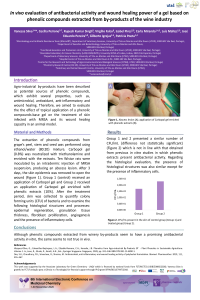
Agro-industrial by-products have been described as potential sources of phenolic compounds, which exhibit several properties, such as antimicrobial, antioxidant, anti-inflammatory and wound healing. Therefore, we aimed to evaluate the effect of topical application of a phenolic compounds-base gel on the treatment of skin infected with MRSA and its wound healing capacity in an animal model.
The extraction of phenolic compounds from grape’s peel, stem and seed was performed using ethanol/water (80:20) mixture. Carbopol gel (0.8%) was neutralized with triethanolamine and enriched with the extracts. Ten Wistar rats were inoculated by an intradermic injection of MRSA suspension, producing an abscess lesion. After 3 days, the skin epidermis was removed to open the wound. Group 1 (control) received an application of Carbopol gel and Group 2 received an application of Carbopol gel enriched with phenolic extracts (10%). After the treatment period, skin was collected to quantify colony forming units (CFU) of bacteria and to examine the following histological structures and processes: epidermal regeneration, granulation tissue thickness, fibroblast proliferation, angiogenesis and the presence of inflammatory cells.
Group 1 and 2 presented the same number of CFU which is not in line with that obtained from previous in vitro studies in which phenolic extracts present antibacterial activity. Regarding the histological evaluation, the presence of histological structures was also similar with the exception of the presence of inflammatory cells.
Although phenolic compounds extracted from winery by-products seem to have a promising antibacterial activity in vitro, the same seems to be not true in vivo.
Keywords
antibacterial activity
in vivo
MRSA
phenolic compounds
wound healing
Poster
Silva et al ECMC 2020.pdf
Green synthesis and antimicrobial properties of Lepidium satvium L.-based silver nanoparticles
Antibacterial and antioxidant activities of phenolic compounds extracted from autumn fruits by-products