Event submissions
Published

This submission belongs to the session E. Round Table on Natural Products of the event 6th International Electronic Conference on Medicinal Chemistry
Published date
05 Nov, 2020
Citation
Mariana Oalđe Pavlović, Marija Mandić, Uroš Gašić, Tanja Lunić, Stoimir Kolarević, Branka Vuković-Gačić, Ana Alimpić Aradski, Petar D. Marin, Biljana Božić Nedeljković, Sonja Duletić-Laušević, Chemical characterization of Lamiaceae plant extracts – the quest for novel immunomodulators, in Proceedings of 6th International Electronic Conference on Medicinal Chemistry, 1 November–30 November 2020, MDPI: Basel, Switzerland, doi: 10.3390/ECMC2020-07280
Share
Email
Facebook
Twitter
LinkedIn
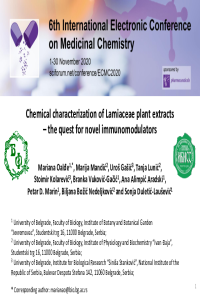
Chemical characterization of Lamiaceae plant extracts – the quest for novel immunomodulators

Mariana Oalđe Pavlović 1
'%3e%3cpath%20d='M12.6647%2010.9104C12.4176%2010.325%2012.0589%209.7933%2011.6088%209.34485C11.16%208.89511%2010.6283%208.53653%2010.0432%208.28891C10.038%208.28629%2010.0327%208.28498%2010.0275%208.28236C10.8437%207.69282%2011.3743%206.73252%2011.3743%205.64907C11.3743%203.85423%209.92005%202.40002%208.12522%202.40002C6.33038%202.40002%204.87618%203.85423%204.87618%205.64907C4.87618%206.73252%205.40677%207.69282%206.22296%208.28367C6.21772%208.28629%206.21248%208.2876%206.20724%208.29022C5.62031%208.53783%205.09365%208.89287%204.64167%209.34616C4.19192%209.79496%203.83334%2010.3266%203.58573%2010.9117C3.34247%2011.4846%203.21128%2012.0987%203.19925%2012.721C3.1989%2012.735%203.20135%2012.7489%203.20646%2012.7619C3.21157%2012.7749%203.21924%2012.7868%203.22901%2012.7968C3.23877%2012.8068%203.25045%2012.8148%203.26334%2012.8202C3.27623%2012.8256%203.29007%2012.8284%203.30406%2012.8284H4.09012C4.14776%2012.8284%204.19362%2012.7825%204.19493%2012.7262C4.22113%2011.7148%204.62726%2010.7676%205.34519%2010.0497C6.08802%209.30686%207.07452%208.89811%208.12522%208.89811C9.17592%208.89811%2010.1624%209.30686%2010.9052%2010.0497C11.6232%2010.7676%2012.0293%2011.7148%2012.0555%2012.7262C12.0568%2012.7839%2012.1027%2012.8284%2012.1603%2012.8284H12.9464C12.9604%2012.8284%2012.9742%2012.8256%2012.9871%2012.8202C13%2012.8148%2013.0117%2012.8068%2013.0214%2012.7968C13.0312%2012.7868%2013.0389%2012.7749%2013.044%2012.7619C13.0491%2012.7489%2013.0515%2012.735%2013.0512%2012.721C13.0381%2012.0947%2012.9084%2011.4856%2012.6647%2010.9104ZM8.12522%207.90243C7.52388%207.90243%206.95792%207.66793%206.53214%207.24215C6.10636%206.81636%205.87185%206.2504%205.87185%205.64907C5.87185%205.04773%206.10636%204.48177%206.53214%204.05599C6.95792%203.63021%207.52388%203.3957%208.12522%203.3957C8.72655%203.3957%209.29252%203.63021%209.7183%204.05599C10.1441%204.48177%2010.3786%205.04773%2010.3786%205.64907C10.3786%206.2504%2010.1441%206.81636%209.7183%207.24215C9.29252%207.66793%208.72655%207.90243%208.12522%207.90243Z'%20fill='%235D1EE1'/%3e%3c/g%3e%3c/svg%3e)
Marija Mandić 2

Uroš Gašić 3
Tanja Lunić 2
Stoimir Kolarević 3
Branka Vuković-Gačić 1
Ana Alimpić Aradski 1

Petar D. Marin 1
Biljana Božić Nedeljković 2
Sonja Duletić-Laušević 1
1. University of Belgrade, Faculty of Biology, Institute of Botany and Botanical Garden “Jevremovac”, Studentski trg 16, 11000 Belgrade, Serbia
2. University of Belgrade, Faculty of Biology, Institute of Physiology and Biochemistry “Ivan Đaja”, Studentski trg 16, 11000 Belgrade, Serbia
3. University of Belgrade, Institute for Biological Research “Siniša Stanković”, National Institute of the Republic of Serbia, Bulevar Despota Stefana 142, 11060 Belgrade, Serbia
Abstract
The physiological imbalance between the production and accumulation of reactive oxygen species (ROS), known as oxidative stress, is responsible for developing and progression of a plethora of diseases – cancer, among others. Since plants are recognized as potential antioxidant agents, the aim of this study was to chemically characterize ethanolic extracts of 18 species from Lamiaceae family using liquid chromatography-mass spectrometry (LC-MS), followed by testing the antioxidant activity using ABTS assay. Biocompatibility of the investigated extracts was assessed by MTT assay on normal human lung fibroblasts (MRC-5). Finally, antiproliferative activity was evaluated using MTT assay on human colorectal cancer (HCT-116) cell line, while the effects of extracts on superoxide anion radical (O2•-) production were tested using NBT assay. Melissa officinalis, Mentha piperita, Origanum majorana, O. vulgare, and Thymus vulgaris showed the highest antioxidant activity against ABTS radicals. LC-MS analysis indicated that these extracts mostly contain caffeic, protocatechuic and p-coumaric acids. The extracts were biocompatible with MRC-5 cell line. Interestingly, Lavandula angustifolia and Ocimum basilicum extracts, which were less active against ABTS radicals, showed a significant antiproliferative effect against HCT-116. Moreover, L. angustifolia and T. vulgaris extracts significantly stimulated the production of O2•- in HCT-116, indicating potential antitumor activity. The extracts that expressed antiproliferative effect and stimulated ROS production contain higher amounts of rosmarinic, caffeic and chlorogenic acids, naringin, luteolin, apigenin and cirsimaritin, indicating that some of them, or more probably their synergistic effects, are responsible for the extracts’ ability to moderate the production of ROS in HCT-116 cells.
Keywords
antioxidant activity
antiproliferative activity
extracts
Lamiaceae
phytochemical composition
ROS production
Poster
Oaldje_et_al_ECMC.pdf
Insight into P-glycoprotein activity of royleanones from Plectranthus spp.
Hedwigia ciliata (Hedw.) P. Beauv. moss extracts - Chemical characterization and in vitro testing of immunomodulatory potential