Event submissions
Published

This submission belongs to the session E. Round Table on Natural Products of the event 6th International Electronic Conference on Medicinal Chemistry
Published date
05 Nov, 2020
Citation
Isabel Maria Ureña Vacas, Simona De Vita, Elena González Burgos, Giuseppe Bifulco, M. Pilar Gómez-Serranillos, Molecular interaction studies of secondary metabolites of the lichen Asahinea scholanderi with acetylcholinesterase and butyrylcholinesterase, in Proceedings of 6th International Electronic Conference on Medicinal Chemistry, 1 November–30 November 2020, MDPI: Basel, Switzerland, doi: 10.3390/ECMC2020-07283
Share
Email
Facebook
Twitter
LinkedIn
Molecular interaction studies of secondary metabolites of the lichen Asahinea scholanderi with acetylcholinesterase and butyrylcholinesterase
'%3e%3cpath%20d='M12.6647%2010.9104C12.4176%2010.325%2012.0589%209.7933%2011.6088%209.34485C11.16%208.89511%2010.6283%208.53653%2010.0432%208.28891C10.038%208.28629%2010.0327%208.28498%2010.0275%208.28236C10.8437%207.69282%2011.3743%206.73252%2011.3743%205.64907C11.3743%203.85423%209.92005%202.40002%208.12522%202.40002C6.33038%202.40002%204.87618%203.85423%204.87618%205.64907C4.87618%206.73252%205.40677%207.69282%206.22296%208.28367C6.21772%208.28629%206.21248%208.2876%206.20724%208.29022C5.62031%208.53783%205.09365%208.89287%204.64167%209.34616C4.19192%209.79496%203.83334%2010.3266%203.58573%2010.9117C3.34247%2011.4846%203.21128%2012.0987%203.19925%2012.721C3.1989%2012.735%203.20135%2012.7489%203.20646%2012.7619C3.21157%2012.7749%203.21924%2012.7868%203.22901%2012.7968C3.23877%2012.8068%203.25045%2012.8148%203.26334%2012.8202C3.27623%2012.8256%203.29007%2012.8284%203.30406%2012.8284H4.09012C4.14776%2012.8284%204.19362%2012.7825%204.19493%2012.7262C4.22113%2011.7148%204.62726%2010.7676%205.34519%2010.0497C6.08802%209.30686%207.07452%208.89811%208.12522%208.89811C9.17592%208.89811%2010.1624%209.30686%2010.9052%2010.0497C11.6232%2010.7676%2012.0293%2011.7148%2012.0555%2012.7262C12.0568%2012.7839%2012.1027%2012.8284%2012.1603%2012.8284H12.9464C12.9604%2012.8284%2012.9742%2012.8256%2012.9871%2012.8202C13%2012.8148%2013.0117%2012.8068%2013.0214%2012.7968C13.0312%2012.7868%2013.0389%2012.7749%2013.044%2012.7619C13.0491%2012.7489%2013.0515%2012.735%2013.0512%2012.721C13.0381%2012.0947%2012.9084%2011.4856%2012.6647%2010.9104ZM8.12522%207.90243C7.52388%207.90243%206.95792%207.66793%206.53214%207.24215C6.10636%206.81636%205.87185%206.2504%205.87185%205.64907C5.87185%205.04773%206.10636%204.48177%206.53214%204.05599C6.95792%203.63021%207.52388%203.3957%208.12522%203.3957C8.72655%203.3957%209.29252%203.63021%209.7183%204.05599C10.1441%204.48177%2010.3786%205.04773%2010.3786%205.64907C10.3786%206.2504%2010.1441%206.81636%209.7183%207.24215C9.29252%207.66793%208.72655%207.90243%208.12522%207.90243Z'%20fill='%235D1EE1'/%3e%3c/g%3e%3c/svg%3e)
Isabel Maria Ureña Vacas 1

Simona De Vita 2
Elena González Burgos 1
Giuseppe Bifulco 2
M. Pilar Gómez-Serranillos 1
1. Department of Pharmacology, Pharmacognosy and Botany, Faculty of Pharmacy, University Complutense of Madrid (Madrid, Spain)
2. Department of Pharmacy, University of Salerno, Via Giovanni Paolo II 134, 84084, Fisciano (SA), Italy.
Abstract
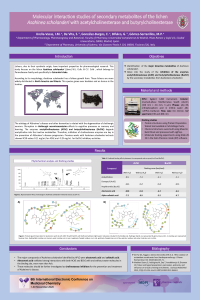
The lichen Asahinea scholanderi (Llano) W.L.Culb. & C.F.Culb. (Cetrarioid clade, Parmeliaceae family) is a potent acetylcholinesterase and butyrylcholinesterase inhibitor. The aim of the present work is to identify the major bioactive compounds of Asahinea scholanderi and clarify how they could inhibit the enzymes acetylcholinesterase (AchE) and butyrylcholinesterase (BuchE). The HPLC study showed that the main secondary metabolites were alectoronic acid, α-collatolic acid. Molecular docking studies revealed that the binding energy values were -10.8 kcal/mol (with water) and -11.1 kcal/mol (without water) for alectoronic acid and -7.2 kcal/mol (with water) and -9.9 kcal/mol (without water) for collatolic acid in acetylcholinesterase. On the other hand, the binding energy values for the secondary metabolites of Asahinea scholanderi against butyrylcholinesterase were -6.2 kcal/mol (with water) and -6.6 kcal/mol (without water) for alectoronic acid and -5.5 kcal/mol (with water) and -6.7 kcal/mol (without water) for collatolic acid. Therefore, the molecular interaction between the major secondary metabolites of Asahinea scholanderi revealed that alectoronic acid exhibited strong interactions with both AChE and BuChE with and without water molecules in the binding site. These molecules should be further investigated as cholinesterase inhibitors for the prevention and treatment of Alzheimer’s disease.
Keywords
AchE
Asahinea scholanderi
BuchE
Docking
lichen
Poster
POSTER Asahinea.pdf
Chemical characterization and immunomodulatory potential of the moss Hypnum cupressiforme Hedw. extracts
Analysis on in vitro antioxidant capacities and phenolic composition of lichens extracts of Cetrarioid clade based on multivariate statistical analysis