Event submissions
Published

This submission belongs to the session E. Round Table on Natural Products of the event 6th International Electronic Conference on Medicinal Chemistry
Published date
05 Nov, 2020
Citation
Isabel Maria Ureña Vacas, Elena González Burgos, M. Pilar Gómez-Serranillos, Analysis on in vitro antioxidant capacities and phenolic composition of lichens extracts of Cetrarioid clade based on multivariate statistical analysis, in Proceedings of 6th International Electronic Conference on Medicinal Chemistry, 1 November–30 November 2020, MDPI: Basel, Switzerland, doi: 10.3390/ECMC2020-07284
Share
Email
Facebook
Twitter
LinkedIn
Analysis on in vitro antioxidant capacities and phenolic composition of lichens extracts of Cetrarioid clade based on multivariate statistical analysis
'%3e%3cpath%20d='M12.6647%2010.9104C12.4176%2010.325%2012.0589%209.7933%2011.6088%209.34485C11.16%208.89511%2010.6283%208.53653%2010.0432%208.28891C10.038%208.28629%2010.0327%208.28498%2010.0275%208.28236C10.8437%207.69282%2011.3743%206.73252%2011.3743%205.64907C11.3743%203.85423%209.92005%202.40002%208.12522%202.40002C6.33038%202.40002%204.87618%203.85423%204.87618%205.64907C4.87618%206.73252%205.40677%207.69282%206.22296%208.28367C6.21772%208.28629%206.21248%208.2876%206.20724%208.29022C5.62031%208.53783%205.09365%208.89287%204.64167%209.34616C4.19192%209.79496%203.83334%2010.3266%203.58573%2010.9117C3.34247%2011.4846%203.21128%2012.0987%203.19925%2012.721C3.1989%2012.735%203.20135%2012.7489%203.20646%2012.7619C3.21157%2012.7749%203.21924%2012.7868%203.22901%2012.7968C3.23877%2012.8068%203.25045%2012.8148%203.26334%2012.8202C3.27623%2012.8256%203.29007%2012.8284%203.30406%2012.8284H4.09012C4.14776%2012.8284%204.19362%2012.7825%204.19493%2012.7262C4.22113%2011.7148%204.62726%2010.7676%205.34519%2010.0497C6.08802%209.30686%207.07452%208.89811%208.12522%208.89811C9.17592%208.89811%2010.1624%209.30686%2010.9052%2010.0497C11.6232%2010.7676%2012.0293%2011.7148%2012.0555%2012.7262C12.0568%2012.7839%2012.1027%2012.8284%2012.1603%2012.8284H12.9464C12.9604%2012.8284%2012.9742%2012.8256%2012.9871%2012.8202C13%2012.8148%2013.0117%2012.8068%2013.0214%2012.7968C13.0312%2012.7868%2013.0389%2012.7749%2013.044%2012.7619C13.0491%2012.7489%2013.0515%2012.735%2013.0512%2012.721C13.0381%2012.0947%2012.9084%2011.4856%2012.6647%2010.9104ZM8.12522%207.90243C7.52388%207.90243%206.95792%207.66793%206.53214%207.24215C6.10636%206.81636%205.87185%206.2504%205.87185%205.64907C5.87185%205.04773%206.10636%204.48177%206.53214%204.05599C6.95792%203.63021%207.52388%203.3957%208.12522%203.3957C8.72655%203.3957%209.29252%203.63021%209.7183%204.05599C10.1441%204.48177%2010.3786%205.04773%2010.3786%205.64907C10.3786%206.2504%2010.1441%206.81636%209.7183%207.24215C9.29252%207.66793%208.72655%207.90243%208.12522%207.90243Z'%20fill='%235D1EE1'/%3e%3c/g%3e%3c/svg%3e)
Isabel Maria Ureña Vacas 1
Elena González Burgos 1
M. Pilar Gómez-Serranillos 1
1. Department of Pharmacology, Pharmacognosy and Botany, Faculty of Pharmacy, University Complutense of Madrid (Madrid, Spain)
Abstract
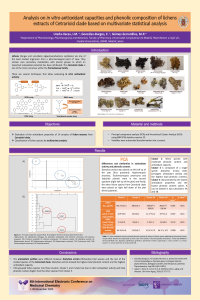
Lichens are symbiotic organisms, which are composed by a mycobiont (fungus) and a photobiont (unicellular algae or cyanobacteria). They are widely distributed from the poles to equatorial zones. It is estimated that there are more than 28,000 species of lichens worldwide, with the Parmeliaceae family being the largest one. Within this, Cetrarioid clade stands out phylogenetically in number. The lichens of this clade have shown an interesting antioxidant activity. The aim of this study was to evaluate the antioxidant properties of 14 samples of lichen extracts from Cetrarioid clade and to classify lichen species by multivariate analysis. Principal component analysis (PCA) and hierarchical cluster (HCA) were performed using antioxidant properties (FRAP, ORAC and DPPH tests) and phenolic content as variables. The results showed that the antioxidant profiles were different between Dactylina arctica (Richardson) Nyl species and the rest of the studied species of the Cetrarioid clade, finding similarities between Nephromopsis stracheyi (C. Bab.) Mull. Arg., Tuckermannopsis americana (Spreng.) Hale and Vulpicida pinastri (Scop.) J.E. Mattsson and M. J. Lai. The HCA results demonstrated that lichen samples were clustered into three groups. Dactylina arctica was included in cluster 1 with high antioxidant activity and high phenolic content. Cluster 2 contained Nephromopsis stracheyi, Tuckermannopsis americana and Vulpicida pinastri with a medium content of phenols and moderate antioxidant activity. Finally, the rest of the lichen species, including those of the genus Cetraria, formed Cluster 3.
Keywords
Cetrarioid clade
HCA
lichens
PCA
Poster
Multivariate analysis.pdf
Molecular interaction studies of secondary metabolites of the lichen Asahinea scholanderi with acetylcholinesterase and butyrylcholinesterase
Identification and quality assessment of commercial valerian samples using DNA barcoding and UHPLC-MS