Event submissions
Published

This submission belongs to the session E. Round Table on Natural Products of the event 6th International Electronic Conference on Medicinal Chemistry
Published date
05 Nov, 2020
Citation
Marta Sánchez Gómez-Serranillos, Elena González-Burgos, M. Pilar Gómez-Serranillos, Identification and quality assessment of commercial valerian samples using DNA barcoding and UHPLC-MS, in Proceedings of 6th International Electronic Conference on Medicinal Chemistry, 1 November–30 November 2020, MDPI: Basel, Switzerland, doi: 10.3390/ECMC2020-07285
Share
Email
Facebook
Twitter
LinkedIn
Identification and quality assessment of commercial valerian samples using DNA barcoding and UHPLC-MS
'%3e%3cpath%20d='M12.6647%2010.9104C12.4176%2010.325%2012.0589%209.7933%2011.6088%209.34485C11.16%208.89511%2010.6283%208.53653%2010.0432%208.28891C10.038%208.28629%2010.0327%208.28498%2010.0275%208.28236C10.8437%207.69282%2011.3743%206.73252%2011.3743%205.64907C11.3743%203.85423%209.92005%202.40002%208.12522%202.40002C6.33038%202.40002%204.87618%203.85423%204.87618%205.64907C4.87618%206.73252%205.40677%207.69282%206.22296%208.28367C6.21772%208.28629%206.21248%208.2876%206.20724%208.29022C5.62031%208.53783%205.09365%208.89287%204.64167%209.34616C4.19192%209.79496%203.83334%2010.3266%203.58573%2010.9117C3.34247%2011.4846%203.21128%2012.0987%203.19925%2012.721C3.1989%2012.735%203.20135%2012.7489%203.20646%2012.7619C3.21157%2012.7749%203.21924%2012.7868%203.22901%2012.7968C3.23877%2012.8068%203.25045%2012.8148%203.26334%2012.8202C3.27623%2012.8256%203.29007%2012.8284%203.30406%2012.8284H4.09012C4.14776%2012.8284%204.19362%2012.7825%204.19493%2012.7262C4.22113%2011.7148%204.62726%2010.7676%205.34519%2010.0497C6.08802%209.30686%207.07452%208.89811%208.12522%208.89811C9.17592%208.89811%2010.1624%209.30686%2010.9052%2010.0497C11.6232%2010.7676%2012.0293%2011.7148%2012.0555%2012.7262C12.0568%2012.7839%2012.1027%2012.8284%2012.1603%2012.8284H12.9464C12.9604%2012.8284%2012.9742%2012.8256%2012.9871%2012.8202C13%2012.8148%2013.0117%2012.8068%2013.0214%2012.7968C13.0312%2012.7868%2013.0389%2012.7749%2013.044%2012.7619C13.0491%2012.7489%2013.0515%2012.735%2013.0512%2012.721C13.0381%2012.0947%2012.9084%2011.4856%2012.6647%2010.9104ZM8.12522%207.90243C7.52388%207.90243%206.95792%207.66793%206.53214%207.24215C6.10636%206.81636%205.87185%206.2504%205.87185%205.64907C5.87185%205.04773%206.10636%204.48177%206.53214%204.05599C6.95792%203.63021%207.52388%203.3957%208.12522%203.3957C8.72655%203.3957%209.29252%203.63021%209.7183%204.05599C10.1441%204.48177%2010.3786%205.04773%2010.3786%205.64907C10.3786%206.2504%2010.1441%206.81636%209.7183%207.24215C9.29252%207.66793%208.72655%207.90243%208.12522%207.90243Z'%20fill='%235D1EE1'/%3e%3c/g%3e%3c/svg%3e)
Marta Sánchez Gómez-Serranillos 1
Elena González-Burgos 1
M. Pilar Gómez-Serranillos 1
1. Department of Pharmacology, Pharmacognosy and Botanical. Faculty of Pharmacy. Universidad Complutense of Madrid, Spain
Abstract
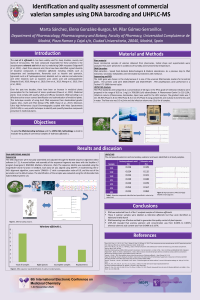
Valeriana officinalis L. (Caprifoliaceae family) has been traditionally used to treat mild nervousness and sleep disorders. The principal chemical constituents are alkaloids (i.e. chatinine, valerine, valerianine and actinidine), organic acids and terpenes (i.e. valerenic acid, isovaleric acid, valeric acid and acetoxyvalerenic) and iridoids (i.e. valepotriate, isovalepotriate), lignanoids (i.e. pinoresinol-4-O-D-glucoside, 8’-hydroxypinoresinol) and flavonoids (i.e. apigenin, luteolin, quercetin).
In the last years, medicinal plants consumption for treatment of minor pathologies has increased. Therefore, medicinal plants must comply with quality, safety and efficacy standards. The aim of this work is to identify and evaluate the quality of a total of seven commercial samples acquired in pharmacies, herbal shops and supermarkets using DNA metabarcoding and HPLC/MS methods.
Taxonomic identity of valerian samples was validated through DNA barcode for the matK region. DNA was successfully extracted from 3 of the 7 samples. The identity of the sequences was evaluated using the mega-BLAST search function in GenBank. These 3 valerian samples were labelled as Valeriana officinalis but they were identified as Valeriana hirtella Kunth. Regarding bioactive compounds, UHPL-MS revealed that the concentration of acetoxyvalerenic acid was from 0.020 % to 0.053 % whereas the content for valerenic acid was from 0.048 % to 0.167 %.
Our study shows the importance to combine DNA barcoding and HPLC-MS to identify correctly botanical species and to quantify bioactive compounds to guarantee the quality and safe of medicinal plants.
Keywords
acetoxyvalerenic acid
DNA barcoding
UHPLC-MS
valerenic acid
valerian
Poster
Poster valeriana ADN corregido.pdf
Analysis on in vitro antioxidant capacities and phenolic composition of lichens extracts of Cetrarioid clade based on multivariate statistical analysis
Self-assembly nanoparticles of 7α-acetoxy-6β-hydroxyroyleanone isolated from Plectranthus hadiensis