Event submissions
Published

This submission belongs to the session E. Round Table on Natural Products of the event 6th International Electronic Conference on Medicinal Chemistry
Published date
05 Nov, 2020
Citation
Francisco Les, Guillermo Cásedas, Víctor López, Phlomis lychnitis L. (Lamiaceae) as a souce of bioactive compounds with functional properties, in Proceedings of 6th International Electronic Conference on Medicinal Chemistry, 1 November–30 November 2020, MDPI: Basel, Switzerland, doi: 10.3390/ECMC2020-07289
Share
Email
Facebook
Twitter
LinkedIn
Phlomis lychnitis L. (Lamiaceae) as a souce of bioactive compounds with functional properties

Francisco Les 1,2

Guillermo Cásedas 1

Víctor López 1
1. Department of Pharmacy, Faculty of Health Sciences, Universidad San Jorge
2. Instituto Agroalimentario de Aragón IA2 CITA- Universidad de Zaragoza
Abstract
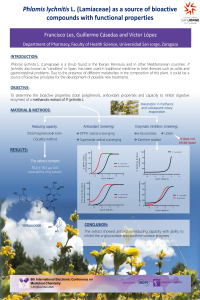
Introduction: Phlomis lychnitis L. (Lamiaceae) is a shrub found in the Iberian Peninsula and in other Mediterranean countries. P. lychnitis, also known as "candilera" in Spain, has been used in traditional medicine to treat illnesses such as colds and gastrointestinal problems. Due to the presence of different metabolites in the composition of this plant, it could be a source of bioactive principles for the development of possible new treatments.
Objective: To determine the bioactive properties of a methanolic extract of P. lychnitis L. in terms of the total polyphenol content, its antioxidant capacity and the capacity to inhibit digestive enzymes related to obesity and diabetes.
Material and methods: the Folin-Ciocalteu assay was carried out in order to determine the reducing capacity of polyphenols. The antioxidant activity was evaluated through the DPPH and xanthine / xanthine oxidase tests. Furthermore, the ability to inhibit enzymes such as xanthine oxidase and the enzymes α-glucosidase and pancreatic lipase was evaluated.
Results and conclusion: The results showed that the extract contains phenolic compounds and has the ability to eliminate free radicals. Furthermore, the extract was able to inhibit the enzymes α-glucosidase and xanthine oxidase. These two properties proved to be concentration dependent. Finally, the extract did not exert any inhibitory action on pancreatic lipase. All these results show that P. lychnitis should be studied as a potential source of antidiabetic and hypouricemic agents.
Keywords
antioxidants
bioactive compounds
medicinal plants
polyphenols
Poster
MedicinalChemistry2020-P.lychnitis.pdf
Evaluation of aryl amidines/benzimidazoles as potential anti-COVID-19 agents: A computational study
Chemical Composition and Biological Activity of Diterpenoids from Plectranthus mutabilis