Event submissions
Published

This submission belongs to the session E. Round Table on Natural Products of the event 6th International Electronic Conference on Medicinal Chemistry
Published date
05 Nov, 2020
Citation
Franziska Michaela Jürgens, Matthias Behrens, Thomas Jürgen Schmidt, In vitro metabolism of 11α,13-dihydrohelenalin acetate, a sesquiterpene lactone from Arnica, in Proceedings of 6th International Electronic Conference on Medicinal Chemistry, 1 November–30 November 2020, MDPI: Basel, Switzerland, doi: 10.3390/ECMC2020-07291
Share
Email
Facebook
Twitter
LinkedIn
In vitro metabolism of 11α,13-dihydrohelenalin acetate, a sesquiterpene lactone from Arnica
'%3e%3cpath%20d='M12.6647%2010.9104C12.4176%2010.325%2012.0589%209.7933%2011.6088%209.34485C11.16%208.89511%2010.6283%208.53653%2010.0432%208.28891C10.038%208.28629%2010.0327%208.28498%2010.0275%208.28236C10.8437%207.69282%2011.3743%206.73252%2011.3743%205.64907C11.3743%203.85423%209.92005%202.40002%208.12522%202.40002C6.33038%202.40002%204.87618%203.85423%204.87618%205.64907C4.87618%206.73252%205.40677%207.69282%206.22296%208.28367C6.21772%208.28629%206.21248%208.2876%206.20724%208.29022C5.62031%208.53783%205.09365%208.89287%204.64167%209.34616C4.19192%209.79496%203.83334%2010.3266%203.58573%2010.9117C3.34247%2011.4846%203.21128%2012.0987%203.19925%2012.721C3.1989%2012.735%203.20135%2012.7489%203.20646%2012.7619C3.21157%2012.7749%203.21924%2012.7868%203.22901%2012.7968C3.23877%2012.8068%203.25045%2012.8148%203.26334%2012.8202C3.27623%2012.8256%203.29007%2012.8284%203.30406%2012.8284H4.09012C4.14776%2012.8284%204.19362%2012.7825%204.19493%2012.7262C4.22113%2011.7148%204.62726%2010.7676%205.34519%2010.0497C6.08802%209.30686%207.07452%208.89811%208.12522%208.89811C9.17592%208.89811%2010.1624%209.30686%2010.9052%2010.0497C11.6232%2010.7676%2012.0293%2011.7148%2012.0555%2012.7262C12.0568%2012.7839%2012.1027%2012.8284%2012.1603%2012.8284H12.9464C12.9604%2012.8284%2012.9742%2012.8256%2012.9871%2012.8202C13%2012.8148%2013.0117%2012.8068%2013.0214%2012.7968C13.0312%2012.7868%2013.0389%2012.7749%2013.044%2012.7619C13.0491%2012.7489%2013.0515%2012.735%2013.0512%2012.721C13.0381%2012.0947%2012.9084%2011.4856%2012.6647%2010.9104ZM8.12522%207.90243C7.52388%207.90243%206.95792%207.66793%206.53214%207.24215C6.10636%206.81636%205.87185%206.2504%205.87185%205.64907C5.87185%205.04773%206.10636%204.48177%206.53214%204.05599C6.95792%203.63021%207.52388%203.3957%208.12522%203.3957C8.72655%203.3957%209.29252%203.63021%209.7183%204.05599C10.1441%204.48177%2010.3786%205.04773%2010.3786%205.64907C10.3786%206.2504%2010.1441%206.81636%209.7183%207.24215C9.29252%207.66793%208.72655%207.90243%208.12522%207.90243Z'%20fill='%235D1EE1'/%3e%3c/g%3e%3c/svg%3e)
Franziska Michaela Jürgens 1
Matthias Behrens 2

Thomas Jürgen Schmidt 1
1. Institute of Pharmaceutical Biology and Phytochemistry (IPBP), University of Münster, Corrensstraße 48, D-48149 Münster, Germany
2. Institute of Food Chemistry, University of Münster, Corrensstraße 45, D-48149 Münster, Germany
Abstract
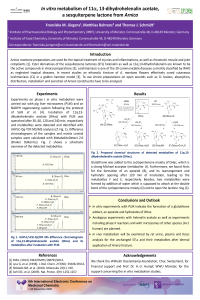
Arnica montana preparations are topically utilized to treat injuries and inflammations, as well as rheumatic muscle and joint complaints. The sesquiterpene lactones helenalin as well as 11α,13-dihydrohelenalin and their esters are known to be the active compounds in Arnica preparations. Leishmaniasis is one of the 20 communicable diseases currently classified by WHO as neglected tropical diseases. In recent studies, an ethanolic tincture of A. montana flowers effectively cured cutaneous leishmaniasis (CL) in a golden hamster model. To use Arnica preparations on open wounds such as CL lesions, absorption, distribution, metabolism and excretion of Arnica ingredients have to be analysed. Experiments on in vitro metabolism of the sesquiterpene lactone 11α,13-dihydrohelenalin acetate, were carried out. Phase I metabolism was investigated with pig liver microsomes and an NADPH-regenerating system. Afterwards, metabolites were detected and identified with UHPLC/ESI QqTOF MS/MS analysis. The Phase I reactions were stopped at different time points to gain time dependent information about the development of metabolites. Difference chromatograms of the UHPLC/ESI QqTOF MS chromatograms of the samples and matrix controls were calculated with MetaboliteDetect 2.0 (Bruker Daltonics). The detected metabolites were formed by addition of glutathione, expoxidation and addition of water to various positions.
Keywords
Arnica montana
11α,13-dihydrohelenalin acetate
metabolism
sesquiterpene lactones
Poster
ecmc-6-juergens.pdf
Chemical Composition and Biological Activity of Diterpenoids from Plectranthus mutabilis
Salvia pratensis L. as a valuable source of phenolic compounds with promising antimicrobial activity