Event submissions
Published

This submission belongs to the session E. Round Table on Natural Products of the event 6th International Electronic Conference on Medicinal Chemistry
Published date
05 Nov, 2020
Citation
Justyna Antoniewicz, Joanna Kochman, Karolina Jakubczyk, Paweł Kwiatkowski, Wojciech Żwierełło, Marta Skórka- Majewicz, Katarzyna Janda, Antimicrobial properties, antioxidant activity and phenolic content of grape vinegars, in Proceedings of 6th International Electronic Conference on Medicinal Chemistry, 1 November–30 November 2020, MDPI: Basel, Switzerland, doi: 10.3390/ECMC2020-07294
Share
Email
Facebook
Twitter
LinkedIn
Antimicrobial properties, antioxidant activity and phenolic content of grape vinegars
'%3e%3cpath%20d='M12.6647%2010.9104C12.4176%2010.325%2012.0589%209.7933%2011.6088%209.34485C11.16%208.89511%2010.6283%208.53653%2010.0432%208.28891C10.038%208.28629%2010.0327%208.28498%2010.0275%208.28236C10.8437%207.69282%2011.3743%206.73252%2011.3743%205.64907C11.3743%203.85423%209.92005%202.40002%208.12522%202.40002C6.33038%202.40002%204.87618%203.85423%204.87618%205.64907C4.87618%206.73252%205.40677%207.69282%206.22296%208.28367C6.21772%208.28629%206.21248%208.2876%206.20724%208.29022C5.62031%208.53783%205.09365%208.89287%204.64167%209.34616C4.19192%209.79496%203.83334%2010.3266%203.58573%2010.9117C3.34247%2011.4846%203.21128%2012.0987%203.19925%2012.721C3.1989%2012.735%203.20135%2012.7489%203.20646%2012.7619C3.21157%2012.7749%203.21924%2012.7868%203.22901%2012.7968C3.23877%2012.8068%203.25045%2012.8148%203.26334%2012.8202C3.27623%2012.8256%203.29007%2012.8284%203.30406%2012.8284H4.09012C4.14776%2012.8284%204.19362%2012.7825%204.19493%2012.7262C4.22113%2011.7148%204.62726%2010.7676%205.34519%2010.0497C6.08802%209.30686%207.07452%208.89811%208.12522%208.89811C9.17592%208.89811%2010.1624%209.30686%2010.9052%2010.0497C11.6232%2010.7676%2012.0293%2011.7148%2012.0555%2012.7262C12.0568%2012.7839%2012.1027%2012.8284%2012.1603%2012.8284H12.9464C12.9604%2012.8284%2012.9742%2012.8256%2012.9871%2012.8202C13%2012.8148%2013.0117%2012.8068%2013.0214%2012.7968C13.0312%2012.7868%2013.0389%2012.7749%2013.044%2012.7619C13.0491%2012.7489%2013.0515%2012.735%2013.0512%2012.721C13.0381%2012.0947%2012.9084%2011.4856%2012.6647%2010.9104ZM8.12522%207.90243C7.52388%207.90243%206.95792%207.66793%206.53214%207.24215C6.10636%206.81636%205.87185%206.2504%205.87185%205.64907C5.87185%205.04773%206.10636%204.48177%206.53214%204.05599C6.95792%203.63021%207.52388%203.3957%208.12522%203.3957C8.72655%203.3957%209.29252%203.63021%209.7183%204.05599C10.1441%204.48177%2010.3786%205.04773%2010.3786%205.64907C10.3786%206.2504%2010.1441%206.81636%209.7183%207.24215C9.29252%207.66793%208.72655%207.90243%208.12522%207.90243Z'%20fill='%235D1EE1'/%3e%3c/g%3e%3c/svg%3e)
Justyna Antoniewicz 1
Joanna Kochman 1

Karolina Jakubczyk 1

Paweł Kwiatkowski 2

Wojciech Żwierełło 3
Marta Skórka- Majewicz 3
Katarzyna Janda 1
1. Department of Human Nutrition and Metabolomics, Pomeranian Medical University
2. Department of Diagnostic Immunology, Pomeranian Medical University
3. Department of Medical Chemistry, Pomeranian Medical University
Abstract
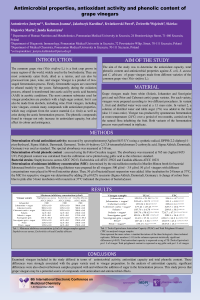
A research on the total antioxidant capacity, total phenolic content and antimicrobial properties against Staphylococcus aureus, Escherichia coli and Candida albicans of grape vinegars was conducted. The research material consisted of vinegars made from different wine grape varieties grown in Poland. The study used white grape varieties: Solaris, Johanniter and Souvignier gris, as well as red varieties: Prior and Cabernet cortis. For each variety, two variants were prepared: with and without the addition of sugar in the fermentation process. The total antioxidant capacity and total phenolic content were determined by spectrophotometry. The minimum inhibitory concentration of the vinegars was determined using the microdilution method. The highest antimicrobial activity against all microorganisms was observed in the vinegar made from Solaris grapes with added sugar. The highest polyphenol content was observed in the vinegar made from the Prior grape variety with added sugar (143.77±14.74 mg of gallic acid /1 liter of liquid), and the highest total antioxidant capacity – in Johanniter with added sugar (203.67±35.73 mg Trolox Equivalent/1 liter of liquid). The vinegars examined in this study differed, depending on grape variety, in terms of antimicrobial properties, antioxidant capacity and total phenolic content. These differences were strongly associated with the grape variety used to vinegar preparation. Sugar addition caused an significant differences in the antioxidant capacity of vinegar samples.
Keywords
antimicrobial properties
antioxidant capacity
fruit vinegars
phenolic content
Poster
Antoniewicz1.pdf
Cytotoxic activity of silver nanoparticles synthesized using aerial part and root extracts of Lythrum salicaria L.
Aqueous extract from a hemp agrimony – evaluation of the cytotoxic effect on the human brain glioblastoma cells