Event submissions
Published

This submission belongs to the session E. Round Table on Natural Products of the event 6th International Electronic Conference on Medicinal Chemistry
Published date
05 Nov, 2020
Citation
Wojciech Żwierełło, Marta Skórka-Majewicz, Justyna Antoniewicz, Daniel Styburski, Agnieszka Maruszewska, Aqueous extract from a hemp agrimony – evaluation of the cytotoxic effect on the human brain glioblastoma cells, in Proceedings of 6th International Electronic Conference on Medicinal Chemistry, 1 November–30 November 2020, MDPI: Basel, Switzerland, doi: 10.3390/ECMC2020-07295
Share
Email
Facebook
Twitter
LinkedIn
Aqueous extract from a hemp agrimony – evaluation of the cytotoxic effect on the human brain glioblastoma cells

Wojciech Żwierełło 1
'%3e%3cpath%20d='M12.6647%2010.9104C12.4176%2010.325%2012.0589%209.7933%2011.6088%209.34485C11.16%208.89511%2010.6283%208.53653%2010.0432%208.28891C10.038%208.28629%2010.0327%208.28498%2010.0275%208.28236C10.8437%207.69282%2011.3743%206.73252%2011.3743%205.64907C11.3743%203.85423%209.92005%202.40002%208.12522%202.40002C6.33038%202.40002%204.87618%203.85423%204.87618%205.64907C4.87618%206.73252%205.40677%207.69282%206.22296%208.28367C6.21772%208.28629%206.21248%208.2876%206.20724%208.29022C5.62031%208.53783%205.09365%208.89287%204.64167%209.34616C4.19192%209.79496%203.83334%2010.3266%203.58573%2010.9117C3.34247%2011.4846%203.21128%2012.0987%203.19925%2012.721C3.1989%2012.735%203.20135%2012.7489%203.20646%2012.7619C3.21157%2012.7749%203.21924%2012.7868%203.22901%2012.7968C3.23877%2012.8068%203.25045%2012.8148%203.26334%2012.8202C3.27623%2012.8256%203.29007%2012.8284%203.30406%2012.8284H4.09012C4.14776%2012.8284%204.19362%2012.7825%204.19493%2012.7262C4.22113%2011.7148%204.62726%2010.7676%205.34519%2010.0497C6.08802%209.30686%207.07452%208.89811%208.12522%208.89811C9.17592%208.89811%2010.1624%209.30686%2010.9052%2010.0497C11.6232%2010.7676%2012.0293%2011.7148%2012.0555%2012.7262C12.0568%2012.7839%2012.1027%2012.8284%2012.1603%2012.8284H12.9464C12.9604%2012.8284%2012.9742%2012.8256%2012.9871%2012.8202C13%2012.8148%2013.0117%2012.8068%2013.0214%2012.7968C13.0312%2012.7868%2013.0389%2012.7749%2013.044%2012.7619C13.0491%2012.7489%2013.0515%2012.735%2013.0512%2012.721C13.0381%2012.0947%2012.9084%2011.4856%2012.6647%2010.9104ZM8.12522%207.90243C7.52388%207.90243%206.95792%207.66793%206.53214%207.24215C6.10636%206.81636%205.87185%206.2504%205.87185%205.64907C5.87185%205.04773%206.10636%204.48177%206.53214%204.05599C6.95792%203.63021%207.52388%203.3957%208.12522%203.3957C8.72655%203.3957%209.29252%203.63021%209.7183%204.05599C10.1441%204.48177%2010.3786%205.04773%2010.3786%205.64907C10.3786%206.2504%2010.1441%206.81636%209.7183%207.24215C9.29252%207.66793%208.72655%207.90243%208.12522%207.90243Z'%20fill='%235D1EE1'/%3e%3c/g%3e%3c/svg%3e)
Marta Skórka-Majewicz 1
Justyna Antoniewicz 2
Daniel Styburski 1
Agnieszka Maruszewska 3,4
1. Department of Medical Chemistry, Pomeranian Medical University in Szczecin, Powst. Wlkp. 72, Szczecin 70-111, Poland
2. Department of Human Nutrition and Metabolomics, Pomeranian Medical University in Szczecin, Broniewskiego 24, Szczecin 71-460, Poland
3. Institute of Biology, University of Szczecin, 3c Felczaka St., Szczecin 71-412, Poland
4. Molecular Biology and Biotechnology Center, Institute of Biology, University of Szczecin, 13 Wąska St, Szczecin 71-415, Poland
Abstract
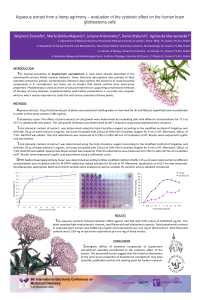
The healing properties of hemp agrimony (Eupatorium cannabinum L.) have been already described in the seventeenth-century Polish medical herbaria. These historical descriptions also pointed to their potential anticancer activity. Contemporary literature data confirm the presence of many bioactive compounds in hemp agrimony, but there are few data confirming their anti-cancer properties. Phytotherapy is used as a form of natural treatment or supporting conventional methods of therapy of many diseases. Supplementation with herbal preparations is currently very popular, which is why it seems important to study the anti-cancer potential of these plants. Aqueous extract: 10 g of dried aerial part of plants was extracted in water at temp. 80*C for 3h and filtered, evaporated, and reconstituted in water to a final stock solution (100 mg/mL). Cytotoxicity assay: The effects of plant extracts on cell growth were determined by incubating cells with different concentrations for 72 h at 37°C in standard 96-well plates. The cell growth inhibition was determined by MTT reduction assay (spectrophotometric analysis). The aqueous extract showed a cytotoxic effect against U87 MG with IC50 values of 0,09±0,01 μg/mL. The plant revealed high total phenolic content, total flavonoid, and antioxidant capacity. The synergistic effect of bioactive compounds of hemp agrimony plausibly contributed to the cytotoxic effect of the extract. The presented results suggest that the historical description of the anti-cancer properties of hemp agrimony may have scientific justification and be the starting point for further research.
Keywords
aqueous extract
cytotoxicity
Eupatorium cannabinum L.
glioblastoma
hemp agrimony
Poster
zwierello.ECMC2020.pdf
Antimicrobial properties, antioxidant activity and phenolic content of grape vinegars
Human endogenous retrovirus and clinical treatments of neurological disease