Event submissions
Published

This submission belongs to the session F. Round Table on Viral Infections of the event 6th International Electronic Conference on Medicinal Chemistry
Published date
05 Nov, 2020
Citation
Karen Giménez, Elisa Oltra, Human endogenous retrovirus and clinical treatments of neurological disease, in Proceedings of 6th International Electronic Conference on Medicinal Chemistry, 1 November–30 November 2020, MDPI: Basel, Switzerland, doi: 10.3390/ECMC2020-07296
Share
Email
Facebook
Twitter
LinkedIn
Human endogenous retrovirus and clinical treatments of neurological disease
'%3e%3cpath%20d='M12.6647%2010.9104C12.4176%2010.325%2012.0589%209.7933%2011.6088%209.34485C11.16%208.89511%2010.6283%208.53653%2010.0432%208.28891C10.038%208.28629%2010.0327%208.28498%2010.0275%208.28236C10.8437%207.69282%2011.3743%206.73252%2011.3743%205.64907C11.3743%203.85423%209.92005%202.40002%208.12522%202.40002C6.33038%202.40002%204.87618%203.85423%204.87618%205.64907C4.87618%206.73252%205.40677%207.69282%206.22296%208.28367C6.21772%208.28629%206.21248%208.2876%206.20724%208.29022C5.62031%208.53783%205.09365%208.89287%204.64167%209.34616C4.19192%209.79496%203.83334%2010.3266%203.58573%2010.9117C3.34247%2011.4846%203.21128%2012.0987%203.19925%2012.721C3.1989%2012.735%203.20135%2012.7489%203.20646%2012.7619C3.21157%2012.7749%203.21924%2012.7868%203.22901%2012.7968C3.23877%2012.8068%203.25045%2012.8148%203.26334%2012.8202C3.27623%2012.8256%203.29007%2012.8284%203.30406%2012.8284H4.09012C4.14776%2012.8284%204.19362%2012.7825%204.19493%2012.7262C4.22113%2011.7148%204.62726%2010.7676%205.34519%2010.0497C6.08802%209.30686%207.07452%208.89811%208.12522%208.89811C9.17592%208.89811%2010.1624%209.30686%2010.9052%2010.0497C11.6232%2010.7676%2012.0293%2011.7148%2012.0555%2012.7262C12.0568%2012.7839%2012.1027%2012.8284%2012.1603%2012.8284H12.9464C12.9604%2012.8284%2012.9742%2012.8256%2012.9871%2012.8202C13%2012.8148%2013.0117%2012.8068%2013.0214%2012.7968C13.0312%2012.7868%2013.0389%2012.7749%2013.044%2012.7619C13.0491%2012.7489%2013.0515%2012.735%2013.0512%2012.721C13.0381%2012.0947%2012.9084%2011.4856%2012.6647%2010.9104ZM8.12522%207.90243C7.52388%207.90243%206.95792%207.66793%206.53214%207.24215C6.10636%206.81636%205.87185%206.2504%205.87185%205.64907C5.87185%205.04773%206.10636%204.48177%206.53214%204.05599C6.95792%203.63021%207.52388%203.3957%208.12522%203.3957C8.72655%203.3957%209.29252%203.63021%209.7183%204.05599C10.1441%204.48177%2010.3786%205.04773%2010.3786%205.64907C10.3786%206.2504%2010.1441%206.81636%209.7183%207.24215C9.29252%207.66793%208.72655%207.90243%208.12522%207.90243Z'%20fill='%235D1EE1'/%3e%3c/g%3e%3c/svg%3e)
Karen Giménez 1
Elisa Oltra 2,3
1. Escuela de doctorado, Universidad Católica de Valencia San Vicente Mártir, 46001, Valencia, Spain
2. School of Medicine, Universidad Católica de Valencia San Vicente Mártir, 46001, Valencia, Spain
3. Centro de Investigación Traslacional San Alberto Magno, Universidad Católica de Valencia San Vicente Mártir, 46001, Valencia, Spain
Abstract
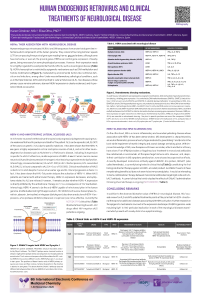
Human endogenous retroviruses (HERVs) are ancient retroviral DNA sequences whose expression plays important roles in mammalian physiological processes such as syncytium formation during pregnancy or brain development. Aberrant expression of HERVs is associated with neurological disease, with cause/effect relationships in multiple sclerosis (MS) and amyotrophic lateral sclerosis (ALS). Environmental factors, viral infections included, alter their tight epigenetic control. For example, some HIV patients develop HIV-associated ALS (HALS). Importantly, antiretroviral therapy relieves ALS symptoms at the time that reduces HERV-K expression. Furthermore, in vitro experiments show that FDA-approved anti-HIV drugs are effective at reducing HERV-K expression in HIV-negative ALS patients. Thus, two clinical trials testing antiretroviral therapy in ALS patients are ongoing (NCT02868580 and NCT02437110). In addition, a monoclonal antibody targeting the envelope protein (Env) of the human endogenous multiple sclerosis-associated retrovirus, HERV-W, called GNbAC1 or Temelimab, has been developed by the Swiss company GeNeuro. The results for the clinical trials NCT02782858 and NCT03239860 seem encouraging. This poster summarizes the epigenetic mechanisms controlling HERV expression, the relationship of their activation with inflammatory processes and the clinical trials directed at regulating aberrant HERV expression in MS and ALS.
Keywords
amyotrophic lateral sclerosis
HERV-K
HERV-W
HIV human endogenous retrovirus
multiple sclerosis
neurological disease
temelimab
Poster
Karen Giménez poster.pdf
Aqueous extract from a hemp agrimony – evaluation of the cytotoxic effect on the human brain glioblastoma cells
Potential antioxidative and inhibitory activity of parietin