Event submissions
Published

This submission belongs to the session F. Round Table on Viral Infections of the event 6th International Electronic Conference on Medicinal Chemistry
Published date
05 Nov, 2020
Citation
Fausta Ulgheri, Pietro Spanu, Francesco Deligia, Giovanni Loriga, Maria Pia Fuggetta, Andrea Morra, Iris de Haan, Ajay Chandgudge, Matthew R. Groves, Alexander Domling, Non-covalent inflammasome-caspase-1 complex inhibitors: New molecules targeting immune and inflammatory disorders including COVID-19, in Proceedings of 6th International Electronic Conference on Medicinal Chemistry, 1 November–30 November 2020, MDPI: Basel, Switzerland, doi: 10.3390/ECMC2020-07299
Share
Email
Facebook
Twitter
LinkedIn
Non-covalent inflammasome-caspase-1 complex inhibitors: New molecules targeting immune and inflammatory disorders including COVID-19
'%3e%3cpath%20d='M12.6647%2010.9104C12.4176%2010.325%2012.0589%209.7933%2011.6088%209.34485C11.16%208.89511%2010.6283%208.53653%2010.0432%208.28891C10.038%208.28629%2010.0327%208.28498%2010.0275%208.28236C10.8437%207.69282%2011.3743%206.73252%2011.3743%205.64907C11.3743%203.85423%209.92005%202.40002%208.12522%202.40002C6.33038%202.40002%204.87618%203.85423%204.87618%205.64907C4.87618%206.73252%205.40677%207.69282%206.22296%208.28367C6.21772%208.28629%206.21248%208.2876%206.20724%208.29022C5.62031%208.53783%205.09365%208.89287%204.64167%209.34616C4.19192%209.79496%203.83334%2010.3266%203.58573%2010.9117C3.34247%2011.4846%203.21128%2012.0987%203.19925%2012.721C3.1989%2012.735%203.20135%2012.7489%203.20646%2012.7619C3.21157%2012.7749%203.21924%2012.7868%203.22901%2012.7968C3.23877%2012.8068%203.25045%2012.8148%203.26334%2012.8202C3.27623%2012.8256%203.29007%2012.8284%203.30406%2012.8284H4.09012C4.14776%2012.8284%204.19362%2012.7825%204.19493%2012.7262C4.22113%2011.7148%204.62726%2010.7676%205.34519%2010.0497C6.08802%209.30686%207.07452%208.89811%208.12522%208.89811C9.17592%208.89811%2010.1624%209.30686%2010.9052%2010.0497C11.6232%2010.7676%2012.0293%2011.7148%2012.0555%2012.7262C12.0568%2012.7839%2012.1027%2012.8284%2012.1603%2012.8284H12.9464C12.9604%2012.8284%2012.9742%2012.8256%2012.9871%2012.8202C13%2012.8148%2013.0117%2012.8068%2013.0214%2012.7968C13.0312%2012.7868%2013.0389%2012.7749%2013.044%2012.7619C13.0491%2012.7489%2013.0515%2012.735%2013.0512%2012.721C13.0381%2012.0947%2012.9084%2011.4856%2012.6647%2010.9104ZM8.12522%207.90243C7.52388%207.90243%206.95792%207.66793%206.53214%207.24215C6.10636%206.81636%205.87185%206.2504%205.87185%205.64907C5.87185%205.04773%206.10636%204.48177%206.53214%204.05599C6.95792%203.63021%207.52388%203.3957%208.12522%203.3957C8.72655%203.3957%209.29252%203.63021%209.7183%204.05599C10.1441%204.48177%2010.3786%205.04773%2010.3786%205.64907C10.3786%206.2504%2010.1441%206.81636%209.7183%207.24215C9.29252%207.66793%208.72655%207.90243%208.12522%207.90243Z'%20fill='%235D1EE1'/%3e%3c/g%3e%3c/svg%3e)
Fausta Ulgheri 1
Pietro Spanu 1
Francesco Deligia 1
Giovanni Loriga 1
Maria Pia Fuggetta 2
Andrea Morra 1
Iris de Haan 3
Ajay Chandgudge 3
Matthew R. Groves 3
Alexander Domling 3
1. Istituto di Chimica Biomolecolare-CNR
2. Istituto di Farmacologia Traslazionale-CNR
3. University of Groningen
Abstract
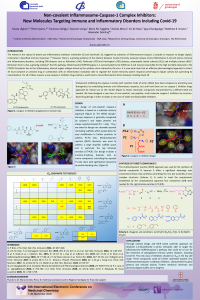
There is a growing evidence of the relation between an excessive release of pro-inflammatory IL-1beta triggered by the inflammasome-caspase 1 complex, and various immune and inflammatory disorders, including CNS diseases such as Alzheimer's (AD), Parkinson’s (PD) and Huntington's (HD) diseases, amyotrophic lateral sclerosis (ALS), and multiple sclerosis (MS). Moreover, there is also a growing evidence that the pathway inflammasome NLRP3/caspase-1 is overactivated by the SARS-Cov-2 and may be responsible for the high mortality observed in the COVID-19 patients due to the inflammatory internal organs collapse driven by the cytokine storm induced by the virus. It is now quite clear that an effective pharmacological approach to Covid-19 must comprise an antiviral drug in combination with an inflammation modulator able to regulate the innate immunity system response preserving its regular activity but quenching its overactivation. For all of these reasons a new caspase-1 inhibitor drug could be a useful tool to treat inflammation driven diseases including Covid-19.
For this purpose, we have designed a new class of non-covalent, non-peptidic, small molecule caspase-1 inhibitors through structure-based drug design. The multicomponent reaction approach allows the straightforward synthesis of the desired compounds, offering a significant advantage over conventional linear step synthesis by permitting the one pot assembly of very complex structures. This new class of inhibitors shows an IC50 in the low micromolar range, and could be further optimized towards new inflammasome/caspase-1 pathway inhibitors characterized by high bioavailability, potency and reduced toxicity.
Keywords
caspase-1
COVID-19
inflammasome
NLRP3
Poster
Poster.pdf
Gene expression profile in peripheral blood cells of patients with COVID-19
Drug repurposing: Dipeptidyl peptidase IV (DPP4) inhibitors as potential agents to treat SARS-CoV-2 (2019-nCov) infection