Event submissions
Published

This submission belongs to the session F. Round Table on Viral Infections of the event 6th International Electronic Conference on Medicinal Chemistry
Published date
05 Nov, 2020
Citation
Evgenii Mozhaitsev, Evgenii Suslov, Darya Rastrepaeva, Dina Korchagina, Nikolay Bormotov, Olga Yarovaya, Olga Serova, Alexander Agafonov, Rinat Maksyutov, Larisa Shishkina, New adamantane derivatives containing monoterpene fragments in their structure and investigation of their antipox activity, in Proceedings of 6th International Electronic Conference on Medicinal Chemistry, 1 November–30 November 2020, MDPI: Basel, Switzerland, doi: 10.3390/ECMC2020-07302
Share
Email
Facebook
Twitter
LinkedIn
New adamantane derivatives containing monoterpene fragments in their structure and investigation of their antipox activity
'%3e%3cpath%20d='M12.6647%2010.9104C12.4176%2010.325%2012.0589%209.7933%2011.6088%209.34485C11.16%208.89511%2010.6283%208.53653%2010.0432%208.28891C10.038%208.28629%2010.0327%208.28498%2010.0275%208.28236C10.8437%207.69282%2011.3743%206.73252%2011.3743%205.64907C11.3743%203.85423%209.92005%202.40002%208.12522%202.40002C6.33038%202.40002%204.87618%203.85423%204.87618%205.64907C4.87618%206.73252%205.40677%207.69282%206.22296%208.28367C6.21772%208.28629%206.21248%208.2876%206.20724%208.29022C5.62031%208.53783%205.09365%208.89287%204.64167%209.34616C4.19192%209.79496%203.83334%2010.3266%203.58573%2010.9117C3.34247%2011.4846%203.21128%2012.0987%203.19925%2012.721C3.1989%2012.735%203.20135%2012.7489%203.20646%2012.7619C3.21157%2012.7749%203.21924%2012.7868%203.22901%2012.7968C3.23877%2012.8068%203.25045%2012.8148%203.26334%2012.8202C3.27623%2012.8256%203.29007%2012.8284%203.30406%2012.8284H4.09012C4.14776%2012.8284%204.19362%2012.7825%204.19493%2012.7262C4.22113%2011.7148%204.62726%2010.7676%205.34519%2010.0497C6.08802%209.30686%207.07452%208.89811%208.12522%208.89811C9.17592%208.89811%2010.1624%209.30686%2010.9052%2010.0497C11.6232%2010.7676%2012.0293%2011.7148%2012.0555%2012.7262C12.0568%2012.7839%2012.1027%2012.8284%2012.1603%2012.8284H12.9464C12.9604%2012.8284%2012.9742%2012.8256%2012.9871%2012.8202C13%2012.8148%2013.0117%2012.8068%2013.0214%2012.7968C13.0312%2012.7868%2013.0389%2012.7749%2013.044%2012.7619C13.0491%2012.7489%2013.0515%2012.735%2013.0512%2012.721C13.0381%2012.0947%2012.9084%2011.4856%2012.6647%2010.9104ZM8.12522%207.90243C7.52388%207.90243%206.95792%207.66793%206.53214%207.24215C6.10636%206.81636%205.87185%206.2504%205.87185%205.64907C5.87185%205.04773%206.10636%204.48177%206.53214%204.05599C6.95792%203.63021%207.52388%203.3957%208.12522%203.3957C8.72655%203.3957%209.29252%203.63021%209.7183%204.05599C10.1441%204.48177%2010.3786%205.04773%2010.3786%205.64907C10.3786%206.2504%2010.1441%206.81636%209.7183%207.24215C9.29252%207.66793%208.72655%207.90243%208.12522%207.90243Z'%20fill='%235D1EE1'/%3e%3c/g%3e%3c/svg%3e)
Evgenii Mozhaitsev 1
Evgenii Suslov 1
Darya Rastrepaeva 1,2
Dina Korchagina 1
Nikolay Bormotov 3

Olga Yarovaya 1,2
Olga Serova 3
Alexander Agafonov 3
Rinat Maksyutov 3
Larisa Shishkina 3
1. N.N. Vorozhtsov Novosibirsk Institute of Organic Chemistry of Siberian Branch of Russian Academy of Sciences, Lavrentjev Avenue 9, 630090 Novosibirsk, Russia
2. Novosibirsk State University, Pirogova St. 2, 630090 Novosibirsk, Russia
3. Department of prevention and treatment of especially dangerous infections, State Research Center of Virology and Biotechnology VECTOR, Koltsovo, Novosibirsk Region, 630559, Russia
Abstract
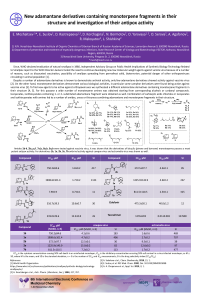
Since, WHO declared eradication of natural smallpox in 1980, Independent Advisory Group on Public Health Implications of Synthetic Biology Technology Related to Smallpox report to the WHO Director-General noted the need to continue developing new low molecular weight agents against variola virus because of a number of reasons, such as discounted vaccination, possibility of smallpox spreading from permafrost solid, bioterrorism, potential danger of other orthopoxviruses circulating in animal population.
Despite a number of adamantane derivatives is known to demonstrate antiviral activity, only few adamantane derivatives showed activity against vaccinia virus. From the other hand, monoterpene derivatives demonstrate various biological activities, in particular some camphor derivatives were found being active against vaccinia virus. To find new agents to be active against orthopoxviruses we synthesized a different adamantane derivatives containing monoterpene fragments in their structure.
For this purpose, a number of monoterpene amines was obtained starting from corresponding alcohols and ketones. Their reaction with 1- or 2-adamantane carboxylic acid chlorides led to amides. For a number of them antipox activity against vaccinia virus was demonstrated, with SI being from 5 to 1123. A most active amides were investigated against cowpox virus and ectromelia virus, with SI being from 30 to 406 and from 39 to 707 respectively.
A number of ureas and thioureas was obtained starting from isocyanates and isothiocyanates containing 1- and 2-substituted adamantane fragments and corresponding monoterpene amines as well. The antipox activity of this new adamantane derivatives hasn’t been investigated.
Keywords
adamantane
antipox activity
monoterpene
Poster
Poster_MozhaitsevES.pdf
In Silico prediction of biopharmaceutical features of remdesivir: A serendipitous drug for COVID-19
Selection of RNA aptamers targeting the 3’ untranslated region of the West Nile Virus genome