Event submissions
Published

This submission belongs to the session F. Round Table on Viral Infections of the event 6th International Electronic Conference on Medicinal Chemistry
Published date
05 Nov, 2020
Citation
Pramodkumar P Gupta, Virupaksha A Bastikar, Alpana Bastikar, Santosh S Chhajed, Sequence and structure analysis of surface glycoprotein of SARS-CoV-2 from India variants, in Proceedings of 6th International Electronic Conference on Medicinal Chemistry, 1 November–30 November 2020, MDPI: Basel, Switzerland, doi: 10.3390/ECMC2020-07305
Share
Email
Facebook
Twitter
LinkedIn
Sequence and structure analysis of surface glycoprotein of SARS-CoV-2 from India variants

Pramodkumar P Gupta 1
'%3e%3cpath%20d='M12.6647%2010.9104C12.4176%2010.325%2012.0589%209.7933%2011.6088%209.34485C11.16%208.89511%2010.6283%208.53653%2010.0432%208.28891C10.038%208.28629%2010.0327%208.28498%2010.0275%208.28236C10.8437%207.69282%2011.3743%206.73252%2011.3743%205.64907C11.3743%203.85423%209.92005%202.40002%208.12522%202.40002C6.33038%202.40002%204.87618%203.85423%204.87618%205.64907C4.87618%206.73252%205.40677%207.69282%206.22296%208.28367C6.21772%208.28629%206.21248%208.2876%206.20724%208.29022C5.62031%208.53783%205.09365%208.89287%204.64167%209.34616C4.19192%209.79496%203.83334%2010.3266%203.58573%2010.9117C3.34247%2011.4846%203.21128%2012.0987%203.19925%2012.721C3.1989%2012.735%203.20135%2012.7489%203.20646%2012.7619C3.21157%2012.7749%203.21924%2012.7868%203.22901%2012.7968C3.23877%2012.8068%203.25045%2012.8148%203.26334%2012.8202C3.27623%2012.8256%203.29007%2012.8284%203.30406%2012.8284H4.09012C4.14776%2012.8284%204.19362%2012.7825%204.19493%2012.7262C4.22113%2011.7148%204.62726%2010.7676%205.34519%2010.0497C6.08802%209.30686%207.07452%208.89811%208.12522%208.89811C9.17592%208.89811%2010.1624%209.30686%2010.9052%2010.0497C11.6232%2010.7676%2012.0293%2011.7148%2012.0555%2012.7262C12.0568%2012.7839%2012.1027%2012.8284%2012.1603%2012.8284H12.9464C12.9604%2012.8284%2012.9742%2012.8256%2012.9871%2012.8202C13%2012.8148%2013.0117%2012.8068%2013.0214%2012.7968C13.0312%2012.7868%2013.0389%2012.7749%2013.044%2012.7619C13.0491%2012.7489%2013.0515%2012.735%2013.0512%2012.721C13.0381%2012.0947%2012.9084%2011.4856%2012.6647%2010.9104ZM8.12522%207.90243C7.52388%207.90243%206.95792%207.66793%206.53214%207.24215C6.10636%206.81636%205.87185%206.2504%205.87185%205.64907C5.87185%205.04773%206.10636%204.48177%206.53214%204.05599C6.95792%203.63021%207.52388%203.3957%208.12522%203.3957C8.72655%203.3957%209.29252%203.63021%209.7183%204.05599C10.1441%204.48177%2010.3786%205.04773%2010.3786%205.64907C10.3786%206.2504%2010.1441%206.81636%209.7183%207.24215C9.29252%207.66793%208.72655%207.90243%208.12522%207.90243Z'%20fill='%235D1EE1'/%3e%3c/g%3e%3c/svg%3e)
Virupaksha A Bastikar 2
Alpana Bastikar 3
Santosh S Chhajed 4
1. School of Biotechnology and Bioinformatics, D Y Patil Deemed to be University, Navi Mumbai, Maharashtra, India
2. Amity Institute of Biotechnology, Amity University Maharashtra, Mumbai, Maharashtra, India
3. Department of Computer-Aided Drug Design, Navin Saxena Research and Technology Pvt. Ltd, Gandhidham, Gujarat, India
4. Department of Pharmaceutical Chemistry, Bhujbal Knowledge City, MET's Institute of Pharmacy, Adgaon, Nashik, Maharashtra, India
Abstract
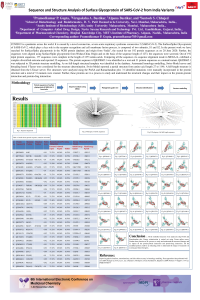
COVID19 is a pandemic across the world. It is caused by a novel coronavirus, severe acute respiratory syndrome coronavirus 2 (SARS-CoV-2). The Surface/Spike Glycoprotein of SARS-CoV-2, which plays a key role in the receptor recognition and cell membrane fusion process, is composed of two subunits, S1 and S2. In the present work we have searched for Surface/Spike glycoprotein in the NCBI protein database and origin from “India”, the search hit out 192 protein sequences as on 20 June 2020. Further, the sequences were aligned using Surface/Spike glycoprotein from Wuhan-China Origin and on the basis of the sequence length of 1273, the sequences were screened. Out of 192 input protein sequences, 177 sequences were complete in the length of 1273 amino-acids. Comparing all the sequences via sequence alignment mode in MEGA-X, exhibited a complex diversified outcome and reported 32 sequences. The protein sequence id QKI28685.1 was identified as a root and 31 protein sequences as a mutant/variant. QKI28685.1 was subjected to 3D protein structure modelling. As no full-length structural template was identified in the database. Automated homology modelling, Swiss-Model server and threading based I-Tasser were considered for the structure determination. Swiss-Model reported a partial structure from amino acid length 27 to 1146. A full-length structure is obtained from the I-Tasser server. The structures were analyzed using the ProSA and Ramachandran plot. 31 identified mutations were manually incorporated in the protein structure and a total of 31 mutants were created. Further, these proteins are in a process to study and understand the structural changes and their impact on the protein-protein interaction and protein-drug interaction.
Keywords
protein Modelling
SARS-CoV-2
sequence analysis
surface glycoprotein
Poster
sciforum-040500.pdf
Stability study, method for the quantitation of a new antifilovirus agent in biological fluids and a preliminary study of its pharmacokinetics
Design and synthesis of new hybrid latency reversal agents for HIV treatment