Event submissions
Published

This submission belongs to the session F. Round Table on Viral Infections of the event 6th International Electronic Conference on Medicinal Chemistry
Published date
05 Nov, 2020
Citation
Juliana Romano Lopes, Igor Muccilo Prokopczyk, Jean Leandro Dos Santos, Design and synthesis of new hybrid latency reversal agents for HIV treatment, in Proceedings of 6th International Electronic Conference on Medicinal Chemistry, 1 November–30 November 2020, MDPI: Basel, Switzerland, doi: 10.3390/ECMC2020-07306
Share
Email
Facebook
Twitter
LinkedIn
Design and synthesis of new hybrid latency reversal agents for HIV treatment
'%3e%3cpath%20d='M12.6647%2010.9104C12.4176%2010.325%2012.0589%209.7933%2011.6088%209.34485C11.16%208.89511%2010.6283%208.53653%2010.0432%208.28891C10.038%208.28629%2010.0327%208.28498%2010.0275%208.28236C10.8437%207.69282%2011.3743%206.73252%2011.3743%205.64907C11.3743%203.85423%209.92005%202.40002%208.12522%202.40002C6.33038%202.40002%204.87618%203.85423%204.87618%205.64907C4.87618%206.73252%205.40677%207.69282%206.22296%208.28367C6.21772%208.28629%206.21248%208.2876%206.20724%208.29022C5.62031%208.53783%205.09365%208.89287%204.64167%209.34616C4.19192%209.79496%203.83334%2010.3266%203.58573%2010.9117C3.34247%2011.4846%203.21128%2012.0987%203.19925%2012.721C3.1989%2012.735%203.20135%2012.7489%203.20646%2012.7619C3.21157%2012.7749%203.21924%2012.7868%203.22901%2012.7968C3.23877%2012.8068%203.25045%2012.8148%203.26334%2012.8202C3.27623%2012.8256%203.29007%2012.8284%203.30406%2012.8284H4.09012C4.14776%2012.8284%204.19362%2012.7825%204.19493%2012.7262C4.22113%2011.7148%204.62726%2010.7676%205.34519%2010.0497C6.08802%209.30686%207.07452%208.89811%208.12522%208.89811C9.17592%208.89811%2010.1624%209.30686%2010.9052%2010.0497C11.6232%2010.7676%2012.0293%2011.7148%2012.0555%2012.7262C12.0568%2012.7839%2012.1027%2012.8284%2012.1603%2012.8284H12.9464C12.9604%2012.8284%2012.9742%2012.8256%2012.9871%2012.8202C13%2012.8148%2013.0117%2012.8068%2013.0214%2012.7968C13.0312%2012.7868%2013.0389%2012.7749%2013.044%2012.7619C13.0491%2012.7489%2013.0515%2012.735%2013.0512%2012.721C13.0381%2012.0947%2012.9084%2011.4856%2012.6647%2010.9104ZM8.12522%207.90243C7.52388%207.90243%206.95792%207.66793%206.53214%207.24215C6.10636%206.81636%205.87185%206.2504%205.87185%205.64907C5.87185%205.04773%206.10636%204.48177%206.53214%204.05599C6.95792%203.63021%207.52388%203.3957%208.12522%203.3957C8.72655%203.3957%209.29252%203.63021%209.7183%204.05599C10.1441%204.48177%2010.3786%205.04773%2010.3786%205.64907C10.3786%206.2504%2010.1441%206.81636%209.7183%207.24215C9.29252%207.66793%208.72655%207.90243%208.12522%207.90243Z'%20fill='%235D1EE1'/%3e%3c/g%3e%3c/svg%3e)
Juliana Romano Lopes 1
Igor Muccilo Prokopczyk 1

Jean Leandro Dos Santos 1
1. São Paulo State University "Júlio de Mesquita Filho"
Abstract
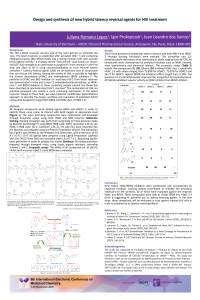
Background: HIV latency reservoir remains one of the main barriers to eliminate the virus. The “kick-and-kill” strategy aims to reactivate the HIV latency reservoir in the first step “kick” and the elimination of these reactivated virus in the second step, “kill”. Latency-reversing agents such as histone deacetylase (HDAC) and bromodomain (BRD-4) inhibitors have been described in “kick-and-kill” strategy to reactivate HIV reservoirs. Here, we described the design, preparation and evaluation of hybrid compounds designed to target both BRD-4 and HDAC 1-3 simultaneously. Methods: In silico studies were performed using the molecular modelling Maestro by Schrödinger environment, using BRD-4 (pdb code: 4WIV) and HDAC-2 (pdb code: 4LY1). All compounds were prepared through divergent synthesis. First, it was performed a Suzuki coupling reaction between the methyl 4-iodobenzoate and boronic acid derivatives. The ester function was hydrolysed and the compound was coupled with o-phenylenediamine using EDC. The ability of the compounds (at 10 mM) to inhibit both HDAC 1-3 and BRD-4 were evaluated. Results: Docking simulation suggests that all compounds are able to interact with BRD-4 and HDAC-2. Five compounds were synthesized at global yields ranging from 11-20%. All structures were characterized by analytical methods. The most promising compound was able to inhibit HDAC 1-3 and BRD4 at values of 75 %, 72 %, 57 % and 21 %, respectively. Conclusions: Hybrid compounds were designed, synthesized and evaluated against the enzymes HDAC and BRD. These dual compounds were able to inhibit BRD-4 and HDAC 1-3 suggesting its potential use as latency-reversing agents.
Keywords
BRD4 inhibitors
HDAC inhibitors
hybrid compounds
latency reversal agents
Poster
Poster_ECMC_JulianaRomanoLopes.pdf
Sequence and structure analysis of surface glycoprotein of SARS-CoV-2 from India variants
Understanding knowledge and behaviors related to COVID–19 epidemic in United Arab Emirates undergraduate pharmacy students: A cross-sectional study