Event submissions
Published

This submission belongs to the session F. Phase Transformations in Crystalline Materials of the event The 2nd International Online Conference on Crystals
Published date
06 Nov, 2020
Citation
Margaux Larcher, Cyril Cayron, Andreas Blatter, Raphaëlle Soulignac, Roland Logé, EBSD study of variant selection in red gold alloys during phase transformation under four point bending, in Proceedings of The 2nd International Online Conference on Crystals, 10 November–20 November 2020, MDPI: Basel, Switzerland, doi: 10.3390/IOCC_2020-07325
Share
Email
Facebook
Twitter
LinkedIn
EBSD study of variant selection in red gold alloys during phase transformation under four point bending
'%3e%3cpath%20d='M12.6647%2010.9104C12.4176%2010.325%2012.0589%209.7933%2011.6088%209.34485C11.16%208.89511%2010.6283%208.53653%2010.0432%208.28891C10.038%208.28629%2010.0327%208.28498%2010.0275%208.28236C10.8437%207.69282%2011.3743%206.73252%2011.3743%205.64907C11.3743%203.85423%209.92005%202.40002%208.12522%202.40002C6.33038%202.40002%204.87618%203.85423%204.87618%205.64907C4.87618%206.73252%205.40677%207.69282%206.22296%208.28367C6.21772%208.28629%206.21248%208.2876%206.20724%208.29022C5.62031%208.53783%205.09365%208.89287%204.64167%209.34616C4.19192%209.79496%203.83334%2010.3266%203.58573%2010.9117C3.34247%2011.4846%203.21128%2012.0987%203.19925%2012.721C3.1989%2012.735%203.20135%2012.7489%203.20646%2012.7619C3.21157%2012.7749%203.21924%2012.7868%203.22901%2012.7968C3.23877%2012.8068%203.25045%2012.8148%203.26334%2012.8202C3.27623%2012.8256%203.29007%2012.8284%203.30406%2012.8284H4.09012C4.14776%2012.8284%204.19362%2012.7825%204.19493%2012.7262C4.22113%2011.7148%204.62726%2010.7676%205.34519%2010.0497C6.08802%209.30686%207.07452%208.89811%208.12522%208.89811C9.17592%208.89811%2010.1624%209.30686%2010.9052%2010.0497C11.6232%2010.7676%2012.0293%2011.7148%2012.0555%2012.7262C12.0568%2012.7839%2012.1027%2012.8284%2012.1603%2012.8284H12.9464C12.9604%2012.8284%2012.9742%2012.8256%2012.9871%2012.8202C13%2012.8148%2013.0117%2012.8068%2013.0214%2012.7968C13.0312%2012.7868%2013.0389%2012.7749%2013.044%2012.7619C13.0491%2012.7489%2013.0515%2012.735%2013.0512%2012.721C13.0381%2012.0947%2012.9084%2011.4856%2012.6647%2010.9104ZM8.12522%207.90243C7.52388%207.90243%206.95792%207.66793%206.53214%207.24215C6.10636%206.81636%205.87185%206.2504%205.87185%205.64907C5.87185%205.04773%206.10636%204.48177%206.53214%204.05599C6.95792%203.63021%207.52388%203.3957%208.12522%203.3957C8.72655%203.3957%209.29252%203.63021%209.7183%204.05599C10.1441%204.48177%2010.3786%205.04773%2010.3786%205.64907C10.3786%206.2504%2010.1441%206.81636%209.7183%207.24215C9.29252%207.66793%208.72655%207.90243%208.12522%207.90243Z'%20fill='%235D1EE1'/%3e%3c/g%3e%3c/svg%3e)
Margaux Larcher 1

Cyril Cayron 1
Andreas Blatter 2
Raphaëlle Soulignac 2

Roland Logé 1
1. Ecole Polytechnique Fédérale de Lausanne (EPFL)
2. PX Group
Abstract
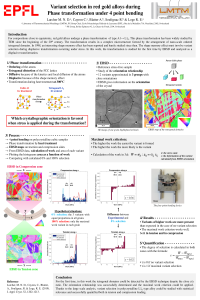
The A0→L10 phase transformation, which appears in red gold alloys with compositions close to Au-Cu, is well known as diffusive. However, a shape memory effect has been reported in these alloys, which must involve variant selection during a displacive transformation. Therefore, in this work, the variant selection is studied by EBSD in a polycrystalline red gold alloy heat treated under 4-point bending. For the first time, the L10 domains could be identified by EBSD despite their c/a ratio close to unity and their nanometric scale. The orientation relationship between parent and daughter phases was determined and the mechanical work of the variant formation calculated from both the lattice distortion and the experimental orientations. The maximal work criterion, initially introduced for variant selection in martensitic transformations, was applied on large-scale areas with statistical data and it provided quantitative results on the degree of variant selection in both tension and compression.
Keywords
EBSD
Variant selection
Red gold alloys
Poster
Poster MDPI.pdf
En-Type Ligands as Dimensional Reduction Agents in Coordination Polymers containing Dicarboxylic Acids.
Halogen bonds involving pentafluoroiodbenzene: Answers from experimental electron density