Event submissions
Published

This submission belongs to the session C. Crystal Engineering of the event The 2nd International Online Conference on Crystals
Published date
06 Nov, 2020
Citation
Wei Li, Brahim Benyahia, Chris Rielly, Needle crystal shape modification through combined additive, T-cycling and wet-milling: experimental validation and modelling approach , in Proceedings of The 2nd International Online Conference on Crystals, 10 November–20 November 2020, MDPI: Basel, Switzerland, doi: 10.3390/IOCC_2020-07338
Share
Email
Facebook
Twitter
LinkedIn
Needle crystal shape modification through combined additive, T-cycling and wet-milling: experimental validation and modelling approach
'%3e%3cpath%20d='M12.6647%2010.9104C12.4176%2010.325%2012.0589%209.7933%2011.6088%209.34485C11.16%208.89511%2010.6283%208.53653%2010.0432%208.28891C10.038%208.28629%2010.0327%208.28498%2010.0275%208.28236C10.8437%207.69282%2011.3743%206.73252%2011.3743%205.64907C11.3743%203.85423%209.92005%202.40002%208.12522%202.40002C6.33038%202.40002%204.87618%203.85423%204.87618%205.64907C4.87618%206.73252%205.40677%207.69282%206.22296%208.28367C6.21772%208.28629%206.21248%208.2876%206.20724%208.29022C5.62031%208.53783%205.09365%208.89287%204.64167%209.34616C4.19192%209.79496%203.83334%2010.3266%203.58573%2010.9117C3.34247%2011.4846%203.21128%2012.0987%203.19925%2012.721C3.1989%2012.735%203.20135%2012.7489%203.20646%2012.7619C3.21157%2012.7749%203.21924%2012.7868%203.22901%2012.7968C3.23877%2012.8068%203.25045%2012.8148%203.26334%2012.8202C3.27623%2012.8256%203.29007%2012.8284%203.30406%2012.8284H4.09012C4.14776%2012.8284%204.19362%2012.7825%204.19493%2012.7262C4.22113%2011.7148%204.62726%2010.7676%205.34519%2010.0497C6.08802%209.30686%207.07452%208.89811%208.12522%208.89811C9.17592%208.89811%2010.1624%209.30686%2010.9052%2010.0497C11.6232%2010.7676%2012.0293%2011.7148%2012.0555%2012.7262C12.0568%2012.7839%2012.1027%2012.8284%2012.1603%2012.8284H12.9464C12.9604%2012.8284%2012.9742%2012.8256%2012.9871%2012.8202C13%2012.8148%2013.0117%2012.8068%2013.0214%2012.7968C13.0312%2012.7868%2013.0389%2012.7749%2013.044%2012.7619C13.0491%2012.7489%2013.0515%2012.735%2013.0512%2012.721C13.0381%2012.0947%2012.9084%2011.4856%2012.6647%2010.9104ZM8.12522%207.90243C7.52388%207.90243%206.95792%207.66793%206.53214%207.24215C6.10636%206.81636%205.87185%206.2504%205.87185%205.64907C5.87185%205.04773%206.10636%204.48177%206.53214%204.05599C6.95792%203.63021%207.52388%203.3957%208.12522%203.3957C8.72655%203.3957%209.29252%203.63021%209.7183%204.05599C10.1441%204.48177%2010.3786%205.04773%2010.3786%205.64907C10.3786%206.2504%2010.1441%206.81636%209.7183%207.24215C9.29252%207.66793%208.72655%207.90243%208.12522%207.90243Z'%20fill='%235D1EE1'/%3e%3c/g%3e%3c/svg%3e)
Wei Li 1

Brahim Benyahia 1
Chris Rielly 1
1. Continuous Manufacturing and Advanced Crystallization (CMAC) Future Research Hub at Loughborough University, Loughborough, LE11 3TU, UK
Abstract
To improve drug product quality, the size and shape of active pharmaceutical ingredient (API) crystals need to meet tight specifications, in part determined by downstream manufacturing requirements. Improved critical quality attributes may also lead to better solubilisation and bioavailability during drug product delivery. Milling-aided crystallisation is a practical means to reduce the mean particle size and aspect ratio to meet these requirements and to improve downstream manufacturability. Other methods to control crystal shape employ temperature cycling during solution state crystallisation, e.g. Direct Nucleation Control (DNC) may be used to alter the particle morphology and size distribution through successive heating-cooling cycles for dissolution and recrystallisation.
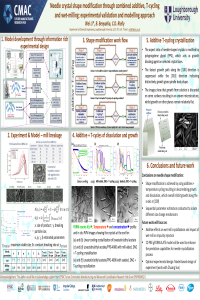
In this work, the process objective is to target uniformly sized, equant shaped crystals with enhanced bioavailability using DNC crystallisation, integrated with either external loop and in-situ wet-milling. Experiments were conducted using mefenamic acid in 2-butanol, starting with a benchmark case of batch crystallisation with a linear cooling profile. This allowed identification of suitable DNC set-points, which were then implemented using closed-loop feedback control, based on sensing the FBRM counts. DNC is shown to be capable of improving crystal shape, but additional control is added by applying wet-milling to reduce crystal size. Application of wet-milling, combined with DNC was effective in reducing the crystal size D90 < 50 mm and reducing the aspect ratio.
The wet-milling approaches were compared in terms of cycle time and final crystal size and shape, by varying the wet-milling speed, with targeted counts specified for the DNC set-point. The external wet-mill aided DNC crystallisations reached a steady-state with reduced cycle time and improved crystal morphology, in comparison with in-situ wet-mill aided DNC processes.
Keywords
Direct Nucleation Control
wet-milling
size reduction
shape modification
Poster
sciforum-035806.pdf
CHALCOGENAZINOQUINOLINIUM MONOIODIDES: PHASE TRANSITION, SPECTRAL PROPERTIES AND NON-COVALENT BONDING
Shifts in Cα backbone conformation in X-ray structures of human acetylcholinesterase covalently inhibited by organophosphorates and organophosphoramidates revealed by PACCT3 comparative analysis