Event submissions
Published

This submission belongs to the session F. Round Table on Viral Infections of the event 6th International Electronic Conference on Medicinal Chemistry
Published date
06 Nov, 2020
Citation
Nermin S. Ahmed, Mai H. A. Mousa, Kai Schwedtmann, Efseveia Frakolaki, Niki Vassilaki, Grigoris Zoidis, Jan Weigand, Ashraf Abadi, Design and synthesis of novel symmetric diaminofluorene prolinamide analogues as potent hepatitis C virus inhibitors, in Proceedings of 6th International Electronic Conference on Medicinal Chemistry, 1 November–30 November 2020, MDPI: Basel, Switzerland, doi: 10.3390/ECMC2020-07367
Share
Email
Facebook
Twitter
LinkedIn
Design and synthesis of novel symmetric diaminofluorene prolinamide analogues as potent hepatitis C virus inhibitors
'%3e%3cpath%20d='M12.6647%2010.9104C12.4176%2010.325%2012.0589%209.7933%2011.6088%209.34485C11.16%208.89511%2010.6283%208.53653%2010.0432%208.28891C10.038%208.28629%2010.0327%208.28498%2010.0275%208.28236C10.8437%207.69282%2011.3743%206.73252%2011.3743%205.64907C11.3743%203.85423%209.92005%202.40002%208.12522%202.40002C6.33038%202.40002%204.87618%203.85423%204.87618%205.64907C4.87618%206.73252%205.40677%207.69282%206.22296%208.28367C6.21772%208.28629%206.21248%208.2876%206.20724%208.29022C5.62031%208.53783%205.09365%208.89287%204.64167%209.34616C4.19192%209.79496%203.83334%2010.3266%203.58573%2010.9117C3.34247%2011.4846%203.21128%2012.0987%203.19925%2012.721C3.1989%2012.735%203.20135%2012.7489%203.20646%2012.7619C3.21157%2012.7749%203.21924%2012.7868%203.22901%2012.7968C3.23877%2012.8068%203.25045%2012.8148%203.26334%2012.8202C3.27623%2012.8256%203.29007%2012.8284%203.30406%2012.8284H4.09012C4.14776%2012.8284%204.19362%2012.7825%204.19493%2012.7262C4.22113%2011.7148%204.62726%2010.7676%205.34519%2010.0497C6.08802%209.30686%207.07452%208.89811%208.12522%208.89811C9.17592%208.89811%2010.1624%209.30686%2010.9052%2010.0497C11.6232%2010.7676%2012.0293%2011.7148%2012.0555%2012.7262C12.0568%2012.7839%2012.1027%2012.8284%2012.1603%2012.8284H12.9464C12.9604%2012.8284%2012.9742%2012.8256%2012.9871%2012.8202C13%2012.8148%2013.0117%2012.8068%2013.0214%2012.7968C13.0312%2012.7868%2013.0389%2012.7749%2013.044%2012.7619C13.0491%2012.7489%2013.0515%2012.735%2013.0512%2012.721C13.0381%2012.0947%2012.9084%2011.4856%2012.6647%2010.9104ZM8.12522%207.90243C7.52388%207.90243%206.95792%207.66793%206.53214%207.24215C6.10636%206.81636%205.87185%206.2504%205.87185%205.64907C5.87185%205.04773%206.10636%204.48177%206.53214%204.05599C6.95792%203.63021%207.52388%203.3957%208.12522%203.3957C8.72655%203.3957%209.29252%203.63021%209.7183%204.05599C10.1441%204.48177%2010.3786%205.04773%2010.3786%205.64907C10.3786%206.2504%2010.1441%206.81636%209.7183%207.24215C9.29252%207.66793%208.72655%207.90243%208.12522%207.90243Z'%20fill='%235D1EE1'/%3e%3c/g%3e%3c/svg%3e)
Nermin S. Ahmed 1
Mai H. A. Mousa 2
Kai Schwedtmann 3
Efseveia Frakolaki 4
Niki Vassilaki 5

Grigoris Zoidis 6
Jan Weigand 3
Ashraf Abadi 1
1. Department of Pharmaceutical Chemistry, Faculty of Pharmacy and Biotechnology, German University in Cairo, Cairo 11835, Egypt.
2. Department of Pharmaceutical Chemistry, Faculty of Pharmacy and Biotechnology, German University in Cairo, Cairo , Egypt.
3. Faculty of Chemistry and Food Chemistry, Technische Universität Dresden, 01062 Dresden, Germany
4. Molecular Virology Laboratory, Hellenic Pasteur Institute, 127 Vas. Sofias Avenue, 11521, Athens, Greece
5. Molecular Virology Laboratory, Hellenic Pasteur Institute, 127 Vas. Sofias Avenue, 11521, Athens, Greece.
6. Department of Pharmacy, Division of Pharmaceutical Chemistry, School of Health Sciences, National and Kapodistrian University of Athens, 15771, Athens, Greece.
Abstract
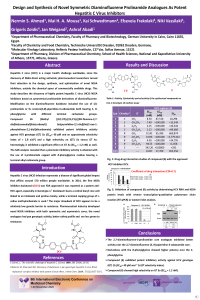
Hepatitis C virus (HCV) is a major health challenge worldwide, since the discovery of NS5A direct acting antivirals; pharmaceutical researchers turned their attention to the design, synthesis, and optimization of novel NS5A inhibitors, outside the chemical space of commercially available drugs. This study describes the discovery of highly potent hepatitis C virus (HCV) NS5A inhibitors based on symmetrical prolinamide derivatives of diaminofluorene. Modification on the diaminoflourene backbone included the use of (S)-prolinamide or its isostere(S,R)-piperidine-3-caboxamide both bearing S, R-phenylglycine with different terminal carbamate groups. Compound 26 (Diethyl ((1R,1'R)-((2S,2'S)-(((9H-fluorene-2,7-diyl)bis(azanediyl))bis(carbonyl)) bis(pyrrolidine-2,1-diyl))bis(2-oxo-1-phenylethane-2,1-diyl))dicarbamate) exhibited potent inhibitory activity against HCV genotype (GT) 1b (EC50= 40 pM and an approximate selectivity index of > 2.8 x10⁶) and a high selectivity on (GT) 1b versus GT 4a. Interestingly, it exhibited a significant effect on GT 3a (EC50 = 1.2 nM) as well. The SAR analysis revealed that a picomolar inhibitory activity is attained with the use of S-prolinamide capped with R-phenylglycine residue bearing a terminal alkyl carbamate group.
Keywords
DAA
diaminofluorene
HCV
NS5A inhibitors
Replicon assay
symmetric
Poster
Nermin_Ahmed sciforum ID-037982.pdf
One hour in vivo-like phenotypic screening system for anti-cancer drugs using a high precision surface plasmon resonance device
A robust bioassay of the human bradykinin B2 receptor that extends molecular/cellular studies: The isolated umbilical vein