Event submissions
Published

This submission belongs to the session C. General: Presentations of the event 6th International Electronic Conference on Medicinal Chemistry
Published date
06 Nov, 2020
Citation
Tina P. Andrejevic, Dusan Milivojevic, Darko P. Ašanin, Nevena Lj. Stevanović, Jasmina Nikodinovic-Runic, Miloš I. Djuran, Biljana Đ. Glišić, DNA/BSA binding affinities and in vivo toxicity of dinuclear silver(I) complexes with phthalazine, in Proceedings of 6th International Electronic Conference on Medicinal Chemistry, 1 November–30 November 2020, MDPI: Basel, Switzerland, doi: 10.3390/ECMC2020-07371
Share
Email
Facebook
Twitter
LinkedIn
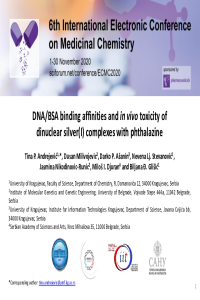
DNA/BSA binding affinities and in vivo toxicity of dinuclear silver(I) complexes with phthalazine
'%3e%3cpath%20d='M12.6647%2010.9104C12.4176%2010.325%2012.0589%209.7933%2011.6088%209.34485C11.16%208.89511%2010.6283%208.53653%2010.0432%208.28891C10.038%208.28629%2010.0327%208.28498%2010.0275%208.28236C10.8437%207.69282%2011.3743%206.73252%2011.3743%205.64907C11.3743%203.85423%209.92005%202.40002%208.12522%202.40002C6.33038%202.40002%204.87618%203.85423%204.87618%205.64907C4.87618%206.73252%205.40677%207.69282%206.22296%208.28367C6.21772%208.28629%206.21248%208.2876%206.20724%208.29022C5.62031%208.53783%205.09365%208.89287%204.64167%209.34616C4.19192%209.79496%203.83334%2010.3266%203.58573%2010.9117C3.34247%2011.4846%203.21128%2012.0987%203.19925%2012.721C3.1989%2012.735%203.20135%2012.7489%203.20646%2012.7619C3.21157%2012.7749%203.21924%2012.7868%203.22901%2012.7968C3.23877%2012.8068%203.25045%2012.8148%203.26334%2012.8202C3.27623%2012.8256%203.29007%2012.8284%203.30406%2012.8284H4.09012C4.14776%2012.8284%204.19362%2012.7825%204.19493%2012.7262C4.22113%2011.7148%204.62726%2010.7676%205.34519%2010.0497C6.08802%209.30686%207.07452%208.89811%208.12522%208.89811C9.17592%208.89811%2010.1624%209.30686%2010.9052%2010.0497C11.6232%2010.7676%2012.0293%2011.7148%2012.0555%2012.7262C12.0568%2012.7839%2012.1027%2012.8284%2012.1603%2012.8284H12.9464C12.9604%2012.8284%2012.9742%2012.8256%2012.9871%2012.8202C13%2012.8148%2013.0117%2012.8068%2013.0214%2012.7968C13.0312%2012.7868%2013.0389%2012.7749%2013.044%2012.7619C13.0491%2012.7489%2013.0515%2012.735%2013.0512%2012.721C13.0381%2012.0947%2012.9084%2011.4856%2012.6647%2010.9104ZM8.12522%207.90243C7.52388%207.90243%206.95792%207.66793%206.53214%207.24215C6.10636%206.81636%205.87185%206.2504%205.87185%205.64907C5.87185%205.04773%206.10636%204.48177%206.53214%204.05599C6.95792%203.63021%207.52388%203.3957%208.12522%203.3957C8.72655%203.3957%209.29252%203.63021%209.7183%204.05599C10.1441%204.48177%2010.3786%205.04773%2010.3786%205.64907C10.3786%206.2504%2010.1441%206.81636%209.7183%207.24215C9.29252%207.66793%208.72655%207.90243%208.12522%207.90243Z'%20fill='%235D1EE1'/%3e%3c/g%3e%3c/svg%3e)
Tina P. Andrejevic 1
Dusan Milivojevic 2

Darko P. Ašanin 3

Nevena Lj. Stevanović 1

Jasmina Nikodinovic-Runic 2

Miloš I. Djuran 4

Biljana Đ. Glišić 1
1. University of Kragujevac, Faculty of Science, Department of Chemistry, R. Domanovića 12, 34000 Kragujevac, Serbia
2. Institute of Molecular Genetics and Genetic Engineering, University of Belgrade, Vojvode Stepe 444a, 11042 Belgrade, Serbia
3. University of Kragujevac, Institute for Information Technologies Kragujevac, Department of Science, Jovana Cvijića bb, 34000 Kragujevac, Serbia
4. Serbian Academy of Sciences and Arts, Knez Mihailova 35, 11000 Belgrade, Serbia
Abstract
Silver(I) complexes with aromatic nitrogen-containing heterocycles have shown an effective and wide-spectrum of antimicrobial activity. The possible mechanism of their antimicrobial activity can be attributed to interactions of these complexes with biomolecules, including DNA and proteins. Herein, we investigated the interactions of two antimicrobial active dinuclear phthalazine-silver(I) complexes, [{Ag(NO3)(phtz)}2(μ-phtz)2] (Ag1) and [{Ag(CF3SO3)(phtz)}2(μ-phtz)2] (Ag2) (phtz is phthalazine), with calf thymus DNA (ctDNA) and bovine serum albumin (BSA) to evaluate their binding affinities towards these biomolecules for possible insights on their mode of antimicrobial activity. The value of binding constants (KA) of Ag1 and Ag2 to BSA is higher than that for DNA, indicating greater affinity of the complexes toward this model protein. The partition coefficient (logP) values for Ag1 and Ag2 are 0.0035 and -0.0063, respectively, what is in accordance with higher cellular uptake efficiency and better antibacterial activity of Ag1 in respect to Ag2. In order to determine the therapeutic potential of Ag1 and Ag2 complexes, their toxicity in vivo against nematode, Caenorhabditis elegans, was investigated.
Keywords
Caenorhabditis elegans
DNA/BSA interaction
lipophilicity
phthalazine
silver(I) complexes
Poster
ECMC Tina Andrejevic.pdf
Synthesis and biological evaluation of inducible nitric oxide synthase inhibitors as anticancer agents
Antimicrobial activity and DNA/BSA binding study of new silver(I) complexes with 1,8-naphthyridine