Event submissions
Published

This submission belongs to the session B. General: Posters of the event 6th International Electronic Conference on Medicinal Chemistry
Published date
06 Nov, 2020
Citation
Aldar Munkuev, Alexandra Zakharenko, Evgeniy Suslov, Arina Chepanova, Konstantin Volcho, Nariman Salakhutdinov, Olga Lavrik, Adamantane derivatives having heterocyclic and monoterpenoid residues as potent Tdp1 inhibitors, in Proceedings of 6th International Electronic Conference on Medicinal Chemistry, 1 November–30 November 2020, MDPI: Basel, Switzerland, doi: 10.3390/ECMC2020-07374
Share
Email
Facebook
Twitter
LinkedIn
Adamantane derivatives having heterocyclic and monoterpenoid residues as potent Tdp1 inhibitors
'%3e%3cpath%20d='M12.6647%2010.9104C12.4176%2010.325%2012.0589%209.7933%2011.6088%209.34485C11.16%208.89511%2010.6283%208.53653%2010.0432%208.28891C10.038%208.28629%2010.0327%208.28498%2010.0275%208.28236C10.8437%207.69282%2011.3743%206.73252%2011.3743%205.64907C11.3743%203.85423%209.92005%202.40002%208.12522%202.40002C6.33038%202.40002%204.87618%203.85423%204.87618%205.64907C4.87618%206.73252%205.40677%207.69282%206.22296%208.28367C6.21772%208.28629%206.21248%208.2876%206.20724%208.29022C5.62031%208.53783%205.09365%208.89287%204.64167%209.34616C4.19192%209.79496%203.83334%2010.3266%203.58573%2010.9117C3.34247%2011.4846%203.21128%2012.0987%203.19925%2012.721C3.1989%2012.735%203.20135%2012.7489%203.20646%2012.7619C3.21157%2012.7749%203.21924%2012.7868%203.22901%2012.7968C3.23877%2012.8068%203.25045%2012.8148%203.26334%2012.8202C3.27623%2012.8256%203.29007%2012.8284%203.30406%2012.8284H4.09012C4.14776%2012.8284%204.19362%2012.7825%204.19493%2012.7262C4.22113%2011.7148%204.62726%2010.7676%205.34519%2010.0497C6.08802%209.30686%207.07452%208.89811%208.12522%208.89811C9.17592%208.89811%2010.1624%209.30686%2010.9052%2010.0497C11.6232%2010.7676%2012.0293%2011.7148%2012.0555%2012.7262C12.0568%2012.7839%2012.1027%2012.8284%2012.1603%2012.8284H12.9464C12.9604%2012.8284%2012.9742%2012.8256%2012.9871%2012.8202C13%2012.8148%2013.0117%2012.8068%2013.0214%2012.7968C13.0312%2012.7868%2013.0389%2012.7749%2013.044%2012.7619C13.0491%2012.7489%2013.0515%2012.735%2013.0512%2012.721C13.0381%2012.0947%2012.9084%2011.4856%2012.6647%2010.9104ZM8.12522%207.90243C7.52388%207.90243%206.95792%207.66793%206.53214%207.24215C6.10636%206.81636%205.87185%206.2504%205.87185%205.64907C5.87185%205.04773%206.10636%204.48177%206.53214%204.05599C6.95792%203.63021%207.52388%203.3957%208.12522%203.3957C8.72655%203.3957%209.29252%203.63021%209.7183%204.05599C10.1441%204.48177%2010.3786%205.04773%2010.3786%205.64907C10.3786%206.2504%2010.1441%206.81636%209.7183%207.24215C9.29252%207.66793%208.72655%207.90243%208.12522%207.90243Z'%20fill='%235D1EE1'/%3e%3c/g%3e%3c/svg%3e)
Aldar Munkuev 1
Alexandra Zakharenko 2
Evgeniy Suslov 1
Arina Chepanova 2

Konstantin Volcho 1,3
Nariman Salakhutdinov 1,3

Olga Lavrik 2,3
1. N.N. Vorozhtsov Novosibirsk Institute of Organic Chemistry, Siberian Branch of Russian Academy of Sciences, 9,
Lavrentiev Ave., Novosibirsk 630090, Russia
2. Institute of Chemical Biology and Fundamental Medicine, Siberian Branch of Russian Academy of Sciences, 8, Lavrentiev
Ave., Novosibirsk 630090, Russia
3. Novosibirsk State University, 2, Pirogova Str., Novosibirsk 630090, Russia
Abstract
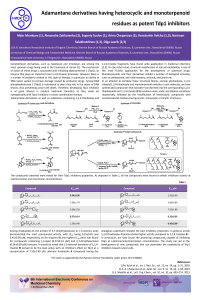
Camptothecin derivatives are among the most common drugs used in the treatment of cancer. The mechanism of action of these drugs is associated with inhibiting topoisomerase 1 (Top1), an enzyme that plays an important role in cell division processes. However, there is a number of problems related to this type of therapy, particularly an ability of DNA repair system to remove damage caused by antitumor drugs. Tyrosyl-DNA phosphodiesterase 1 (Tdp1) is considered to play a key role in the repair of DNA lesions, thus preventing cancer cell death. Therefore, developing Tdp1 inhibitors is of great interest in modern medicinal chemistry.
Pharmacophore groups have found wide application in medicinal chemistry. On the other hand, modification of natural metabolites is one of the most fruitful methods for the development of potential drugs. In an attempt to combine these approaches, we have synthesized adamantanecarbonylthiosemicarbazide that has been transformed into the corresponding 1,3,4-thiadiazole and 1,2,4-triazole derivatives under alkaline and acidic conditions respectively, followed by the modification of heterocyclic compounds with monoterpenoid residues.
All the compounds were found to exhibit inhibitory activity against Tdp1 at micromolar concentrations. Among thiadiazoles, the amides of 3,7-dimethyloctanoic or (-)-myrtenic acids demonstrated the most pronounced activity, IC50 being 0.35±0.05 and 0.45±0.09 μM, respectively. As for triazoles, the best IC50 values were found for compounds containing (-)-nopol (0.57±0.14 μM) and 3,7-dimethyloctanol (0.54±0.09 μM) moieties. It is worth noting that 1,3,4-thiadiazoles tended to demonstrate higher activity compared to 1,2,4-triazoles.
This work is supported by the Russian Science Foundation under grant 19-13-00040.
Keywords
adamantane
monoterpenoids
Tdp1
Poster
poster_1.pdf
Improvement of antifungal activity and therapeutic profile of fluconazole by its complexation with copper(II) and zinc(II) ions. Complex characterization and antimicrobial activity studies
QSAR study for antifungal activity of coumarin derivatives