Event submissions
Published

This submission belongs to the session B. General: Posters of the event 6th International Electronic Conference on Medicinal Chemistry
Published date
06 Nov, 2020
Citation
Vesna Rastija, Melita Lončarić, Maja Karnaš, Karolina Vrandečić, Maja Molnar, QSAR study for antifungal activity of coumarin derivatives, in Proceedings of 6th International Electronic Conference on Medicinal Chemistry, 1 November–30 November 2020, MDPI: Basel, Switzerland, doi: 10.3390/ECMC2020-07375
Share
Email
Facebook
Twitter
LinkedIn
QSAR study for antifungal activity of coumarin derivatives
'%3e%3cpath%20d='M12.6647%2010.9104C12.4176%2010.325%2012.0589%209.7933%2011.6088%209.34485C11.16%208.89511%2010.6283%208.53653%2010.0432%208.28891C10.038%208.28629%2010.0327%208.28498%2010.0275%208.28236C10.8437%207.69282%2011.3743%206.73252%2011.3743%205.64907C11.3743%203.85423%209.92005%202.40002%208.12522%202.40002C6.33038%202.40002%204.87618%203.85423%204.87618%205.64907C4.87618%206.73252%205.40677%207.69282%206.22296%208.28367C6.21772%208.28629%206.21248%208.2876%206.20724%208.29022C5.62031%208.53783%205.09365%208.89287%204.64167%209.34616C4.19192%209.79496%203.83334%2010.3266%203.58573%2010.9117C3.34247%2011.4846%203.21128%2012.0987%203.19925%2012.721C3.1989%2012.735%203.20135%2012.7489%203.20646%2012.7619C3.21157%2012.7749%203.21924%2012.7868%203.22901%2012.7968C3.23877%2012.8068%203.25045%2012.8148%203.26334%2012.8202C3.27623%2012.8256%203.29007%2012.8284%203.30406%2012.8284H4.09012C4.14776%2012.8284%204.19362%2012.7825%204.19493%2012.7262C4.22113%2011.7148%204.62726%2010.7676%205.34519%2010.0497C6.08802%209.30686%207.07452%208.89811%208.12522%208.89811C9.17592%208.89811%2010.1624%209.30686%2010.9052%2010.0497C11.6232%2010.7676%2012.0293%2011.7148%2012.0555%2012.7262C12.0568%2012.7839%2012.1027%2012.8284%2012.1603%2012.8284H12.9464C12.9604%2012.8284%2012.9742%2012.8256%2012.9871%2012.8202C13%2012.8148%2013.0117%2012.8068%2013.0214%2012.7968C13.0312%2012.7868%2013.0389%2012.7749%2013.044%2012.7619C13.0491%2012.7489%2013.0515%2012.735%2013.0512%2012.721C13.0381%2012.0947%2012.9084%2011.4856%2012.6647%2010.9104ZM8.12522%207.90243C7.52388%207.90243%206.95792%207.66793%206.53214%207.24215C6.10636%206.81636%205.87185%206.2504%205.87185%205.64907C5.87185%205.04773%206.10636%204.48177%206.53214%204.05599C6.95792%203.63021%207.52388%203.3957%208.12522%203.3957C8.72655%203.3957%209.29252%203.63021%209.7183%204.05599C10.1441%204.48177%2010.3786%205.04773%2010.3786%205.64907C10.3786%206.2504%2010.1441%206.81636%209.7183%207.24215C9.29252%207.66793%208.72655%207.90243%208.12522%207.90243Z'%20fill='%235D1EE1'/%3e%3c/g%3e%3c/svg%3e)
Vesna Rastija 1
Melita Lončarić 2
Maja Karnaš 1
Karolina Vrandečić 3

Maja Molnar 2
1. Department of Agroecology and Environmental Protection
Faculty of Agrobiotechnical Sciences Osijek,
Josip Juraj Strossmayer University of Osijek,
2. Department of Applied Chemistry and Ecology, Faculty of Food Technology Osijek, Josip Juraj Stossmayer University of Osijek
3. Faculty of Agrobiotechnical Sciences Osijek,
Josip Juraj Strossmayer University of Osijek,
Abstract
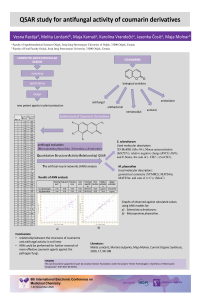
Modern strategy for the development of plant protection substances includes computer-aided molecular design as a rational approach used for screening, optimization, and the design of new potent agents in plant protection. Coumarins, secondary plant metabolites, and their derivatives demonstrated a wide range of biological activities on different organisms, as well as their applications in agriculture as eco-friendly plant protection agents. Coumarin derivatives have been reported as strong agents against pathogenic species of fungi. 46 Novel coumarin derivatives have been evaluated against four pathogen fungi (Macropomina phaseolina, Sclerotinia sclerotiorum, Fusarium oxysporum, Fusarium culmorum). Observed compounds have shown activity against two fungi, M. phaseolina, S. sclerotiorum. Quantitative structure-activity relationships (QSAR) analysis has been performed on obtained experimental data. Since the quality models were not obtained by multiple linear regression (MLR), the artificial neural networks (ANN) analysis was performed using four descriptors appearing in the best MLR models. For the antifungal activity against S. sclerotiorum, ANN analysis was performed using descriptors: 3D-MoRSE (Mor19v); Moran autocorrelation (MATS7v); relative negative charge (RNCG AM1); and E-States, the sum of (- CH2 -) (SssCH2), while for M. phaseolina: geometrical symmetry (SYMM2); MATS4m; MATS5m; and the sum of (= C<) (SdssC). Nonlinearities of the best ANN model compared with the linear model improved the coefficient of determination to 76.2 % for S. sclerotiorum and 93.6 % for M. phaseolina, and showed a better external predictive ability 92.44 % and 87.81 %, respectively. ANN could be performed for further research of more effective coumarin agents against the pathogen fungi.
Keywords
antifungal activity
artificial neural networks
coumarin
QSAR
Poster
Rastija 2020-06-03_2.ecmc-6_ecmc-5_Poster.pdf
Adamantane derivatives having heterocyclic and monoterpenoid residues as potent Tdp1 inhibitors
In vitro reactivation of chlorpyrifos-inhibited rat brain acetylcholinesterase from pyrazole-oxime derivatives