Event submissions
Published

This submission belongs to the session B. General: Posters of the event 6th International Electronic Conference on Medicinal Chemistry
Published date
06 Nov, 2020
Citation
Manjunath S Katagi, Girish Bolakatti, Sujatha ML, Suchitra M, Shivlingrao Mamledesai, In vitro reactivation of chlorpyrifos-inhibited rat brain acetylcholinesterase from pyrazole-oxime derivatives, in Proceedings of 6th International Electronic Conference on Medicinal Chemistry, 1 November–30 November 2020, MDPI: Basel, Switzerland, doi: 10.3390/ECMC2020-07376
Share
Email
Facebook
Twitter
LinkedIn
In vitro reactivation of chlorpyrifos-inhibited rat brain acetylcholinesterase from pyrazole-oxime derivatives
'%3e%3cpath%20d='M12.6647%2010.9104C12.4176%2010.325%2012.0589%209.7933%2011.6088%209.34485C11.16%208.89511%2010.6283%208.53653%2010.0432%208.28891C10.038%208.28629%2010.0327%208.28498%2010.0275%208.28236C10.8437%207.69282%2011.3743%206.73252%2011.3743%205.64907C11.3743%203.85423%209.92005%202.40002%208.12522%202.40002C6.33038%202.40002%204.87618%203.85423%204.87618%205.64907C4.87618%206.73252%205.40677%207.69282%206.22296%208.28367C6.21772%208.28629%206.21248%208.2876%206.20724%208.29022C5.62031%208.53783%205.09365%208.89287%204.64167%209.34616C4.19192%209.79496%203.83334%2010.3266%203.58573%2010.9117C3.34247%2011.4846%203.21128%2012.0987%203.19925%2012.721C3.1989%2012.735%203.20135%2012.7489%203.20646%2012.7619C3.21157%2012.7749%203.21924%2012.7868%203.22901%2012.7968C3.23877%2012.8068%203.25045%2012.8148%203.26334%2012.8202C3.27623%2012.8256%203.29007%2012.8284%203.30406%2012.8284H4.09012C4.14776%2012.8284%204.19362%2012.7825%204.19493%2012.7262C4.22113%2011.7148%204.62726%2010.7676%205.34519%2010.0497C6.08802%209.30686%207.07452%208.89811%208.12522%208.89811C9.17592%208.89811%2010.1624%209.30686%2010.9052%2010.0497C11.6232%2010.7676%2012.0293%2011.7148%2012.0555%2012.7262C12.0568%2012.7839%2012.1027%2012.8284%2012.1603%2012.8284H12.9464C12.9604%2012.8284%2012.9742%2012.8256%2012.9871%2012.8202C13%2012.8148%2013.0117%2012.8068%2013.0214%2012.7968C13.0312%2012.7868%2013.0389%2012.7749%2013.044%2012.7619C13.0491%2012.7489%2013.0515%2012.735%2013.0512%2012.721C13.0381%2012.0947%2012.9084%2011.4856%2012.6647%2010.9104ZM8.12522%207.90243C7.52388%207.90243%206.95792%207.66793%206.53214%207.24215C6.10636%206.81636%205.87185%206.2504%205.87185%205.64907C5.87185%205.04773%206.10636%204.48177%206.53214%204.05599C6.95792%203.63021%207.52388%203.3957%208.12522%203.3957C8.72655%203.3957%209.29252%203.63021%209.7183%204.05599C10.1441%204.48177%2010.3786%205.04773%2010.3786%205.64907C10.3786%206.2504%2010.1441%206.81636%209.7183%207.24215C9.29252%207.66793%208.72655%207.90243%208.12522%207.90243Z'%20fill='%235D1EE1'/%3e%3c/g%3e%3c/svg%3e)
Manjunath S Katagi 1
Girish Bolakatti 2
Sujatha ML 1
Suchitra M 1
Shivlingrao Mamledesai 3
1. Department of Pharmaceutical Chemistry, Bapuji Pharmacy College, Davangere, Karnataka.
2. Department of Pharmaceutical Chemistry, GM Institute of Pharmaceutical Sciences & Research, Davangere, Karnataka.
3. Department of Pharmaceutical Chemistry, PES’s Rajaram Tarabhai bhanderkar College of Pharmacy, Farmagudi-Ponda, Goa
Abstract
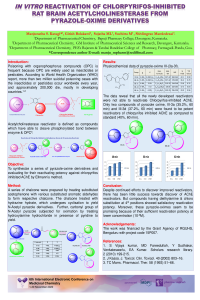
Background: The biological effects of organophosphorus (OP) compounds are connected with the irreversible inhibition of acetylcholinesterase (AChE), an important neuromediator acetylcholine (ACh) splitting enzyme in the human body at the synaptic clefts. Due to this inhibition, AChE is unable to fulfill its physiological function resulting in the accumulation of ACh, which in turn over stimulates the parasympathetic nerve receptors, and causes fatal cholinergic crisis.
Objective: To synthesize a series of pyrazole-oxime derivatives and to asses in vitro reactivating potency against chlorpyrifos-inhibited AChE.
Method: The titled derivatives were prepared by condensation, cyclisation and oximation using various substituted aromatic ketones and aldehydes. The structures of compounds were confirmed by physical and spectral analysis. The synthesized compounds were evaluated for their reactivation efficacy against chlorpyrifos-inhibited rat brain AChE by Ellmann’s method.
Results: The data reveal that all the newly developed reactivators were not able to reactivate chlorpyrifos-inhibited AChE. Only two compounds of pyrazole oxime, 1-(3-(4-aminophenyl)-5-(4-(dimethylamino)phenyl)-4,5-dihydropyrazol-1-yl)ethanon-oxime III-3a (35.2 %, 60 min) and 1-(3-(3-aminophenyl)-5-(4-chlorophenyl)-4,5-dihydropyrazol-1-yl)ethanon-oxime III-3d (37.2 %, 60 min) were found to be potent reactivators as compared to standard (40 %, 60 min).
Conclusion: Despite continued efforts to discover improved reactivators, there has been little success towards discover of AChE reactivators. But compounds having diethylamino & chloro substitution at 4th position showed satisfactory reactivation potency. Moreover, these pyrazole-oximes seem to be promising because of their sufficient reactivation potency at lower concentration (10-3 M).
Keywords
acetylcholinesterase
organophosphorus
pyrazole-oxime
Poster
Manjunath S. Katagi.pdf
QSAR study for antifungal activity of coumarin derivatives
Design, synthesis and biological screening of 2,4-dichlorothiazole-5-carboxaldehyde-derived chalcones as potential antitubercular and antiproliferative agents