Event submissions
Published

This submission belongs to the session B. General: Posters of the event 6th International Electronic Conference on Medicinal Chemistry
Published date
06 Nov, 2020
Citation
Ana Dolšak, Urban Švajger, Samo Lešnik, Janez Konc, Stanislav Gobec, Matej Sova, Discovery of novel selective TLR7 agonists based on chromeno[3,4-d]imidazol-4(1H)-one and 2-(trifluoromethyl)quinoline/ quinazoline-4-amine scaffold, in Proceedings of 6th International Electronic Conference on Medicinal Chemistry, 1 November–30 November 2020, MDPI: Basel, Switzerland, doi: 10.3390/ECMC2020-07382
Share
Email
Facebook
Twitter
LinkedIn
Discovery of novel selective TLR7 agonists based on chromeno[3,4-d]imidazol-4(1H)-one and 2-(trifluoromethyl)quinoline/ quinazoline-4-amine scaffold
'%3e%3cpath%20d='M12.6647%2010.9104C12.4176%2010.325%2012.0589%209.7933%2011.6088%209.34485C11.16%208.89511%2010.6283%208.53653%2010.0432%208.28891C10.038%208.28629%2010.0327%208.28498%2010.0275%208.28236C10.8437%207.69282%2011.3743%206.73252%2011.3743%205.64907C11.3743%203.85423%209.92005%202.40002%208.12522%202.40002C6.33038%202.40002%204.87618%203.85423%204.87618%205.64907C4.87618%206.73252%205.40677%207.69282%206.22296%208.28367C6.21772%208.28629%206.21248%208.2876%206.20724%208.29022C5.62031%208.53783%205.09365%208.89287%204.64167%209.34616C4.19192%209.79496%203.83334%2010.3266%203.58573%2010.9117C3.34247%2011.4846%203.21128%2012.0987%203.19925%2012.721C3.1989%2012.735%203.20135%2012.7489%203.20646%2012.7619C3.21157%2012.7749%203.21924%2012.7868%203.22901%2012.7968C3.23877%2012.8068%203.25045%2012.8148%203.26334%2012.8202C3.27623%2012.8256%203.29007%2012.8284%203.30406%2012.8284H4.09012C4.14776%2012.8284%204.19362%2012.7825%204.19493%2012.7262C4.22113%2011.7148%204.62726%2010.7676%205.34519%2010.0497C6.08802%209.30686%207.07452%208.89811%208.12522%208.89811C9.17592%208.89811%2010.1624%209.30686%2010.9052%2010.0497C11.6232%2010.7676%2012.0293%2011.7148%2012.0555%2012.7262C12.0568%2012.7839%2012.1027%2012.8284%2012.1603%2012.8284H12.9464C12.9604%2012.8284%2012.9742%2012.8256%2012.9871%2012.8202C13%2012.8148%2013.0117%2012.8068%2013.0214%2012.7968C13.0312%2012.7868%2013.0389%2012.7749%2013.044%2012.7619C13.0491%2012.7489%2013.0515%2012.735%2013.0512%2012.721C13.0381%2012.0947%2012.9084%2011.4856%2012.6647%2010.9104ZM8.12522%207.90243C7.52388%207.90243%206.95792%207.66793%206.53214%207.24215C6.10636%206.81636%205.87185%206.2504%205.87185%205.64907C5.87185%205.04773%206.10636%204.48177%206.53214%204.05599C6.95792%203.63021%207.52388%203.3957%208.12522%203.3957C8.72655%203.3957%209.29252%203.63021%209.7183%204.05599C10.1441%204.48177%2010.3786%205.04773%2010.3786%205.64907C10.3786%206.2504%2010.1441%206.81636%209.7183%207.24215C9.29252%207.66793%208.72655%207.90243%208.12522%207.90243Z'%20fill='%235D1EE1'/%3e%3c/g%3e%3c/svg%3e)
Ana Dolšak 1

Urban Švajger 2
Samo Lešnik 3
Janez Konc 3
Stanislav Gobec 4

Matej Sova 4
1. University of Ljubljana, Faculty of Pharmacy, Aškerčeva 7, 1000 Ljubljana, Slovenia
2. Blood Transfusion Centre of Slovenia, Šlajmerjeva 6, SI-1000 Ljubljana, Slovenia
3. National Institute of Chemistry, Hajdrihova 19, SI-1001 Ljubljana, Slovenia
4. University of Ljubljana, Faculty of Pharmacy, Aškerčeva 7, SI-1000 Ljubljana, Slovenia
Abstract
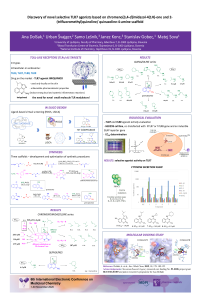
Toll-like receptors (TLRs) are pattern-recognition receptors involved in host cell recognition and initiation of immune responses against microbes. Among 10 functional TLRs identified in human, TLR7 and TLR8, which specifically recognize single-stranded RNAs, have been considered as emerging therapeutic targets for several life-threatening diseases, i.e. viral infections, autoimmune diseases and cancers.
In our study, two different ligand-based virtual screening protocols with imiquimod as a query compound were used for identification of novel TLR7 ligands. The first hit compound with potent TLR7 antagonist activity was 1-isobutylchromeno[3,4-d]imidazol-4(1H)-one, which was used a starting point for further exploration of the chemical space around the chromenoimidazolone scaffold. The synthesis of a small library of selected analogs led to the discovery of chromenoimidazolone-based TLR7 agonists with EC50 values in low micromolar range. The second in-house ligand-based virtual screening protocol LiSiCA was used for discovery of two hits TLR7 agonists that were topologically most similar to imiquimod, i.e. 2-(trifluoromethyl)quinolone and quinazoline derivatives. Synthesis of a focused library of analogs, biological evaluation on HEK293-hTLR7/8 cells, and docking studies provided systematic exploration of structure-activity relationship indicating that a secondary or tertiary amine with smaller flexible alkyl substituents or bulkier rigid aliphatic rings on the position 4 of 2-(trifluoromethyl)quinoline/ quinazoline scaffold is required for potent TLR7 agonist activity. N-Cyclopropyl-2-(trifluoromethyl)quinazolin-4-amine with EC50 of 16.8 µM was able to induce increased levels of proinflammatory cytokines IL-6 and IL-8. Our study demonstrated successful in-silico discovery and further synthesis of novel TLR7 over TLR8-selective compounds as promising chemical probes for development of small-molecule immunomodulators.
Keywords
agonists
small-molecule
synthesis
Toll-like receptors
virtual screening
Poster
2020-06-03_2.ecmc-6_ecmc-5_Poster_Sova.pdf
Dual- and multi-action Pt(IV) antitumor prodrugs or how to kill two birds with one stone
From LP2 to 2S-LP2: discovery of a biased dual-target mu/delta opioid receptor agonist for pain management