Event submissions
Published

This submission belongs to the session B. General: Posters of the event 6th International Electronic Conference on Medicinal Chemistry
Published date
06 Nov, 2020
Citation
Ibrahima Sory Sow, Michel Gelbcke, Franck Meyer, Dong Yang, Koen Robeyns, Véronique Fontaine, François Dufrasne, Synthesis and antibacterial, antimycobacterial and antifungal activities of the complexes of Fe(II), Fe(III), Cu(II), Zn(II) and Ni(II) of aliphatic hydroxamic acids, in Proceedings of 6th International Electronic Conference on Medicinal Chemistry, 1 November–30 November 2020, MDPI: Basel, Switzerland, doi: 10.3390/ECMC2020-07384
Share
Email
Facebook
Twitter
LinkedIn
Synthesis and antibacterial, antimycobacterial and antifungal activities of the complexes of Fe(II), Fe(III), Cu(II), Zn(II) and Ni(II) of aliphatic hydroxamic acids
'%3e%3cpath%20d='M12.6647%2010.9104C12.4176%2010.325%2012.0589%209.7933%2011.6088%209.34485C11.16%208.89511%2010.6283%208.53653%2010.0432%208.28891C10.038%208.28629%2010.0327%208.28498%2010.0275%208.28236C10.8437%207.69282%2011.3743%206.73252%2011.3743%205.64907C11.3743%203.85423%209.92005%202.40002%208.12522%202.40002C6.33038%202.40002%204.87618%203.85423%204.87618%205.64907C4.87618%206.73252%205.40677%207.69282%206.22296%208.28367C6.21772%208.28629%206.21248%208.2876%206.20724%208.29022C5.62031%208.53783%205.09365%208.89287%204.64167%209.34616C4.19192%209.79496%203.83334%2010.3266%203.58573%2010.9117C3.34247%2011.4846%203.21128%2012.0987%203.19925%2012.721C3.1989%2012.735%203.20135%2012.7489%203.20646%2012.7619C3.21157%2012.7749%203.21924%2012.7868%203.22901%2012.7968C3.23877%2012.8068%203.25045%2012.8148%203.26334%2012.8202C3.27623%2012.8256%203.29007%2012.8284%203.30406%2012.8284H4.09012C4.14776%2012.8284%204.19362%2012.7825%204.19493%2012.7262C4.22113%2011.7148%204.62726%2010.7676%205.34519%2010.0497C6.08802%209.30686%207.07452%208.89811%208.12522%208.89811C9.17592%208.89811%2010.1624%209.30686%2010.9052%2010.0497C11.6232%2010.7676%2012.0293%2011.7148%2012.0555%2012.7262C12.0568%2012.7839%2012.1027%2012.8284%2012.1603%2012.8284H12.9464C12.9604%2012.8284%2012.9742%2012.8256%2012.9871%2012.8202C13%2012.8148%2013.0117%2012.8068%2013.0214%2012.7968C13.0312%2012.7868%2013.0389%2012.7749%2013.044%2012.7619C13.0491%2012.7489%2013.0515%2012.735%2013.0512%2012.721C13.0381%2012.0947%2012.9084%2011.4856%2012.6647%2010.9104ZM8.12522%207.90243C7.52388%207.90243%206.95792%207.66793%206.53214%207.24215C6.10636%206.81636%205.87185%206.2504%205.87185%205.64907C5.87185%205.04773%206.10636%204.48177%206.53214%204.05599C6.95792%203.63021%207.52388%203.3957%208.12522%203.3957C8.72655%203.3957%209.29252%203.63021%209.7183%204.05599C10.1441%204.48177%2010.3786%205.04773%2010.3786%205.64907C10.3786%206.2504%2010.1441%206.81636%209.7183%207.24215C9.29252%207.66793%208.72655%207.90243%208.12522%207.90243Z'%20fill='%235D1EE1'/%3e%3c/g%3e%3c/svg%3e)
Ibrahima Sory Sow 1
Michel Gelbcke 1

Franck Meyer 1

Dong Yang 1
Koen Robeyns 2

Véronique Fontaine 1

François Dufrasne 1
1. Université Libre de Bruxelles, Faculté de Pharmacie, Unité de Microbiologie, Chimie Bioorganique et Macromoléculaire
2. Université Catholique de Louvain, Institute of Condensed Matter and Nanosciences, Molecular Structural Analysis
Abstract
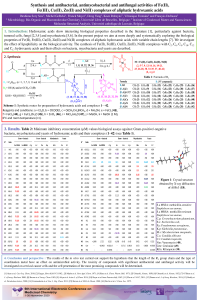
Aliphatic hydroxamic acids (AHAs) at C2, C6, C8, C10, C12, C17 and their metal complexes (Fe(II), Fe(III), Cu(II), Zn(II) and Ni(II)) have been synthesized. The compounds have been characterized by 1H- and 13C-NMR, and infrared spectroscopy, and the complexes have been further studied by UV spectroscopy, mass spectrometry, Karl Fischer titration, cyclic voltammetry and X-ray diffraction. The biological activity of the compounds has been evaluated using various microorganism, including bacteria (3 Gram-positive and 3 Gram-negative), 1 strain of mycobacteria and 2 strains of fungi by microdilution method. Regarding AHAs, HA12 displayed the best minimum inhibitory concentration (MIC) for several microbial strains in the study. The zinc complexes, as well as ZnCl2 itself, showed a lower MIC than their iron counterparts on E. coli . Copper, zinc and nickel complexes of HA12 have showed a very interesting antifungal effect on C. albicans. Finally, the toxicity of compounds with significant antibacterial and antifungal activity has been assessed on cervical cancer cells. These results need further studies to assess the potential interest of these compounds in medicine.
Keywords
aliphatic hydroxamic acids
antimicrobial
complexes
cytotoxicity
Poster
Poster_VF_Template_Sciforum6th.pdf
From LP2 to 2S-LP2: discovery of a biased dual-target mu/delta opioid receptor agonist for pain management
Synthesis and biological evaluation of mono- and tri-heterocyclic azole derivatives as anticancer agents