Event submissions
Published

This submission belongs to the session B. General: Posters of the event 6th International Electronic Conference on Medicinal Chemistry
Published date
06 Nov, 2020
Citation
Agnieszka Zagórska, Anna Czopek, Magdalena Mielczarek-Puta, Marta Struga, Marek Bajda, Synthesis and biological evaluation of mono- and tri-heterocyclic azole derivatives as anticancer agents, in Proceedings of 6th International Electronic Conference on Medicinal Chemistry, 1 November–30 November 2020, MDPI: Basel, Switzerland, doi: 10.3390/ECMC2020-07385
Share
Email
Facebook
Twitter
LinkedIn
Synthesis and biological evaluation of mono- and tri-heterocyclic azole derivatives as anticancer agents

Agnieszka Zagórska 1
'%3e%3cpath%20d='M12.6647%2010.9104C12.4176%2010.325%2012.0589%209.7933%2011.6088%209.34485C11.16%208.89511%2010.6283%208.53653%2010.0432%208.28891C10.038%208.28629%2010.0327%208.28498%2010.0275%208.28236C10.8437%207.69282%2011.3743%206.73252%2011.3743%205.64907C11.3743%203.85423%209.92005%202.40002%208.12522%202.40002C6.33038%202.40002%204.87618%203.85423%204.87618%205.64907C4.87618%206.73252%205.40677%207.69282%206.22296%208.28367C6.21772%208.28629%206.21248%208.2876%206.20724%208.29022C5.62031%208.53783%205.09365%208.89287%204.64167%209.34616C4.19192%209.79496%203.83334%2010.3266%203.58573%2010.9117C3.34247%2011.4846%203.21128%2012.0987%203.19925%2012.721C3.1989%2012.735%203.20135%2012.7489%203.20646%2012.7619C3.21157%2012.7749%203.21924%2012.7868%203.22901%2012.7968C3.23877%2012.8068%203.25045%2012.8148%203.26334%2012.8202C3.27623%2012.8256%203.29007%2012.8284%203.30406%2012.8284H4.09012C4.14776%2012.8284%204.19362%2012.7825%204.19493%2012.7262C4.22113%2011.7148%204.62726%2010.7676%205.34519%2010.0497C6.08802%209.30686%207.07452%208.89811%208.12522%208.89811C9.17592%208.89811%2010.1624%209.30686%2010.9052%2010.0497C11.6232%2010.7676%2012.0293%2011.7148%2012.0555%2012.7262C12.0568%2012.7839%2012.1027%2012.8284%2012.1603%2012.8284H12.9464C12.9604%2012.8284%2012.9742%2012.8256%2012.9871%2012.8202C13%2012.8148%2013.0117%2012.8068%2013.0214%2012.7968C13.0312%2012.7868%2013.0389%2012.7749%2013.044%2012.7619C13.0491%2012.7489%2013.0515%2012.735%2013.0512%2012.721C13.0381%2012.0947%2012.9084%2011.4856%2012.6647%2010.9104ZM8.12522%207.90243C7.52388%207.90243%206.95792%207.66793%206.53214%207.24215C6.10636%206.81636%205.87185%206.2504%205.87185%205.64907C5.87185%205.04773%206.10636%204.48177%206.53214%204.05599C6.95792%203.63021%207.52388%203.3957%208.12522%203.3957C8.72655%203.3957%209.29252%203.63021%209.7183%204.05599C10.1441%204.48177%2010.3786%205.04773%2010.3786%205.64907C10.3786%206.2504%2010.1441%206.81636%209.7183%207.24215C9.29252%207.66793%208.72655%207.90243%208.12522%207.90243Z'%20fill='%235D1EE1'/%3e%3c/g%3e%3c/svg%3e)
Anna Czopek 2
Magdalena Mielczarek-Puta 3
Marta Struga 3
Marek Bajda 4
1. Faculty of Pharmacy, Chair of Medicinal Chemistry, Jagiellonian University Medical College, 9 Medyczna Street, 30-688 Kraków, Poland
2. Department of Medicinal Chemistry, Jagiellonian University Medical College
Medyczna 9 Str, 30-688 Kraków, Poland
3. Chair and Department of Biochemistry, Medical University of Warsaw, Poland
4. Department of Physicochemical Drug Analysis, Jagiellonian University Medical College
Abstract
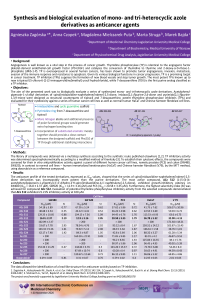
The aim of the presented work was to biologically evaluate a series of synthesized mono- and tri-heterocyclic azole derivatives. Acetylphenyl-piperazin-1-yl-alkyl derivatives of spiro[imidazolidine-naphthalene/indene]-2,5-dione, imidazo[2,1-f]purine-2,4-dione and pyrimido[2,1-f]purine-1,3,9-trione were designed as structural counterparts of tipiracil and 7-deazaxanthine, potent thymidine phosphorylase inhibitors (TPIs). The library of compounds was obtained via a multistep synthesis according to the synthetic route published elsewhere. TP inhibitory activity was determined spectrophotometrically according to a modified method of Krenitsky. To establish their cytotoxic effects, the compounds were screened for their in vitro antiproliferative activity against a panel of different human cancer cell lines, namely prostate (PC3) and colon (SW480, SW620), in contrast to normal cell lines – human endothelial microvascular cells (HMEC) and Chinese hamster fibroblast (V79), by the MTT method, using doxorubicin as a reference compound. The anticancer profile of the tested derivatives, expressed as IC50 values, showed that the series of spiro[imidazolidyne-naphthalene/indene]-2,5-dione derivatives was incomparably more potent than the purine derivatives. The most active compound (ACz 512) exhibited growth-inhibitory potency on SW480 (IC50 = 16.8 ± 2.37 µM), SW620 (IC50 = 12.9 ± 3.16 µM) and PC3 (IC50 = 20.58 ± 3.35 µM). Furthermore, the highest selectivity index (SI) was achieved for compound ACz 512. Cell viability of 50% was observed above 100 µM for ACz 512 with HMEC cells. Evaluation of potential TP inhibitory activity from the selected compounds demonstrated that ACz 512 exhibited low activity (21.21% of inhibition, 100 μM). The data allowed the identification of a lead-like structure for anticancer activity based on TP inhibition.
Keywords
anticancer
cytotoxic
thymidine phosphorylase inhibitors
Poster
Zagórska poster.pdf
Synthesis and antibacterial, antimycobacterial and antifungal activities of the complexes of Fe(II), Fe(III), Cu(II), Zn(II) and Ni(II) of aliphatic hydroxamic acids
Targeting CK1 isoforms in colon and rectal cancer: Initial steps towards the development of CK1 mutant-specific inhibitors