Event submissions
Published

This submission belongs to the session B. General: Posters of the event 6th International Electronic Conference on Medicinal Chemistry
Published date
06 Nov, 2020
Citation
Beniamin Oskar Grabarek, Dominika Wcisło-Dziadecka, Jakub Krzaczyński, Agnieszka Gancarczyk, Anita Lyssek-Boroń, Evaluation of differences in the expression of TNF, TNFR1, TNFR2 and dermatological scales under conventional and anti-cytokine therapy of psoriasis, in Proceedings of 6th International Electronic Conference on Medicinal Chemistry, 1 November–30 November 2020, MDPI: Basel, Switzerland, doi: 10.3390/ECMC2020-07387
Share
Email
Facebook
Twitter
LinkedIn
Evaluation of differences in the expression of TNF, TNFR1, TNFR2 and dermatological scales under conventional and anti-cytokine therapy of psoriasis
'%3e%3cpath%20d='M12.6647%2010.9104C12.4176%2010.325%2012.0589%209.7933%2011.6088%209.34485C11.16%208.89511%2010.6283%208.53653%2010.0432%208.28891C10.038%208.28629%2010.0327%208.28498%2010.0275%208.28236C10.8437%207.69282%2011.3743%206.73252%2011.3743%205.64907C11.3743%203.85423%209.92005%202.40002%208.12522%202.40002C6.33038%202.40002%204.87618%203.85423%204.87618%205.64907C4.87618%206.73252%205.40677%207.69282%206.22296%208.28367C6.21772%208.28629%206.21248%208.2876%206.20724%208.29022C5.62031%208.53783%205.09365%208.89287%204.64167%209.34616C4.19192%209.79496%203.83334%2010.3266%203.58573%2010.9117C3.34247%2011.4846%203.21128%2012.0987%203.19925%2012.721C3.1989%2012.735%203.20135%2012.7489%203.20646%2012.7619C3.21157%2012.7749%203.21924%2012.7868%203.22901%2012.7968C3.23877%2012.8068%203.25045%2012.8148%203.26334%2012.8202C3.27623%2012.8256%203.29007%2012.8284%203.30406%2012.8284H4.09012C4.14776%2012.8284%204.19362%2012.7825%204.19493%2012.7262C4.22113%2011.7148%204.62726%2010.7676%205.34519%2010.0497C6.08802%209.30686%207.07452%208.89811%208.12522%208.89811C9.17592%208.89811%2010.1624%209.30686%2010.9052%2010.0497C11.6232%2010.7676%2012.0293%2011.7148%2012.0555%2012.7262C12.0568%2012.7839%2012.1027%2012.8284%2012.1603%2012.8284H12.9464C12.9604%2012.8284%2012.9742%2012.8256%2012.9871%2012.8202C13%2012.8148%2013.0117%2012.8068%2013.0214%2012.7968C13.0312%2012.7868%2013.0389%2012.7749%2013.044%2012.7619C13.0491%2012.7489%2013.0515%2012.735%2013.0512%2012.721C13.0381%2012.0947%2012.9084%2011.4856%2012.6647%2010.9104ZM8.12522%207.90243C7.52388%207.90243%206.95792%207.66793%206.53214%207.24215C6.10636%206.81636%205.87185%206.2504%205.87185%205.64907C5.87185%205.04773%206.10636%204.48177%206.53214%204.05599C6.95792%203.63021%207.52388%203.3957%208.12522%203.3957C8.72655%203.3957%209.29252%203.63021%209.7183%204.05599C10.1441%204.48177%2010.3786%205.04773%2010.3786%205.64907C10.3786%206.2504%2010.1441%206.81636%209.7183%207.24215C9.29252%207.66793%208.72655%207.90243%208.12522%207.90243Z'%20fill='%235D1EE1'/%3e%3c/g%3e%3c/svg%3e)
Beniamin Oskar Grabarek 1,2
Dominika Wcisło-Dziadecka 3
Jakub Krzaczyński 4
Agnieszka Gancarczyk 3
Anita Lyssek-Boroń 5
1. Department of Histology, Cytophysiology and Embryology, Faculty of Medicine in Zabrze, Academy of Silesia, 40-555 Katowice, Poland
2. Department of Neurosurgery, 5th Military Clinical Hospital with the SP ZOZ Polyclinic in Krakow, 30-901 Krakow, Poland
3. Department of Cosmetology, Faculty of Pharmaceutical Sciences in Sosnowiec, Medical University of Silesia in Katowice, Poland
4. Department of Histology, Cytophysiology and Embryology, Faculty of Medicine in Zabrze, University of Technology in Katowice, Poland
5. Department of Ophthalmology, Faculty of Medicine in Zabrze, University of Technology in Katowice, Poland
Abstract
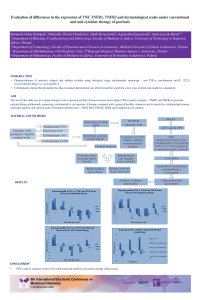
Pharmacotherapy of psoriasis vulgaris and arthritis includes using anti-cytokine or conventional drugs Unfortunately, during this treatment, the drug-resistance phenomenon was observed and the search for a new class of molecular markers is mandatory. The aim of this study was to evaluate changes in the expression profile of TNF-α and its receptor – TNFR1 and TNFR2 in psoriatic patients during adalimumab, etanercept, ustekinumab or cyclosporine A therapy and clinical scales of treatment effectiveness – PASI, BSA, DAS28, DLQI. The study group consisted of whole blood and serum from psoriatic patients during adalimumab, etanercept, ustekinumab or cyclosporine A pharmacotherapy. Each of these subgroups consisted of 30 patients. Follow-ups were made after 4 years. RTqPCR and MALDI-TOF spectrometry were used. PASI, BSA, DAS28, and DLQI scales were evaluated in each group. HaCaT were exposed to 1µg/ml LPS)in order to induce inflammation and next were treated with adalimumab (8µg/ml) or cyclosporine A (100 ng/ml) for 2, 24 and 48 hours in comparison to untreated cells. To determine the expression of analyzed genes in different microarrays, the ELISA and Western blot tests were performed. The analysis showed that all used drugs changed the expression profile of selected genes at the mRNA and protein level. It An in vitro study confirmed the assessment that drugs act via TNF-α signal paths. Regardless of the drug, the highest differences in the expression of these genes was observed after 2 hours compared to a control. TNF-α and its receptors seem to be useful molecular markers of psoriasis therapy effectiveness.
Keywords
anti-cytokine drugs
cyclosporine A
drug resistance
keratinocytes
psoriasis
Poster
Grabarek et al 1.pdf
Targeting CK1 isoforms in colon and rectal cancer: Initial steps towards the development of CK1 mutant-specific inhibitors
Redox-active antifungals that target stress defense system in fungi