Event submissions
Published

This submission belongs to the session B. General: Posters of the event 6th International Electronic Conference on Medicinal Chemistry
Published date
06 Nov, 2020
Citation
Dmitry Yaroslavtsev, Anastasiya Solovieva, Anastasiya Kotlyarova, German Baykalov, Konstantin Ershov, Pavel Madonov, L-arginine delivery based on peptide-like polymeric molecules contributes to changes in nitric oxide biosynthesis and vascular tone, in Proceedings of 6th International Electronic Conference on Medicinal Chemistry, 1 November–30 November 2020, MDPI: Basel, Switzerland, doi: 10.3390/ECMC2020-07389
Share
Email
Facebook
Twitter
LinkedIn
L-arginine delivery based on peptide-like polymeric molecules contributes to changes in nitric oxide biosynthesis and vascular tone
'%3e%3cpath%20d='M12.6647%2010.9104C12.4176%2010.325%2012.0589%209.7933%2011.6088%209.34485C11.16%208.89511%2010.6283%208.53653%2010.0432%208.28891C10.038%208.28629%2010.0327%208.28498%2010.0275%208.28236C10.8437%207.69282%2011.3743%206.73252%2011.3743%205.64907C11.3743%203.85423%209.92005%202.40002%208.12522%202.40002C6.33038%202.40002%204.87618%203.85423%204.87618%205.64907C4.87618%206.73252%205.40677%207.69282%206.22296%208.28367C6.21772%208.28629%206.21248%208.2876%206.20724%208.29022C5.62031%208.53783%205.09365%208.89287%204.64167%209.34616C4.19192%209.79496%203.83334%2010.3266%203.58573%2010.9117C3.34247%2011.4846%203.21128%2012.0987%203.19925%2012.721C3.1989%2012.735%203.20135%2012.7489%203.20646%2012.7619C3.21157%2012.7749%203.21924%2012.7868%203.22901%2012.7968C3.23877%2012.8068%203.25045%2012.8148%203.26334%2012.8202C3.27623%2012.8256%203.29007%2012.8284%203.30406%2012.8284H4.09012C4.14776%2012.8284%204.19362%2012.7825%204.19493%2012.7262C4.22113%2011.7148%204.62726%2010.7676%205.34519%2010.0497C6.08802%209.30686%207.07452%208.89811%208.12522%208.89811C9.17592%208.89811%2010.1624%209.30686%2010.9052%2010.0497C11.6232%2010.7676%2012.0293%2011.7148%2012.0555%2012.7262C12.0568%2012.7839%2012.1027%2012.8284%2012.1603%2012.8284H12.9464C12.9604%2012.8284%2012.9742%2012.8256%2012.9871%2012.8202C13%2012.8148%2013.0117%2012.8068%2013.0214%2012.7968C13.0312%2012.7868%2013.0389%2012.7749%2013.044%2012.7619C13.0491%2012.7489%2013.0515%2012.735%2013.0512%2012.721C13.0381%2012.0947%2012.9084%2011.4856%2012.6647%2010.9104ZM8.12522%207.90243C7.52388%207.90243%206.95792%207.66793%206.53214%207.24215C6.10636%206.81636%205.87185%206.2504%205.87185%205.64907C5.87185%205.04773%206.10636%204.48177%206.53214%204.05599C6.95792%203.63021%207.52388%203.3957%208.12522%203.3957C8.72655%203.3957%209.29252%203.63021%209.7183%204.05599C10.1441%204.48177%2010.3786%205.04773%2010.3786%205.64907C10.3786%206.2504%2010.1441%206.81636%209.7183%207.24215C9.29252%207.66793%208.72655%207.90243%208.12522%207.90243Z'%20fill='%235D1EE1'/%3e%3c/g%3e%3c/svg%3e)
Dmitry Yaroslavtsev 1

Anastasiya Solovieva 1
Anastasiya Kotlyarova 1,2
German Baykalov 1
Konstantin Ershov 3
Pavel Madonov 1
1. Department of Experimental Pharmacology, Research Institute of Clinical and Experimental Lymphology - a branch of the Institute of Cytology and Genetics of Siberian Branch of Russian Academy of Sciences, Acad. Timakova str., 2, 630060, Novosibirsk, Russia
2. Department of Medicinal Chemistry, Novosibirsk Institute of Organic Chemistry of Siberian Branch of Russian Academy of Sciences, Lavrentjev av. 9, 630090, Novosibirsk, Russia
3. Department of pharmacology, clinical pharmacology, and evidential medicine, Novosibirsk State Medical University, Krasny Prospect 5, 630091, Novosibirsk, Russia
Abstract
[Background / Aims]
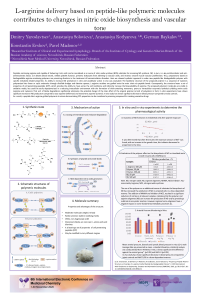
Peptides containing arginine and capable of delivering it into cells can be considered as a source of nitric oxide synthase (NOS) substrate for increasing NO synthesis. NO, in turn, is a key antithrombotic and anti-atherosclerotic factor. Thus, preparations based on biodegradable arginine-containing polymers are a promising direction in the treatment of hemocirculation disorders. Here we showed a synthetic approach to make a new peptide-like biodegradable polymer with specific metabolic-related properties. Its ability to increase NO production in vitro and vasodilator action in vivo was evaluated.
[Results]
The backbone structure of the proposed polymer is a sequence of cysteines polymerized into linear or cyclic molecules through disulfide bridges and diamine spacers; L-arginine residues are grafted onto the main chain via peptide bonds. Consequently, the structure bears a set of properties of cell-penetrating peptides (CPP), which provides the ability to move across the cell membrane and indirectly increase the bioavailability of arginine. The proposed polymeric molecules are stable in oxidative media but could be easily depolymerized in a reducing intracellular environment with the formation of thiol-containing monomers, prone to intracellular enzymatic hydrolysis yielding amino acids (arginine and cysteine). In vitro experiments have shown a significant increase in NO production compared to octa-arginine (reference) and monomeric arginine (control). In vivo study has shown a significant decrease in blood pressure compared to intact controls.
As a result, a peptide-like L-arginine grafted polymeric structure demonstrating CPP-properties can be considered a promising compound for creating vasoactive drugs.
Keywords
L-arginine
biodegradable polymer
cell penetrating peptides
nitric oxide
Poster
Poster_Polymer_ed.pdf
Redox-active antifungals that target stress defense system in fungi
Exploring kinase inhibition properties of 9H-pyrimido[5,4-b]- and [4,5-b]indol-4-amine derivatives