Event submissions
Published

This submission belongs to the session B. General: Posters of the event 6th International Electronic Conference on Medicinal Chemistry
Published date
06 Nov, 2020
Citation
Marine Duplantier, Elodie Lohou, Pascal Sonnet, Development of new 2-heteroaryl-4-quinolones as potential antivirulence agents targeting multi-drug resistant ESKAPEE pathogens, in Proceedings of 6th International Electronic Conference on Medicinal Chemistry, 1 November–30 November 2020, MDPI: Basel, Switzerland, doi: 10.3390/ECMC2020-07396
Share
Email
Facebook
Twitter
LinkedIn
Development of new 2-heteroaryl-4-quinolones as potential antivirulence agents targeting multi-drug resistant ESKAPEE pathogens
'%3e%3cpath%20d='M12.6647%2010.9104C12.4176%2010.325%2012.0589%209.7933%2011.6088%209.34485C11.16%208.89511%2010.6283%208.53653%2010.0432%208.28891C10.038%208.28629%2010.0327%208.28498%2010.0275%208.28236C10.8437%207.69282%2011.3743%206.73252%2011.3743%205.64907C11.3743%203.85423%209.92005%202.40002%208.12522%202.40002C6.33038%202.40002%204.87618%203.85423%204.87618%205.64907C4.87618%206.73252%205.40677%207.69282%206.22296%208.28367C6.21772%208.28629%206.21248%208.2876%206.20724%208.29022C5.62031%208.53783%205.09365%208.89287%204.64167%209.34616C4.19192%209.79496%203.83334%2010.3266%203.58573%2010.9117C3.34247%2011.4846%203.21128%2012.0987%203.19925%2012.721C3.1989%2012.735%203.20135%2012.7489%203.20646%2012.7619C3.21157%2012.7749%203.21924%2012.7868%203.22901%2012.7968C3.23877%2012.8068%203.25045%2012.8148%203.26334%2012.8202C3.27623%2012.8256%203.29007%2012.8284%203.30406%2012.8284H4.09012C4.14776%2012.8284%204.19362%2012.7825%204.19493%2012.7262C4.22113%2011.7148%204.62726%2010.7676%205.34519%2010.0497C6.08802%209.30686%207.07452%208.89811%208.12522%208.89811C9.17592%208.89811%2010.1624%209.30686%2010.9052%2010.0497C11.6232%2010.7676%2012.0293%2011.7148%2012.0555%2012.7262C12.0568%2012.7839%2012.1027%2012.8284%2012.1603%2012.8284H12.9464C12.9604%2012.8284%2012.9742%2012.8256%2012.9871%2012.8202C13%2012.8148%2013.0117%2012.8068%2013.0214%2012.7968C13.0312%2012.7868%2013.0389%2012.7749%2013.044%2012.7619C13.0491%2012.7489%2013.0515%2012.735%2013.0512%2012.721C13.0381%2012.0947%2012.9084%2011.4856%2012.6647%2010.9104ZM8.12522%207.90243C7.52388%207.90243%206.95792%207.66793%206.53214%207.24215C6.10636%206.81636%205.87185%206.2504%205.87185%205.64907C5.87185%205.04773%206.10636%204.48177%206.53214%204.05599C6.95792%203.63021%207.52388%203.3957%208.12522%203.3957C8.72655%203.3957%209.29252%203.63021%209.7183%204.05599C10.1441%204.48177%2010.3786%205.04773%2010.3786%205.64907C10.3786%206.2504%2010.1441%206.81636%209.7183%207.24215C9.29252%207.66793%208.72655%207.90243%208.12522%207.90243Z'%20fill='%235D1EE1'/%3e%3c/g%3e%3c/svg%3e)
Marine Duplantier 1

Elodie Lohou 1

Pascal Sonnet 1
1. AGIR, UR4294, UFR of Pharmacy, Jules Verne University of Picardie, 80037 Amiens, France
Abstract
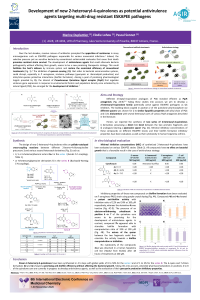
Over the last decades, massive misuse of antibiotics prompted the apparition of resistances in many microorganisms such as ESKAPEE pathogens responsible for various nosocomial infections. Indeed, the selective pressure put on sensitive bacteria by conventional antimicrobial molecules that cause their death promotes resistant strain survival. The development of antivirulence agents that could attenuate bacteria pathogenicity without affecting their growth, seems to be a new promising therapeutic strategy. This could facilitate the host’s defence by immune system and restore the associated efficiency of conventional treatments.
The inhibition of quorum sensing (QS) that refers to bacterial communication systems, could disrupt, especially in P. aeruginosa, virulence pathways (synthesis of pyocyanin or rhamnolipids) and intra/inter-species protective interactions (biofilm formation). Among a pool of promising pharmacological targets provided by QS, the interest of Pseudomonas Quinolone Signal receptor (PqsR) that regulates virulence gene expression in response to environmental factors and population density once activated by its natural ligand (PQS), has emerged for the development of inhibitors. Several 2-heptyl-4-quinolone analogues of PQS, recently described in the literature, revealed efficient as PqsR antagonists.
Taking these studies into account, we aim to develop a new 2‑heteroaryl‑4‑quinolone family potentially active against ESKAPEE pathogens as QS inhibitors. The synthesis pathways based on pallado-catalyzed coupling reactions, but also the physicochemical and biological evaluations of these compounds (MIC in various ESKAPEE strains and biofilm formation inhibitory properties) will be described in the presentation.
Keywords
antivirulence agents
ESKAPEE pathogens
pallado-catalysed cross-coupling reactions
quinolones
quorum sensing
Poster
ECMC-6_Poster_Marine_Duplantier.pdf
Design, synthesis, and biological evaluation of 1,2,3-triazole-linked triazino[5,6-b]indole-benzene sulfonamide conjugates as potent carbonic anhydrase I, II, IX , and XIII inhibitors
Synthesis and biological evaluation of new enantiopure 4-aminoalcohol-quinoline and -fluorene hybrids as antimalarial drugs