Event submissions
Published

This submission belongs to the session B. General: Posters of the event 6th International Electronic Conference on Medicinal Chemistry
Published date
06 Nov, 2020
Citation
Sabina Podlewska, Rafał Kafel, Optimization of compounds ADMET properties via machine-learning-based tools, in Proceedings of 6th International Electronic Conference on Medicinal Chemistry, 1 November–30 November 2020, MDPI: Basel, Switzerland, doi: 10.3390/ECMC2020-07401
Share
Email
Facebook
Twitter
LinkedIn
Optimization of compounds ADMET properties via machine-learning-based tools

Sabina Podlewska 1
'%3e%3cpath%20d='M12.6647%2010.9104C12.4176%2010.325%2012.0589%209.7933%2011.6088%209.34485C11.16%208.89511%2010.6283%208.53653%2010.0432%208.28891C10.038%208.28629%2010.0327%208.28498%2010.0275%208.28236C10.8437%207.69282%2011.3743%206.73252%2011.3743%205.64907C11.3743%203.85423%209.92005%202.40002%208.12522%202.40002C6.33038%202.40002%204.87618%203.85423%204.87618%205.64907C4.87618%206.73252%205.40677%207.69282%206.22296%208.28367C6.21772%208.28629%206.21248%208.2876%206.20724%208.29022C5.62031%208.53783%205.09365%208.89287%204.64167%209.34616C4.19192%209.79496%203.83334%2010.3266%203.58573%2010.9117C3.34247%2011.4846%203.21128%2012.0987%203.19925%2012.721C3.1989%2012.735%203.20135%2012.7489%203.20646%2012.7619C3.21157%2012.7749%203.21924%2012.7868%203.22901%2012.7968C3.23877%2012.8068%203.25045%2012.8148%203.26334%2012.8202C3.27623%2012.8256%203.29007%2012.8284%203.30406%2012.8284H4.09012C4.14776%2012.8284%204.19362%2012.7825%204.19493%2012.7262C4.22113%2011.7148%204.62726%2010.7676%205.34519%2010.0497C6.08802%209.30686%207.07452%208.89811%208.12522%208.89811C9.17592%208.89811%2010.1624%209.30686%2010.9052%2010.0497C11.6232%2010.7676%2012.0293%2011.7148%2012.0555%2012.7262C12.0568%2012.7839%2012.1027%2012.8284%2012.1603%2012.8284H12.9464C12.9604%2012.8284%2012.9742%2012.8256%2012.9871%2012.8202C13%2012.8148%2013.0117%2012.8068%2013.0214%2012.7968C13.0312%2012.7868%2013.0389%2012.7749%2013.044%2012.7619C13.0491%2012.7489%2013.0515%2012.735%2013.0512%2012.721C13.0381%2012.0947%2012.9084%2011.4856%2012.6647%2010.9104ZM8.12522%207.90243C7.52388%207.90243%206.95792%207.66793%206.53214%207.24215C6.10636%206.81636%205.87185%206.2504%205.87185%205.64907C5.87185%205.04773%206.10636%204.48177%206.53214%204.05599C6.95792%203.63021%207.52388%203.3957%208.12522%203.3957C8.72655%203.3957%209.29252%203.63021%209.7183%204.05599C10.1441%204.48177%2010.3786%205.04773%2010.3786%205.64907C10.3786%206.2504%2010.1441%206.81636%209.7183%207.24215C9.29252%207.66793%208.72655%207.90243%208.12522%207.90243Z'%20fill='%235D1EE1'/%3e%3c/g%3e%3c/svg%3e)
Rafał Kafel 1
1. Maj Institute of Pharmacology Polish Academy of Sciences, Smetna Street 12, 31-343 Krakow
Abstract
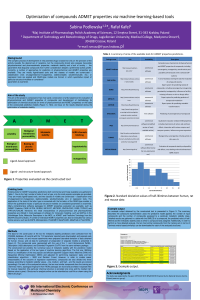
Computational strategies are an indispensable part of all drug design campaigns, facilitating both the search for new drug candidates, as well as the optimization of their physicochemical and pharmacokinetic properties. Thanks to the construction of various databases gathering results on compound bioactivities and properties, the constructed computational models are constantly improved and are less prone to bias connected with the coverage of limited chemical space by the training set.
Evaluation of compound ADMET properties is not less important that the determination of its activity profile. There is already a wide range of approaches available for in silico compound evaluation in terms of its ADMET profile. These are mostly ligand-based tools with two types of assessment made – they provide binary information based on the classification model (stable/unstable, soluble/insoluble, etc.) or they return predicted numerical value of evaluated parameter when regression strategy is applied.
In the study, we combined ML-based tools not only to evaluate selected compound properties (solubility, metabolic stability, biological membranes permeability, hERG channels blocking, and mutagenicity), but we also provide a tool for optimization of a compound structure in terms of evaluated property. The approach makes evaluation of an input structure and automatically generates its derivatives. They are then also assessed by the model and the compounds are ranked according to the obtained values.
Acknowledgments : The study was supported by the grant OPUS 2018/31/B/NZ2/00165 financed by the National Science Centre, Poland (www.ncn.gov.pl).
Keywords
ADMET
computer-aided drug design
drug discovery
ligand-based methods
machine learning
Poster
Poster_IECMC_forum_SP.pdf
SLMP53-1 inhibits tumor cell growth through regulation of glucose metabolism and angiogenesis in a P53-dependent manner
A combined experimental and theoretical study of an oxalato-bridged copper(II) complex: Crystal structure and Hirshfeld surface analysis of the non-covalent interactions