Event submissions
Published

This submission belongs to the session C. General: Presentations of the event 6th International Electronic Conference on Medicinal Chemistry
Published date
06 Nov, 2020
Citation
Hana Michnová, Tomas Strharsky, Sarka Pospisilova, Jiri Kos, Alois Cizek, Josef Jampilek, Anti-infective activity of selected trifluoromethyl-substituted N-arylcinnamamides, in Proceedings of 6th International Electronic Conference on Medicinal Chemistry, 1 November–30 November 2020, MDPI: Basel, Switzerland, doi: 10.3390/ECMC2020-07404
Share
Email
Facebook
Twitter
LinkedIn
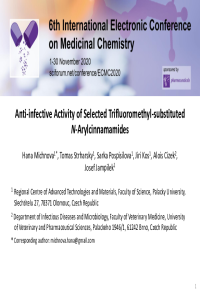
Anti-infective activity of selected trifluoromethyl-substituted N-arylcinnamamides
'%3e%3cpath%20d='M12.6647%2010.9104C12.4176%2010.325%2012.0589%209.7933%2011.6088%209.34485C11.16%208.89511%2010.6283%208.53653%2010.0432%208.28891C10.038%208.28629%2010.0327%208.28498%2010.0275%208.28236C10.8437%207.69282%2011.3743%206.73252%2011.3743%205.64907C11.3743%203.85423%209.92005%202.40002%208.12522%202.40002C6.33038%202.40002%204.87618%203.85423%204.87618%205.64907C4.87618%206.73252%205.40677%207.69282%206.22296%208.28367C6.21772%208.28629%206.21248%208.2876%206.20724%208.29022C5.62031%208.53783%205.09365%208.89287%204.64167%209.34616C4.19192%209.79496%203.83334%2010.3266%203.58573%2010.9117C3.34247%2011.4846%203.21128%2012.0987%203.19925%2012.721C3.1989%2012.735%203.20135%2012.7489%203.20646%2012.7619C3.21157%2012.7749%203.21924%2012.7868%203.22901%2012.7968C3.23877%2012.8068%203.25045%2012.8148%203.26334%2012.8202C3.27623%2012.8256%203.29007%2012.8284%203.30406%2012.8284H4.09012C4.14776%2012.8284%204.19362%2012.7825%204.19493%2012.7262C4.22113%2011.7148%204.62726%2010.7676%205.34519%2010.0497C6.08802%209.30686%207.07452%208.89811%208.12522%208.89811C9.17592%208.89811%2010.1624%209.30686%2010.9052%2010.0497C11.6232%2010.7676%2012.0293%2011.7148%2012.0555%2012.7262C12.0568%2012.7839%2012.1027%2012.8284%2012.1603%2012.8284H12.9464C12.9604%2012.8284%2012.9742%2012.8256%2012.9871%2012.8202C13%2012.8148%2013.0117%2012.8068%2013.0214%2012.7968C13.0312%2012.7868%2013.0389%2012.7749%2013.044%2012.7619C13.0491%2012.7489%2013.0515%2012.735%2013.0512%2012.721C13.0381%2012.0947%2012.9084%2011.4856%2012.6647%2010.9104ZM8.12522%207.90243C7.52388%207.90243%206.95792%207.66793%206.53214%207.24215C6.10636%206.81636%205.87185%206.2504%205.87185%205.64907C5.87185%205.04773%206.10636%204.48177%206.53214%204.05599C6.95792%203.63021%207.52388%203.3957%208.12522%203.3957C8.72655%203.3957%209.29252%203.63021%209.7183%204.05599C10.1441%204.48177%2010.3786%205.04773%2010.3786%205.64907C10.3786%206.2504%2010.1441%206.81636%209.7183%207.24215C9.29252%207.66793%208.72655%207.90243%208.12522%207.90243Z'%20fill='%235D1EE1'/%3e%3c/g%3e%3c/svg%3e)
Hana Michnová 1
Tomas Strharsky 1
Sarka Pospisilova 1
Jiri Kos 1
Alois Cizek 2

Josef Jampilek 1
1. Division of Biologically Active Complexes and Molecular Magnets, Regional Centre of Advanced Technologies and Materials, Faculty of Science, Palacky University, Slechtitelu 27, 78371 Olomouc, Czech Republic
2. Department of Infectious Diseases and Microbiology, Faculty of Veterinary Medicine, University of Veterinary and Pharmaceutical Sciences, Palackeho 1, 61242 Brno, Czech Republic
Abstract
The adaptation of microorganisms to antibiotics is common in all strains. This development of antibiotic resistance is significantly accelerated by the excessive use of antibiotics. One way to fight this severe problem is the search and development of new potentially antimicrobial agents. Three series of newly synthesized trifluoromethyl-substituted N-arylcinnamamides were tested for their anti-infective activity. These series differ in the position of the trifluoromethyl substituent on the phenyl core of the cinnamic acid. All compounds were tested against Staphylococcus aureus and its methicillin-resistant forms, Enterococcus faecalis, and Mycobacterium smegmatis. The activity was determined by the microdilution method for the assessment of minimum inhibitory concentration. For this contribution, one chlorine-substituted compound at position 4 of the anilide ring from each group was selected for activity comparison. The influence of the position of trifluoromethyl group is discussed.
This study was supported by Palacky University Olomouc (IGA_PrF_2020_023).
Keywords
anti-infective activity
N-arylcinnamamides
Enterococcus faecalis
MRSA
Mycobacterium smegmatis
Staphylococcus aureus
Poster
CF_ESMC-20_final.pdf
Antistaphylococcal activity of polychlorinated N-arylcinnamamides
Green synthesis of coumarinyl Schiff bases utilizing choline chloride-based deep eutectic solvents