Event submissions
Published

This submission belongs to the session G. Round Table on Neurodegenerative Disorders of the event 6th International Electronic Conference on Medicinal Chemistry
Published date
06 Nov, 2020
Citation
Anna Czopek, Agnieszka Zagórska, Hanna Byrtus, Małgorzata Góra, Anna Rapacz, Krzysztof Kamiński, Synthesis and anticonvulsant activity of arylpiperazinyl-alkyl and -sulfonylaklyl derivatives of β-tetralinohydantoin, in Proceedings of 6th International Electronic Conference on Medicinal Chemistry, 1 November–30 November 2020, MDPI: Basel, Switzerland, doi: 10.3390/ECMC2020-07408
Share
Email
Facebook
Twitter
LinkedIn
Synthesis and anticonvulsant activity of arylpiperazinyl-alkyl and -sulfonylaklyl derivatives of β-tetralinohydantoin
'%3e%3cpath%20d='M12.6647%2010.9104C12.4176%2010.325%2012.0589%209.7933%2011.6088%209.34485C11.16%208.89511%2010.6283%208.53653%2010.0432%208.28891C10.038%208.28629%2010.0327%208.28498%2010.0275%208.28236C10.8437%207.69282%2011.3743%206.73252%2011.3743%205.64907C11.3743%203.85423%209.92005%202.40002%208.12522%202.40002C6.33038%202.40002%204.87618%203.85423%204.87618%205.64907C4.87618%206.73252%205.40677%207.69282%206.22296%208.28367C6.21772%208.28629%206.21248%208.2876%206.20724%208.29022C5.62031%208.53783%205.09365%208.89287%204.64167%209.34616C4.19192%209.79496%203.83334%2010.3266%203.58573%2010.9117C3.34247%2011.4846%203.21128%2012.0987%203.19925%2012.721C3.1989%2012.735%203.20135%2012.7489%203.20646%2012.7619C3.21157%2012.7749%203.21924%2012.7868%203.22901%2012.7968C3.23877%2012.8068%203.25045%2012.8148%203.26334%2012.8202C3.27623%2012.8256%203.29007%2012.8284%203.30406%2012.8284H4.09012C4.14776%2012.8284%204.19362%2012.7825%204.19493%2012.7262C4.22113%2011.7148%204.62726%2010.7676%205.34519%2010.0497C6.08802%209.30686%207.07452%208.89811%208.12522%208.89811C9.17592%208.89811%2010.1624%209.30686%2010.9052%2010.0497C11.6232%2010.7676%2012.0293%2011.7148%2012.0555%2012.7262C12.0568%2012.7839%2012.1027%2012.8284%2012.1603%2012.8284H12.9464C12.9604%2012.8284%2012.9742%2012.8256%2012.9871%2012.8202C13%2012.8148%2013.0117%2012.8068%2013.0214%2012.7968C13.0312%2012.7868%2013.0389%2012.7749%2013.044%2012.7619C13.0491%2012.7489%2013.0515%2012.735%2013.0512%2012.721C13.0381%2012.0947%2012.9084%2011.4856%2012.6647%2010.9104ZM8.12522%207.90243C7.52388%207.90243%206.95792%207.66793%206.53214%207.24215C6.10636%206.81636%205.87185%206.2504%205.87185%205.64907C5.87185%205.04773%206.10636%204.48177%206.53214%204.05599C6.95792%203.63021%207.52388%203.3957%208.12522%203.3957C8.72655%203.3957%209.29252%203.63021%209.7183%204.05599C10.1441%204.48177%2010.3786%205.04773%2010.3786%205.64907C10.3786%206.2504%2010.1441%206.81636%209.7183%207.24215C9.29252%207.66793%208.72655%207.90243%208.12522%207.90243Z'%20fill='%235D1EE1'/%3e%3c/g%3e%3c/svg%3e)
Anna Czopek 1

Agnieszka Zagórska 1
Hanna Byrtus 1
Małgorzata Góra 1
Anna Rapacz 2
Krzysztof Kamiński 1
1. Department of Medicinal Chemistry, Faculty of Pharmacy, Jagiellonian University Medical College
2. Department of Pharmacodynamics, Faculty of Pharmacy, Jagiellonian University Medical College
Abstract
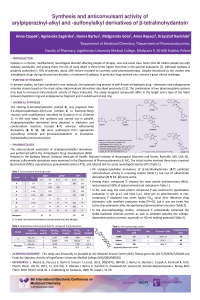
Epilepsy is the chronic, multifactorial, neurological disorder affecting people of all ages, race and social class. More than 60 million people live with epilepsy worldwide, and among them, the risk of early death is three times higher than that in the general population. Although epilepsy is properly controlled in 70% of patients, about 30% remains resistant to currently used pharmacotherapy. Despite introduced to the market new antiepileptic drugs during the past two decades, a treatment of epilepsy, in particular drug-resistant epilepsy, still remains a great challenge.
In present study, we have combined in one molecule, the hydantoin ring present in well-known antiepileptic drug – phenytoin and arylpiperazine moieties chosen on the basis of the most active anticonvulsant derivatives described previously. The newly designed compounds differ in the length and a type of the linker between hydantoin ring and arylpiperazine fragment and in substituent at aryl ring.
The series of compounds was obtained using Bucherer-Bergs cyclization, alkylation and condensation reactions. Then, their anticonvulsant activity was evaluated in preliminary pharmacological models: the maximal electroshock (MES), the subcutaneous pentylenetetrazole (scPTZ), and the 6-Hz tests. Additionally, for the most active molecule, the effect of blocking sodium and calcium channels was assessed to explain the possible mechanism of action.
This study was financially co-founded by the National Science Centre (NSC) Poland grant No 2017/25/B/NZ7/01048 and Funds for Statutory Activity of Jagiellonian University Medical College (N42/DBS/000020).
Keywords
arylpiperazine
dual compounds
epilepsy
hydantoin
Poster
2020-06-03_2.ecmc-6_ecmc-5_ACzopek 3.pdf
Spectral studies of the complex of adenosine with alcohol sugars
Cyclic bridged analogues of Combretastatin A-4: Design, synthesis and biological evaluation of 3-chloroazetidin-2-ones in breast cancer cells