Event submissions
Published

This submission belongs to the session B. General: Posters of the event 6th International Electronic Conference on Medicinal Chemistry
Published date
06 Nov, 2020
Citation
Azizah Malebari, Shu Wang, Darren Fayne, Brendan Twamley, Mary J Meegan, Cyclic bridged analogues of Combretastatin A-4: Design, synthesis and biological evaluation of 3-chloroazetidin-2-ones in breast cancer cells, in Proceedings of 6th International Electronic Conference on Medicinal Chemistry, 1 November–30 November 2020, MDPI: Basel, Switzerland, doi: 10.3390/ECMC2020-07409
Share
Email
Facebook
Twitter
LinkedIn
Cyclic bridged analogues of Combretastatin A-4: Design, synthesis and biological evaluation of 3-chloroazetidin-2-ones in breast cancer cells
'%3e%3cpath%20d='M12.6647%2010.9104C12.4176%2010.325%2012.0589%209.7933%2011.6088%209.34485C11.16%208.89511%2010.6283%208.53653%2010.0432%208.28891C10.038%208.28629%2010.0327%208.28498%2010.0275%208.28236C10.8437%207.69282%2011.3743%206.73252%2011.3743%205.64907C11.3743%203.85423%209.92005%202.40002%208.12522%202.40002C6.33038%202.40002%204.87618%203.85423%204.87618%205.64907C4.87618%206.73252%205.40677%207.69282%206.22296%208.28367C6.21772%208.28629%206.21248%208.2876%206.20724%208.29022C5.62031%208.53783%205.09365%208.89287%204.64167%209.34616C4.19192%209.79496%203.83334%2010.3266%203.58573%2010.9117C3.34247%2011.4846%203.21128%2012.0987%203.19925%2012.721C3.1989%2012.735%203.20135%2012.7489%203.20646%2012.7619C3.21157%2012.7749%203.21924%2012.7868%203.22901%2012.7968C3.23877%2012.8068%203.25045%2012.8148%203.26334%2012.8202C3.27623%2012.8256%203.29007%2012.8284%203.30406%2012.8284H4.09012C4.14776%2012.8284%204.19362%2012.7825%204.19493%2012.7262C4.22113%2011.7148%204.62726%2010.7676%205.34519%2010.0497C6.08802%209.30686%207.07452%208.89811%208.12522%208.89811C9.17592%208.89811%2010.1624%209.30686%2010.9052%2010.0497C11.6232%2010.7676%2012.0293%2011.7148%2012.0555%2012.7262C12.0568%2012.7839%2012.1027%2012.8284%2012.1603%2012.8284H12.9464C12.9604%2012.8284%2012.9742%2012.8256%2012.9871%2012.8202C13%2012.8148%2013.0117%2012.8068%2013.0214%2012.7968C13.0312%2012.7868%2013.0389%2012.7749%2013.044%2012.7619C13.0491%2012.7489%2013.0515%2012.735%2013.0512%2012.721C13.0381%2012.0947%2012.9084%2011.4856%2012.6647%2010.9104ZM8.12522%207.90243C7.52388%207.90243%206.95792%207.66793%206.53214%207.24215C6.10636%206.81636%205.87185%206.2504%205.87185%205.64907C5.87185%205.04773%206.10636%204.48177%206.53214%204.05599C6.95792%203.63021%207.52388%203.3957%208.12522%203.3957C8.72655%203.3957%209.29252%203.63021%209.7183%204.05599C10.1441%204.48177%2010.3786%205.04773%2010.3786%205.64907C10.3786%206.2504%2010.1441%206.81636%209.7183%207.24215C9.29252%207.66793%208.72655%207.90243%208.12522%207.90243Z'%20fill='%235D1EE1'/%3e%3c/g%3e%3c/svg%3e)
Azizah Malebari 1
Shu Wang 2
Darren Fayne 3
Brendan Twamley 4

Mary J Meegan 2
1. Department of Pharmaceutical Chemistry, College of Pharmacy, King Abdulaziz University, Jeddah, KSA
School of Pharmacy and Pharmaceutical Sciences, Trinity Biomedical Sciences Institute, 152-160 Pearse Street, Trinity College Dublin, Dublin 2, Ireland
2. School of Pharmacy and Pharmaceutical Sciences, Trinity College Dublin, Trinity Biomedical Sciences Institute, 152-160 Pearse Street, Dublin 2 DO2R590, Ireland.
3. School of Biochemistry and Immunology, Trinity College Dublin, Trinity Biomedical Sciences Institute, 152-160 Pearse Street, Dublin 2 DO2R590, Ireland.
4. School of Chemistry, Trinity College Dublin, Dublin 2 DO2R590, Ireland.
Abstract
Antimitotic drugs that target tubulin are among the most widely used chemotherapeutic agents; however, the development of multidrug resistance has limited their clinical activity. We have previously investigated the antiproliferative activity of the 1,4-diarylazetidin-2-ones (β-lactam) scaffold in breast cancer cell lines. We now report the synthesis and biological properties of a series of novel 3-chloro-β-lactams (2-azetidinone) and 3,3-dichloro-β-lactams, which are structurally related to Combretastatin CA-4. These compounds were evaluated as potential tubulin polymerization inhibitors and for their antiproliferative effects in breast cancer cells. A number of the compounds showed potent activity breast cancer cells e.g. compound 13 (3-chloro-4-(3-hydroxy-4-methoxy-phenyl)-1-(3,4,5-trimethoxyphenyl)azetidin-2-one) with an IC50 values of 17 nM and 32 nM in MCF-7 and MDA-MB-231 breast cancer cells respectively and displayed comparable cellular effects to those of Combretastatin A-4. Compound 13 displayed minimal cytotoxicity against non-tumorigenic HEK-293T cells and inhibited the in vitro polymerisation of tubulin with significant G2/M phase cell cycle arrest. Immunofluorescence staining of MCF-7 cells confirmed that β-lactam 13 caused mitotic catastrophe by targeting tubulin. In addition, compound 13 promoted apoptosis by regulating the expression of pro-apoptotic protein BAX and anti-apoptotic proteins Bcl-2 and Mcl-1. Molecular docking was used to explore the potential molecular interactions between novel 3-chloro-β-lactams and residues in the colchicine binding active site cavity of b-tubulin. Collectively, these results suggest that 3-chloro-2-azetidinones such as compound 13 could be a promising lead compound for further clinical anti-cancer drug development.
Keywords
Combretastatin A-4 (CA-4)
1,4-diarylazetidin-2-ones
β-lactam
tubulin polymerisation
Poster
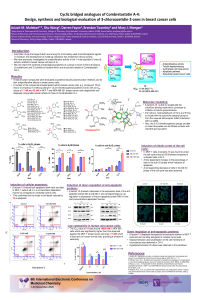
poster for 6th ECMC.pdf
Synthesis and anticonvulsant activity of arylpiperazinyl-alkyl and -sulfonylaklyl derivatives of β-tetralinohydantoin
Synthesis and biological evaluation of new N-substituted 9-nitro-12,14-dioxo-9,10-dihydro-9,10-[3,4]epipyrroloanthracen-13-yl derivatives