Event submissions
Published

This submission belongs to the session B. General: Posters of the event 6th International Electronic Conference on Medicinal Chemistry
Published date
06 Nov, 2020
Citation
Beniamin Oskar Grabarek, Magdalena Mistarz, Mateusz Maziarz, Michał Szurgot, Weronika Wieczorek, Cyclosporine A and adalimumab change the expression profile of mRNAs amd miRNAs related with the histaminergic system in keratinocytes exposed to LPS, in Proceedings of 6th International Electronic Conference on Medicinal Chemistry, 1 November–30 November 2020, MDPI: Basel, Switzerland, doi: 10.3390/ECMC2020-07411
Share
Email
Facebook
Twitter
LinkedIn
Cyclosporine A and adalimumab change the expression profile of mRNAs amd miRNAs related with the histaminergic system in keratinocytes exposed to LPS
'%3e%3cpath%20d='M12.6647%2010.9104C12.4176%2010.325%2012.0589%209.7933%2011.6088%209.34485C11.16%208.89511%2010.6283%208.53653%2010.0432%208.28891C10.038%208.28629%2010.0327%208.28498%2010.0275%208.28236C10.8437%207.69282%2011.3743%206.73252%2011.3743%205.64907C11.3743%203.85423%209.92005%202.40002%208.12522%202.40002C6.33038%202.40002%204.87618%203.85423%204.87618%205.64907C4.87618%206.73252%205.40677%207.69282%206.22296%208.28367C6.21772%208.28629%206.21248%208.2876%206.20724%208.29022C5.62031%208.53783%205.09365%208.89287%204.64167%209.34616C4.19192%209.79496%203.83334%2010.3266%203.58573%2010.9117C3.34247%2011.4846%203.21128%2012.0987%203.19925%2012.721C3.1989%2012.735%203.20135%2012.7489%203.20646%2012.7619C3.21157%2012.7749%203.21924%2012.7868%203.22901%2012.7968C3.23877%2012.8068%203.25045%2012.8148%203.26334%2012.8202C3.27623%2012.8256%203.29007%2012.8284%203.30406%2012.8284H4.09012C4.14776%2012.8284%204.19362%2012.7825%204.19493%2012.7262C4.22113%2011.7148%204.62726%2010.7676%205.34519%2010.0497C6.08802%209.30686%207.07452%208.89811%208.12522%208.89811C9.17592%208.89811%2010.1624%209.30686%2010.9052%2010.0497C11.6232%2010.7676%2012.0293%2011.7148%2012.0555%2012.7262C12.0568%2012.7839%2012.1027%2012.8284%2012.1603%2012.8284H12.9464C12.9604%2012.8284%2012.9742%2012.8256%2012.9871%2012.8202C13%2012.8148%2013.0117%2012.8068%2013.0214%2012.7968C13.0312%2012.7868%2013.0389%2012.7749%2013.044%2012.7619C13.0491%2012.7489%2013.0515%2012.735%2013.0512%2012.721C13.0381%2012.0947%2012.9084%2011.4856%2012.6647%2010.9104ZM8.12522%207.90243C7.52388%207.90243%206.95792%207.66793%206.53214%207.24215C6.10636%206.81636%205.87185%206.2504%205.87185%205.64907C5.87185%205.04773%206.10636%204.48177%206.53214%204.05599C6.95792%203.63021%207.52388%203.3957%208.12522%203.3957C8.72655%203.3957%209.29252%203.63021%209.7183%204.05599C10.1441%204.48177%2010.3786%205.04773%2010.3786%205.64907C10.3786%206.2504%2010.1441%206.81636%209.7183%207.24215C9.29252%207.66793%208.72655%207.90243%208.12522%207.90243Z'%20fill='%235D1EE1'/%3e%3c/g%3e%3c/svg%3e)
Beniamin Oskar Grabarek 1,2
Magdalena Mistarz 3
Mateusz Maziarz 3
Michał Szurgot 3
Weronika Wieczorek 3
1. Department of Histology, Cytophysiology and Embryology, Faculty of Medicine in Zabrze, Academy of Silesia, 40-555 Katowice, Poland
2. Department of Neurosurgery, 5th Military Clinical Hospital with the SP ZOZ Polyclinic in Krakow, 30-901 Krakow, Poland
3. Department of Histology, Cytophysiology and Embryology, Faculty of Medicine in Zabrze, University of Technology in Katowice, Poland
Abstract
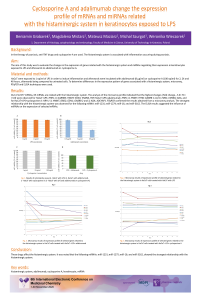
In the therapy of psoriasis, anti-TNF drugs and cyclosporine A are used. The histaminergic system is associated with inflammation occurring during psoriasis. The aim of this study was to evaluate the changes in the expression of genes related with the histaminergic system and miRNAs regulating their expression in keratinocytes exposed to LPS and afterwards to adalimumab or cyclosporine A. HaCaT were exposed to 1 ng/ml of LPS in order to induce inflammation and afterwards were incubated with adalimumab (8 μg/ml) or cyclosporine A (100 ng/ml) for 2, 24 and 48 hours, afterwards being compared to untreated cells. To determine differences in the expression pattern of genes associated with a histaminergic system, microarray, RTqPCR and ELISA techniques were used. Out of 22277 mRNAs, 65 mRNAs are related with the histaminergic system. The analysis of the microarray profile indicated that the highest changes (Fold change, -3.0< FC> +3.0) were observed for HaCaT+LPS: HRH1-3; GABRB3; HNMT; EDN1; ENDRA, for HaCaT+LPS+adalimumab: HRH1-3; HNMT; HTR6; GABRB 1 and 3; EDN1; EDNRA; ADA, and for HaCaT+LPS+cyclosporine A: HRH 1-3; HNMT; DRD2; EDN1; GABRB 2 and 3; ADA; ADCYAP1. RTqPCR confirmed the results obtained from a microarray analysis. The strongest relationship with the histaminergic system was observed for the following miRNA: miR-1231; miR-1274; miR-16; and miR-3162. The ELISA results suggested the influence of miRNAs on the expression of selected mRNAs. These drugs affect the histaminergic system. It was noted that the following miRNAs: miR-1231; miR-1275; miR-16; and miR-3162, showed the strongest relationship with the histaminergic system.
Keywords
adalimumab
cyclosporine A
histaminergic system
keratinocyte
miRNA
Poster
MPDI_Dermatologia_Poster_template.pdf
Synthesis and biological evaluation of new N-substituted 9-nitro-12,14-dioxo-9,10-dihydro-9,10-[3,4]epipyrroloanthracen-13-yl derivatives
Engineering and characterization of a recombinant human interferon alpha-2b fused with apolipoprotein A-I possessing prolonged action