Event submissions
Published

This submission belongs to the session B. General: Posters of the event 6th International Electronic Conference on Medicinal Chemistry
Published date
06 Nov, 2020
Citation
Samantha Dantas Coiado, Gabriela Marques Albuquerque, Izabel G. Souza Sobrinha, Giovannia A. L. Pereira, Goreti Carvalho Pereira, Bimodal nanoprobes based on cationic quantum dots and Gd3+ chelates prepared by covalent and dative bonds for optical and magnetic resonance imaging, in Proceedings of 6th International Electronic Conference on Medicinal Chemistry, 1 November–30 November 2020, MDPI: Basel, Switzerland, doi: 10.3390/ECMC2020-07424
Share
Email
Facebook
Twitter
LinkedIn
Bimodal nanoprobes based on cationic quantum dots and Gd3+ chelates prepared by covalent and dative bonds for optical and magnetic resonance imaging

Samantha Dantas Coiado 1
'%3e%3cpath%20d='M12.6647%2010.9104C12.4176%2010.325%2012.0589%209.7933%2011.6088%209.34485C11.16%208.89511%2010.6283%208.53653%2010.0432%208.28891C10.038%208.28629%2010.0327%208.28498%2010.0275%208.28236C10.8437%207.69282%2011.3743%206.73252%2011.3743%205.64907C11.3743%203.85423%209.92005%202.40002%208.12522%202.40002C6.33038%202.40002%204.87618%203.85423%204.87618%205.64907C4.87618%206.73252%205.40677%207.69282%206.22296%208.28367C6.21772%208.28629%206.21248%208.2876%206.20724%208.29022C5.62031%208.53783%205.09365%208.89287%204.64167%209.34616C4.19192%209.79496%203.83334%2010.3266%203.58573%2010.9117C3.34247%2011.4846%203.21128%2012.0987%203.19925%2012.721C3.1989%2012.735%203.20135%2012.7489%203.20646%2012.7619C3.21157%2012.7749%203.21924%2012.7868%203.22901%2012.7968C3.23877%2012.8068%203.25045%2012.8148%203.26334%2012.8202C3.27623%2012.8256%203.29007%2012.8284%203.30406%2012.8284H4.09012C4.14776%2012.8284%204.19362%2012.7825%204.19493%2012.7262C4.22113%2011.7148%204.62726%2010.7676%205.34519%2010.0497C6.08802%209.30686%207.07452%208.89811%208.12522%208.89811C9.17592%208.89811%2010.1624%209.30686%2010.9052%2010.0497C11.6232%2010.7676%2012.0293%2011.7148%2012.0555%2012.7262C12.0568%2012.7839%2012.1027%2012.8284%2012.1603%2012.8284H12.9464C12.9604%2012.8284%2012.9742%2012.8256%2012.9871%2012.8202C13%2012.8148%2013.0117%2012.8068%2013.0214%2012.7968C13.0312%2012.7868%2013.0389%2012.7749%2013.044%2012.7619C13.0491%2012.7489%2013.0515%2012.735%2013.0512%2012.721C13.0381%2012.0947%2012.9084%2011.4856%2012.6647%2010.9104ZM8.12522%207.90243C7.52388%207.90243%206.95792%207.66793%206.53214%207.24215C6.10636%206.81636%205.87185%206.2504%205.87185%205.64907C5.87185%205.04773%206.10636%204.48177%206.53214%204.05599C6.95792%203.63021%207.52388%203.3957%208.12522%203.3957C8.72655%203.3957%209.29252%203.63021%209.7183%204.05599C10.1441%204.48177%2010.3786%205.04773%2010.3786%205.64907C10.3786%206.2504%2010.1441%206.81636%209.7183%207.24215C9.29252%207.66793%208.72655%207.90243%208.12522%207.90243Z'%20fill='%235D1EE1'/%3e%3c/g%3e%3c/svg%3e)
Gabriela Marques Albuquerque 1
Izabel G. Souza Sobrinha 1
Giovannia A. L. Pereira 1
Goreti Carvalho Pereira 1
1. Federal University of Pernambuco
Abstract
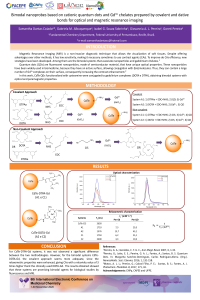
Magnetic Resonance Imaging (MRI) is a non-invasive diagnostic technique that allows the visualization of soft tissues. Despite offering advantages over other methods, it has low sensitivity, making it necessary sometimes to use contrast agents (ACs). And, to improve de ACs efficiency, new strategies have been developed. Among them are the bimodal systems that associate nanoparticles with gadolinium complexes. Quantum dots (QDs) are fluorescent nanoparticles, made of semiconductor material, that have unique optical properties. These nanoparticles have been widely used in biomedicine, because they have an active surface, allowing conjugation with (bio)molecules. Thus, they can contain a large number of Gd3+ complexes on their surface, consequently increasing the contrast enhancement. In this work, CdTe QDs functionalized with cysteamine were conjugated to gadolinium complexes (DOTA e DTPA), obtaining bimodal systems with optical and paramagnetic properties. In this study, two methodologies, a covalent and a non-covalent approach, were used to prepared bimodal nanoprobes. First, the covalent bond was achieved using coupling agents, linking the complex with the nanocrystal stabilizer. The non-covalent association was obtained using thiolated-complexes, allowing the association of the modified complexes with the QDs surface through dative bonding. The optical characterization of the bimodal systems showed that the nanoprobes maintained the QDs fluorescent properties. The relaxometric studies showed an enhancement of the ACs efficiency when compared with the clinically used Gd-complexes. Initial studies did not demonstrate a significant difference between the two methodologies. The results obtained showed that these systems are promising bimodal agents for biological studies by fluorescence and MRI.
Keywords
contrast agents
fluorescence imaging
magnetic resonance imaging
quantum dots
Poster
Poster Samantha_ECMC2020.pdf
Evaluation of different quantification methods to determine the photodynamic inactivation of bacterial biofilms
Preliminary in vitro evaluation of some unsymmetrical porphyrins using human MCF-7 breast tumor cells