Event submissions
Published

This submission belongs to the session B. General: Posters of the event 6th International Electronic Conference on Medicinal Chemistry
Published date
06 Nov, 2020
Citation
Rica Boscencu, Georgiana Vasiliu, Gina Manda, Radu Socoteanu, Dumitru Lupuleasa, Andreea Mihaela Burloiu, Ionela Victoria Neagoe, Laura Olariu, Interaction studies of some porphyrin structures with cell membrane using cell suspensions and fluorescent probes, in Proceedings of 6th International Electronic Conference on Medicinal Chemistry, 1 November–30 November 2020, MDPI: Basel, Switzerland, doi: 10.3390/ECMC2020-07426
Share
Email
Facebook
Twitter
LinkedIn
Interaction studies of some porphyrin structures with cell membrane using cell suspensions and fluorescent probes
'%3e%3cpath%20d='M12.6647%2010.9104C12.4176%2010.325%2012.0589%209.7933%2011.6088%209.34485C11.16%208.89511%2010.6283%208.53653%2010.0432%208.28891C10.038%208.28629%2010.0327%208.28498%2010.0275%208.28236C10.8437%207.69282%2011.3743%206.73252%2011.3743%205.64907C11.3743%203.85423%209.92005%202.40002%208.12522%202.40002C6.33038%202.40002%204.87618%203.85423%204.87618%205.64907C4.87618%206.73252%205.40677%207.69282%206.22296%208.28367C6.21772%208.28629%206.21248%208.2876%206.20724%208.29022C5.62031%208.53783%205.09365%208.89287%204.64167%209.34616C4.19192%209.79496%203.83334%2010.3266%203.58573%2010.9117C3.34247%2011.4846%203.21128%2012.0987%203.19925%2012.721C3.1989%2012.735%203.20135%2012.7489%203.20646%2012.7619C3.21157%2012.7749%203.21924%2012.7868%203.22901%2012.7968C3.23877%2012.8068%203.25045%2012.8148%203.26334%2012.8202C3.27623%2012.8256%203.29007%2012.8284%203.30406%2012.8284H4.09012C4.14776%2012.8284%204.19362%2012.7825%204.19493%2012.7262C4.22113%2011.7148%204.62726%2010.7676%205.34519%2010.0497C6.08802%209.30686%207.07452%208.89811%208.12522%208.89811C9.17592%208.89811%2010.1624%209.30686%2010.9052%2010.0497C11.6232%2010.7676%2012.0293%2011.7148%2012.0555%2012.7262C12.0568%2012.7839%2012.1027%2012.8284%2012.1603%2012.8284H12.9464C12.9604%2012.8284%2012.9742%2012.8256%2012.9871%2012.8202C13%2012.8148%2013.0117%2012.8068%2013.0214%2012.7968C13.0312%2012.7868%2013.0389%2012.7749%2013.044%2012.7619C13.0491%2012.7489%2013.0515%2012.735%2013.0512%2012.721C13.0381%2012.0947%2012.9084%2011.4856%2012.6647%2010.9104ZM8.12522%207.90243C7.52388%207.90243%206.95792%207.66793%206.53214%207.24215C6.10636%206.81636%205.87185%206.2504%205.87185%205.64907C5.87185%205.04773%206.10636%204.48177%206.53214%204.05599C6.95792%203.63021%207.52388%203.3957%208.12522%203.3957C8.72655%203.3957%209.29252%203.63021%209.7183%204.05599C10.1441%204.48177%2010.3786%205.04773%2010.3786%205.64907C10.3786%206.2504%2010.1441%206.81636%209.7183%207.24215C9.29252%207.66793%208.72655%207.90243%208.12522%207.90243Z'%20fill='%235D1EE1'/%3e%3c/g%3e%3c/svg%3e)
Rica Boscencu 1
Georgiana Vasiliu 2

Gina Manda 3
Radu Socoteanu 4
Dumitru Lupuleasa 2
Andreea Mihaela Burloiu 2
Ionela Victoria Neagoe 3
Laura Olariu 5
1. Carol Davila University of Medicine and Pharmacy
2. “Carol Davila” University of Medicine and Pharmacy, Faculty of Pharmacy, 6 Traian Vuia St., 020956 Bucharest, Romania
3. “Victor Babeş” National Institute of Pathology, 99-101 Splaiul Independentei, 050096 Bucharest, Romania
4. “Ilie Murgulescu” Institute of Physical Chemistry, Romanian Academy, 202 Splaiul Independenţei, Bucharest 060021, Romania
5. “SC. Biotehnos SA”, 3-5 Gorunului St., Bucharest, Romania
Abstract
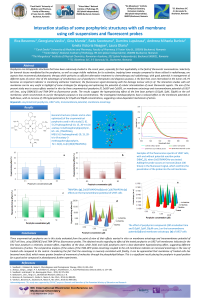
Porphyrins are tetrapyrrolic structures that have been extensively studied in the recent years, especially for their applicability in the field of theranostic nanomedicine. Selectivity for tumor tissues manifested by the porphyrins, as well as usage of visible radiations for their activation implying lower energies compared to those utilized in radiotherapy, are aspects that recommend photodynamic therapy with porphyrins as efficient alternative treatment to chemotherapy and radiotherapy, with good potential in management of different types of cancer. One of the advantages of simultaneous use of porphyrins in therapeutic and diagnosis purpose, is the fact that, once internalized in the tumor cell, PS becomes an important indicator in monitoring antitumor treatment, the fluorescence signal decreasing with the damage tumor cells. The interaction studies with cell membrane can be very useful in highlight of some strategies for designing and optimizing the potential of cellular internalization of novel theranostic agents. The aim of the present study was to assess effects exerted in vitro by three unsymmetrical porphyrins (P, Zn(II)P and Cu(II)P), on membrane anisotropy and transmembrane potential of U937 cell lines, using DiBAC4(3) and TMA-DPH as fluorescence probe. The results suggest the hyperpolarizing effect of the free base porphyrin (0.5μM, 5μM, 50μM) on the cell membrane, which recommends its use for therapeutic purposes in low concentrations. The investigated metalloporphyrins have a reduced effect on the membrane potential at 5μM doses, with an increase of 15% hyperpolarization for 0.5µM and 50µM concentrations, suggesting a dose-dependent mechanism of action.
Keywords
membrane anisotropy
transmembrane potential
U937 cells
unsymmetrical porphyrins
Poster
POSTER 6th_ECMC _ Prof.R.Boscencu_potential U937cells.pdf
Preliminary in vitro evaluation of some unsymmetrical porphyrins using human MCF-7 breast tumor cells
In silico drug-protein binding studies using TLC retention data