Event submissions
Published

This submission belongs to the session B. General: Posters of the event 6th International Electronic Conference on Medicinal Chemistry
Published date
06 Nov, 2020
Citation
Karolina Wanat, Grażyna Żydek, Elżbieta Brzezińska, In silico drug-protein binding studies using TLC retention data, in Proceedings of 6th International Electronic Conference on Medicinal Chemistry, 1 November–30 November 2020, MDPI: Basel, Switzerland, doi: 10.3390/ECMC2020-07427
Share
Email
Facebook
Twitter
LinkedIn
In silico drug-protein binding studies using TLC retention data
'%3e%3cpath%20d='M12.6647%2010.9104C12.4176%2010.325%2012.0589%209.7933%2011.6088%209.34485C11.16%208.89511%2010.6283%208.53653%2010.0432%208.28891C10.038%208.28629%2010.0327%208.28498%2010.0275%208.28236C10.8437%207.69282%2011.3743%206.73252%2011.3743%205.64907C11.3743%203.85423%209.92005%202.40002%208.12522%202.40002C6.33038%202.40002%204.87618%203.85423%204.87618%205.64907C4.87618%206.73252%205.40677%207.69282%206.22296%208.28367C6.21772%208.28629%206.21248%208.2876%206.20724%208.29022C5.62031%208.53783%205.09365%208.89287%204.64167%209.34616C4.19192%209.79496%203.83334%2010.3266%203.58573%2010.9117C3.34247%2011.4846%203.21128%2012.0987%203.19925%2012.721C3.1989%2012.735%203.20135%2012.7489%203.20646%2012.7619C3.21157%2012.7749%203.21924%2012.7868%203.22901%2012.7968C3.23877%2012.8068%203.25045%2012.8148%203.26334%2012.8202C3.27623%2012.8256%203.29007%2012.8284%203.30406%2012.8284H4.09012C4.14776%2012.8284%204.19362%2012.7825%204.19493%2012.7262C4.22113%2011.7148%204.62726%2010.7676%205.34519%2010.0497C6.08802%209.30686%207.07452%208.89811%208.12522%208.89811C9.17592%208.89811%2010.1624%209.30686%2010.9052%2010.0497C11.6232%2010.7676%2012.0293%2011.7148%2012.0555%2012.7262C12.0568%2012.7839%2012.1027%2012.8284%2012.1603%2012.8284H12.9464C12.9604%2012.8284%2012.9742%2012.8256%2012.9871%2012.8202C13%2012.8148%2013.0117%2012.8068%2013.0214%2012.7968C13.0312%2012.7868%2013.0389%2012.7749%2013.044%2012.7619C13.0491%2012.7489%2013.0515%2012.735%2013.0512%2012.721C13.0381%2012.0947%2012.9084%2011.4856%2012.6647%2010.9104ZM8.12522%207.90243C7.52388%207.90243%206.95792%207.66793%206.53214%207.24215C6.10636%206.81636%205.87185%206.2504%205.87185%205.64907C5.87185%205.04773%206.10636%204.48177%206.53214%204.05599C6.95792%203.63021%207.52388%203.3957%208.12522%203.3957C8.72655%203.3957%209.29252%203.63021%209.7183%204.05599C10.1441%204.48177%2010.3786%205.04773%2010.3786%205.64907C10.3786%206.2504%2010.1441%206.81636%209.7183%207.24215C9.29252%207.66793%208.72655%207.90243%208.12522%207.90243Z'%20fill='%235D1EE1'/%3e%3c/g%3e%3c/svg%3e)
Karolina Wanat 1
Grażyna Żydek 1
Elżbieta Brzezińska 1
1. Medical University of Lodz, Faculty of Pharmacy, Department of Analytical Chemistry
Abstract
Protein binding (PB) is one of the most important factors influencing the transport and distribution of a drug in a living organism. The ability to create such connections and their durability determine the bioavailability of drugs at the site of binding to a biological target, penetration through the body natural protective barriers, drug toxicity and elimination.
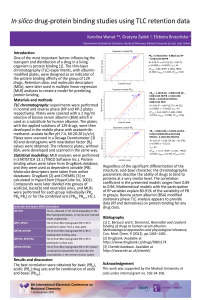
In addition to in vitro studies, drug-protein binding analysis uses different physicochemical properties of compounds and molecular descriptors to build predictive models. In this study, chromatographic experiments, in normal (NP-TLC) and reversed (RP-TLC) mode, were designed as an indicator of the protein binding affinity of 129 test compounds. The affinity chromatography of the analytes to the stationary phase, modified with protein was used. Retention data, along with physicochemical properties, were later used in multiple linear regression (MLR) analyses. Chromatographic indicators can be important independent variables in mathematical models in combination with physicochemical drug descriptors relevant to PB. The mobile phase was based on a buffer with pH 7.4, which makes the analysis conditions closer to physiological conditions. During the analysis, the drugs were divided into acidic, alkaline and neutral groups, and separate models were created for each group. The presented results indicate the usefulness of the chromatographic data in the study of drug binding to blood plasma proteins; all the created MLR models have determination coefficient around 0.9 and higher.
Keywords
chromatographic data
drug-protein binding
mathematical modelling
multiple linear regression
TLC chromatography
Poster
Wanat poster.pdf
Interaction studies of some porphyrin structures with cell membrane using cell suspensions and fluorescent probes
Iron-cyclopentadienyl compounds with nitrile-based ligands show strong activity against a broad panel of human cancer cell lines