Event submissions
Published

This submission belongs to the session G. Round Table on Neurodegenerative Disorders of the event 6th International Electronic Conference on Medicinal Chemistry
Published date
06 Nov, 2020
Citation
Darya Kuznetsova, Mikhail Khvostov, Sergey Kuranov, Olga Luzina, Dmitriy Baev, Nataliya Zhukova, Tatyana Tolstikova, Nariman Salakhutdinov, Hypoglycemic activity study of novel bornyl derivatives of p-(benzyloxy)phenylpropionic acid, in Proceedings of 6th International Electronic Conference on Medicinal Chemistry, 1 November–30 November 2020, MDPI: Basel, Switzerland, doi: 10.3390/ECMC2020-07441
Share
Email
Facebook
Twitter
LinkedIn
Hypoglycemic activity study of novel bornyl derivatives of p-(benzyloxy)phenylpropionic acid
'%3e%3cpath%20d='M12.6647%2010.9104C12.4176%2010.325%2012.0589%209.7933%2011.6088%209.34485C11.16%208.89511%2010.6283%208.53653%2010.0432%208.28891C10.038%208.28629%2010.0327%208.28498%2010.0275%208.28236C10.8437%207.69282%2011.3743%206.73252%2011.3743%205.64907C11.3743%203.85423%209.92005%202.40002%208.12522%202.40002C6.33038%202.40002%204.87618%203.85423%204.87618%205.64907C4.87618%206.73252%205.40677%207.69282%206.22296%208.28367C6.21772%208.28629%206.21248%208.2876%206.20724%208.29022C5.62031%208.53783%205.09365%208.89287%204.64167%209.34616C4.19192%209.79496%203.83334%2010.3266%203.58573%2010.9117C3.34247%2011.4846%203.21128%2012.0987%203.19925%2012.721C3.1989%2012.735%203.20135%2012.7489%203.20646%2012.7619C3.21157%2012.7749%203.21924%2012.7868%203.22901%2012.7968C3.23877%2012.8068%203.25045%2012.8148%203.26334%2012.8202C3.27623%2012.8256%203.29007%2012.8284%203.30406%2012.8284H4.09012C4.14776%2012.8284%204.19362%2012.7825%204.19493%2012.7262C4.22113%2011.7148%204.62726%2010.7676%205.34519%2010.0497C6.08802%209.30686%207.07452%208.89811%208.12522%208.89811C9.17592%208.89811%2010.1624%209.30686%2010.9052%2010.0497C11.6232%2010.7676%2012.0293%2011.7148%2012.0555%2012.7262C12.0568%2012.7839%2012.1027%2012.8284%2012.1603%2012.8284H12.9464C12.9604%2012.8284%2012.9742%2012.8256%2012.9871%2012.8202C13%2012.8148%2013.0117%2012.8068%2013.0214%2012.7968C13.0312%2012.7868%2013.0389%2012.7749%2013.044%2012.7619C13.0491%2012.7489%2013.0515%2012.735%2013.0512%2012.721C13.0381%2012.0947%2012.9084%2011.4856%2012.6647%2010.9104ZM8.12522%207.90243C7.52388%207.90243%206.95792%207.66793%206.53214%207.24215C6.10636%206.81636%205.87185%206.2504%205.87185%205.64907C5.87185%205.04773%206.10636%204.48177%206.53214%204.05599C6.95792%203.63021%207.52388%203.3957%208.12522%203.3957C8.72655%203.3957%209.29252%203.63021%209.7183%204.05599C10.1441%204.48177%2010.3786%205.04773%2010.3786%205.64907C10.3786%206.2504%2010.1441%206.81636%209.7183%207.24215C9.29252%207.66793%208.72655%207.90243%208.12522%207.90243Z'%20fill='%235D1EE1'/%3e%3c/g%3e%3c/svg%3e)
Darya Kuznetsova 1

Mikhail Khvostov 2
Sergey Kuranov 1
Olga Luzina 1
Dmitriy Baev 1
Nataliya Zhukova 1
Tatyana Tolstikova 1
Nariman Salakhutdinov 1
1. N. N. Vorozhtsov Novosibirsk Institute of Organic Chemistry, 9, AkademikaLavrentieva Ave., Novosibirsk, 630090, Russian Federation
2. N. N. Vorozhtsov Novosibirsk Institute of Organic Chemistry, 9, Akademika Lavrentieva Ave., Novosibirsk, 630090, Russian Federation
Abstract
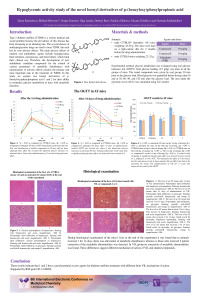
Two bornyl derivatives of p-(benzyloxy)phenylpropionic acid 1 and 2 were studied for their ability to normalize glucose metabolism in mice with metabolic disorders (C57BL/6Ay strain, AY). Compounds were tested at dose of 30 mg/kg. Vildagliptin (VIL) was used as a positive control in the same dose. Glucose tolerance test (OGTT) immediately performed after the first oral introduction of studied compounds to AY mice did not show a hypoglycemic effect but revealed the impaired glucose tolerance in untreated mice. Conversely administration of 1 exerted a hyperglycemic effect. After 14 days of administration, another OGTT was carried out, where it was found that glucose tolerance in untreated AY mice remained abnormal. At the same time, a significant hypoglycemic effect was detected in mice treated by 2. The hyperglycemic effect of 1 decreased, but the total glucose level in these animals did not differ from that in the untreated AY group. The administration of VIL for 2 weeks also improved the results of the OGTT. During histological examination of the mice liver at the end of the experiment, it was found that in animals having received 1 for 14 days, there was alleviation of metabolic disturbances whereas is those who received 2, partial correction of the metabolic abnormalities was detected. In VIL group no correction of metabolic abnormalities was found. These differences suggest different mechanism of action of VIL and studied compounds. Thus, the results obtained indicate that 1 and 2 have a good potential as new agents for diabetes mellitus treatment.
Keywords
agouti mice
bornyl derivative
glucose tolerance
hypoglycemic activity
natural product
type 2 diabetes mellitus
Poster
Kuznetsova et. al_2020.pdf
FrustraPocket: A method to predict protein–ligand binding sites based on frustration
2-Hydroxy-4-methoxyacetophenone substituted chalcones: Synthesis and biological evaluation as potential anticancer agents