Event submissions
Published

This submission belongs to the session B. General: Posters of the event 6th International Electronic Conference on Medicinal Chemistry
Published date
06 Nov, 2020
Citation
Anna Weronika Sobanska, Elżbieta Brzezińska, Application of RP-18 TLC retention data to prediction of transdermal absorption of drugs, in Proceedings of 6th International Electronic Conference on Medicinal Chemistry, 1 November–30 November 2020, MDPI: Basel, Switzerland, doi: 10.3390/ECMC2020-07446
Share
Email
Facebook
Twitter
LinkedIn
Application of RP-18 TLC retention data to prediction of transdermal absorption of drugs
'%3e%3cpath%20d='M12.6647%2010.9104C12.4176%2010.325%2012.0589%209.7933%2011.6088%209.34485C11.16%208.89511%2010.6283%208.53653%2010.0432%208.28891C10.038%208.28629%2010.0327%208.28498%2010.0275%208.28236C10.8437%207.69282%2011.3743%206.73252%2011.3743%205.64907C11.3743%203.85423%209.92005%202.40002%208.12522%202.40002C6.33038%202.40002%204.87618%203.85423%204.87618%205.64907C4.87618%206.73252%205.40677%207.69282%206.22296%208.28367C6.21772%208.28629%206.21248%208.2876%206.20724%208.29022C5.62031%208.53783%205.09365%208.89287%204.64167%209.34616C4.19192%209.79496%203.83334%2010.3266%203.58573%2010.9117C3.34247%2011.4846%203.21128%2012.0987%203.19925%2012.721C3.1989%2012.735%203.20135%2012.7489%203.20646%2012.7619C3.21157%2012.7749%203.21924%2012.7868%203.22901%2012.7968C3.23877%2012.8068%203.25045%2012.8148%203.26334%2012.8202C3.27623%2012.8256%203.29007%2012.8284%203.30406%2012.8284H4.09012C4.14776%2012.8284%204.19362%2012.7825%204.19493%2012.7262C4.22113%2011.7148%204.62726%2010.7676%205.34519%2010.0497C6.08802%209.30686%207.07452%208.89811%208.12522%208.89811C9.17592%208.89811%2010.1624%209.30686%2010.9052%2010.0497C11.6232%2010.7676%2012.0293%2011.7148%2012.0555%2012.7262C12.0568%2012.7839%2012.1027%2012.8284%2012.1603%2012.8284H12.9464C12.9604%2012.8284%2012.9742%2012.8256%2012.9871%2012.8202C13%2012.8148%2013.0117%2012.8068%2013.0214%2012.7968C13.0312%2012.7868%2013.0389%2012.7749%2013.044%2012.7619C13.0491%2012.7489%2013.0515%2012.735%2013.0512%2012.721C13.0381%2012.0947%2012.9084%2011.4856%2012.6647%2010.9104ZM8.12522%207.90243C7.52388%207.90243%206.95792%207.66793%206.53214%207.24215C6.10636%206.81636%205.87185%206.2504%205.87185%205.64907C5.87185%205.04773%206.10636%204.48177%206.53214%204.05599C6.95792%203.63021%207.52388%203.3957%208.12522%203.3957C8.72655%203.3957%209.29252%203.63021%209.7183%204.05599C10.1441%204.48177%2010.3786%205.04773%2010.3786%205.64907C10.3786%206.2504%2010.1441%206.81636%209.7183%207.24215C9.29252%207.66793%208.72655%207.90243%208.12522%207.90243Z'%20fill='%235D1EE1'/%3e%3c/g%3e%3c/svg%3e)
Anna Weronika Sobanska 1
Elżbieta Brzezińska 1
1. Department of Analytical Chemistry, Medical University of Lodz, Poland
Abstract
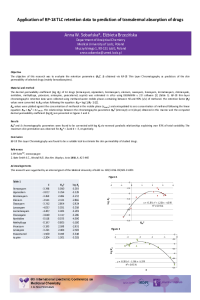
The dermal permeability coefficient (log Kp) of 14 drugs (temazepam, alprazolam, bromazepam, elenium, oxazepam, lorazepam, lormetazepam, clotrazepate, ranitidine, methyldopa, piroxicam, amizepine, paracetamol, aspirin) was estimated in silico using DERMWIN v. 2.0 software. RP-18 thin layer chromatographic retention data were collected using methanol-water mobile phases containing between 50 and 90% (v/v) of methanol. The retention factor (Rf) values were converted to RM values following the equation: RM = log (1/Rf -1).
RM values were plotted against the concentration of methanol in the mobile phase (cMeOH) and extrapolated to zero concentration of methanol following the linear equation: RM = RM0 + S cMeOH.
RM0 and S chromatographic parameters were found to be connected with log Kp via reversed parabolic relationships explaining over 93% of total variability.
This research was supported by an internal grant of the Medical University of Łódź no. 503/3-016-03/503-31-001
Keywords
drugs
RP-18 TLC
transdermal absorption
Poster
Sobańska AW poster.pdf
Trivalent chromium and male germ cells: current prospects and future trends
Viability and oxidative response of human colorectal HCT-116 cancer and human lung healthy pleura MRC-5 cell lines treated with novel bridged heteronuclear Zn(II)-L-Cu(II)