Event submissions
Published

This submission belongs to the session B. General: Posters of the event 6th International Electronic Conference on Medicinal Chemistry
Published date
06 Nov, 2020
Citation
Beatričė Razmienė, Eva Řezníčková, Vaida Dambrauskienė, Eglė Arbačiauskienė, Martin Kubala, Asta Žukauskaitė, Vladimir Kryštof, Algirdas Šačkus, New 2H-pyrazolo[4,3-c]pyridines: Synthesis, optical properties and elucidation of anti-cancer activity, in Proceedings of 6th International Electronic Conference on Medicinal Chemistry, 1 November–30 November 2020, MDPI: Basel, Switzerland, doi: 10.3390/ECMC2020-07448
Share
Email
Facebook
Twitter
LinkedIn
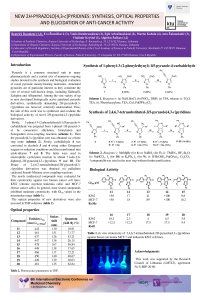
New 2H-pyrazolo[4,3-c]pyridines: Synthesis, optical properties and elucidation of anti-cancer activity
'%3e%3cpath%20d='M12.6647%2010.9104C12.4176%2010.325%2012.0589%209.7933%2011.6088%209.34485C11.16%208.89511%2010.6283%208.53653%2010.0432%208.28891C10.038%208.28629%2010.0327%208.28498%2010.0275%208.28236C10.8437%207.69282%2011.3743%206.73252%2011.3743%205.64907C11.3743%203.85423%209.92005%202.40002%208.12522%202.40002C6.33038%202.40002%204.87618%203.85423%204.87618%205.64907C4.87618%206.73252%205.40677%207.69282%206.22296%208.28367C6.21772%208.28629%206.21248%208.2876%206.20724%208.29022C5.62031%208.53783%205.09365%208.89287%204.64167%209.34616C4.19192%209.79496%203.83334%2010.3266%203.58573%2010.9117C3.34247%2011.4846%203.21128%2012.0987%203.19925%2012.721C3.1989%2012.735%203.20135%2012.7489%203.20646%2012.7619C3.21157%2012.7749%203.21924%2012.7868%203.22901%2012.7968C3.23877%2012.8068%203.25045%2012.8148%203.26334%2012.8202C3.27623%2012.8256%203.29007%2012.8284%203.30406%2012.8284H4.09012C4.14776%2012.8284%204.19362%2012.7825%204.19493%2012.7262C4.22113%2011.7148%204.62726%2010.7676%205.34519%2010.0497C6.08802%209.30686%207.07452%208.89811%208.12522%208.89811C9.17592%208.89811%2010.1624%209.30686%2010.9052%2010.0497C11.6232%2010.7676%2012.0293%2011.7148%2012.0555%2012.7262C12.0568%2012.7839%2012.1027%2012.8284%2012.1603%2012.8284H12.9464C12.9604%2012.8284%2012.9742%2012.8256%2012.9871%2012.8202C13%2012.8148%2013.0117%2012.8068%2013.0214%2012.7968C13.0312%2012.7868%2013.0389%2012.7749%2013.044%2012.7619C13.0491%2012.7489%2013.0515%2012.735%2013.0512%2012.721C13.0381%2012.0947%2012.9084%2011.4856%2012.6647%2010.9104ZM8.12522%207.90243C7.52388%207.90243%206.95792%207.66793%206.53214%207.24215C6.10636%206.81636%205.87185%206.2504%205.87185%205.64907C5.87185%205.04773%206.10636%204.48177%206.53214%204.05599C6.95792%203.63021%207.52388%203.3957%208.12522%203.3957C8.72655%203.3957%209.29252%203.63021%209.7183%204.05599C10.1441%204.48177%2010.3786%205.04773%2010.3786%205.64907C10.3786%206.2504%2010.1441%206.81636%209.7183%207.24215C9.29252%207.66793%208.72655%207.90243%208.12522%207.90243Z'%20fill='%235D1EE1'/%3e%3c/g%3e%3c/svg%3e)
Beatričė Razmienė 1,2
Eva Řezníčková 3
Vaida Dambrauskienė 2
Eglė Arbačiauskienė 2
Martin Kubala 4
Asta Žukauskaitė 3
Vladimir Kryštof 3
Algirdas Šačkus 1,2
1. Institute of Synthetic Chemistry, Kaunas University of Technology, K. Baršausko g. 59, LT-51423 Kaunas, Lithuania
2. Department of Organic Chemistry, Kaunas University of Technology, Radvilėnų pl. 19, LT-50254, Kaunas, Lithuania
3. Laboratory of Growth Regulators, Institute of Experimental Botany of the Czech Academy of Sciences & Palacký
University, Šlechtitelů 27, CZ-78371 Olomouc, Czech Republic
4. Department of Experimental Physics, Faculty of Science, Palacký University, 17. Listopadu 12, CZ-77146 Olomouc,
Czech Republic
Abstract
Pyrazole is a common structural unit in many pharmaceuticals and a central axis of numerous ongoing studies
devoted to the synthesis and biological evaluation of novel pyrazole moiety-bearing molecules. Annelated
pyrazoles are of particular interest as they constitute the core of several well-known drugs, including Sildenafil,
Zaleplon and Allopurinol. Among the vast variety of up to now developed biologically active annelated pyrazole
derivatives, synthetically demanding 2H-pyrazolo[4,3-c]pyridines are still relatively understudied.
Herein we present synthesis of novel variously substituted 2H-pyrazolo[4,3-c]pyridine derivatives, which are
easily accessible from various pyrazolidin-3-ones. The compounds were evaluated for their optical properties
and cytotoxicity in vitro against a small panel of normal and cancer cell lines. The compounds exhibited
favorable cytotoxicity, with GI50 values in the micromolar range and selected ones were further studied to assess
their mode of action.
Acknowledgements
This work was supported by the Research Council of Lithuania (LMTLT), agreement No S-MIP-20-60.
Keywords
anticancer
pyrazolopyridine
Poster
B. Razmiene.pdf
Viability and oxidative response of human colorectal HCT-116 cancer and human lung healthy pleura MRC-5 cell lines treated with novel bridged heteronuclear Zn(II)-L-Cu(II)
Synthesis, characterization and cytotoxicity of Mn(II) and Cu(II) complexes with N-substituted glycine hydrazone