Event submissions
Published

This submission belongs to the session B. General: Posters of the event 6th International Electronic Conference on Medicinal Chemistry
Published date
06 Nov, 2020
Citation
Snežana Selaković, Ivana Matić, Dragana Mitić, Maja Šumar Ristović, Božidar Čobeljić, Katarina Anđelković, Synthesis, characterization and cytotoxicity of Mn(II) and Cu(II) complexes with N-substituted glycine hydrazone, in Proceedings of 6th International Electronic Conference on Medicinal Chemistry, 1 November–30 November 2020, MDPI: Basel, Switzerland, doi: 10.3390/ECMC2020-07449
Share
Email
Facebook
Twitter
LinkedIn
Synthesis, characterization and cytotoxicity of Mn(II) and Cu(II) complexes with N-substituted glycine hydrazone
'%3e%3cpath%20d='M12.6647%2010.9104C12.4176%2010.325%2012.0589%209.7933%2011.6088%209.34485C11.16%208.89511%2010.6283%208.53653%2010.0432%208.28891C10.038%208.28629%2010.0327%208.28498%2010.0275%208.28236C10.8437%207.69282%2011.3743%206.73252%2011.3743%205.64907C11.3743%203.85423%209.92005%202.40002%208.12522%202.40002C6.33038%202.40002%204.87618%203.85423%204.87618%205.64907C4.87618%206.73252%205.40677%207.69282%206.22296%208.28367C6.21772%208.28629%206.21248%208.2876%206.20724%208.29022C5.62031%208.53783%205.09365%208.89287%204.64167%209.34616C4.19192%209.79496%203.83334%2010.3266%203.58573%2010.9117C3.34247%2011.4846%203.21128%2012.0987%203.19925%2012.721C3.1989%2012.735%203.20135%2012.7489%203.20646%2012.7619C3.21157%2012.7749%203.21924%2012.7868%203.22901%2012.7968C3.23877%2012.8068%203.25045%2012.8148%203.26334%2012.8202C3.27623%2012.8256%203.29007%2012.8284%203.30406%2012.8284H4.09012C4.14776%2012.8284%204.19362%2012.7825%204.19493%2012.7262C4.22113%2011.7148%204.62726%2010.7676%205.34519%2010.0497C6.08802%209.30686%207.07452%208.89811%208.12522%208.89811C9.17592%208.89811%2010.1624%209.30686%2010.9052%2010.0497C11.6232%2010.7676%2012.0293%2011.7148%2012.0555%2012.7262C12.0568%2012.7839%2012.1027%2012.8284%2012.1603%2012.8284H12.9464C12.9604%2012.8284%2012.9742%2012.8256%2012.9871%2012.8202C13%2012.8148%2013.0117%2012.8068%2013.0214%2012.7968C13.0312%2012.7868%2013.0389%2012.7749%2013.044%2012.7619C13.0491%2012.7489%2013.0515%2012.735%2013.0512%2012.721C13.0381%2012.0947%2012.9084%2011.4856%2012.6647%2010.9104ZM8.12522%207.90243C7.52388%207.90243%206.95792%207.66793%206.53214%207.24215C6.10636%206.81636%205.87185%206.2504%205.87185%205.64907C5.87185%205.04773%206.10636%204.48177%206.53214%204.05599C6.95792%203.63021%207.52388%203.3957%208.12522%203.3957C8.72655%203.3957%209.29252%203.63021%209.7183%204.05599C10.1441%204.48177%2010.3786%205.04773%2010.3786%205.64907C10.3786%206.2504%2010.1441%206.81636%209.7183%207.24215C9.29252%207.66793%208.72655%207.90243%208.12522%207.90243Z'%20fill='%235D1EE1'/%3e%3c/g%3e%3c/svg%3e)
Snežana Selaković 1
Ivana Matić 2
Dragana Mitić 1
Maja Šumar Ristović 3
Božidar Čobeljić 3
Katarina Anđelković 3
1. Innovation center of the Faculty of Chemistry, University of Belgrade, Studentski trg 12-16, 11000 Belgrade, Serbia
2. Institute of Oncology and Radiology of Serbia, Pasterova 14, Belgrade, Serbia
3. Faculty of Chemistry, University of Belgrade, Studentski trg 12-16, 11000 Belgrade, Serbia
Abstract
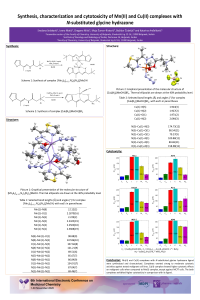
The ligand HLCl, (E)-N,N,N-trimethyl-2-oxo-2-(2-(1-(thiazol-2-yl)ethylidene)hydrazinyl)ethan-1-aminium chloride, was synthesized by the reaction of Girard’s reagent T and 2-acetylthiazole in water.
Reaction of the ligand HLCl with Cu(BF4)2·6H2O and NaN3 in molar ratio 1 : 1 : 4 in methanol resulted in formation of the mononuclear azido Cu(II) complex with composition [CuL(N3)(MeOH)]BF4. The complex has distorted square-pyramidal geometry according to the X-ray. The tridentate hydrazone ligand is coordinated in deprotonated form to the Cu(II) with a NNO set of donor atoms, while the other two coordination sites are occupied by azido ligand and one molecule of solvent.
Reaction of ligand HLCl with MnCl2·4H2O and NaN3 in molar ratio 1 : 1 : 4 in methanol resulted in formation of the binuclear azido bridged Mn(II) complex with composition [Mn2L2(µ-1,1-N3)2(N3)2]MeOH. The ligands are coordinated in deprotonated form to Mn(II) ions with a NNO set of donor atoms, while three remaining coordination sites are occupied with two azido bridged ligands, and one terminal azido ligand.
The cytotoxic effects of the complexes and its precursor ligand were examined against five human malignant cell lines: cervical adenocarcinoma HeLa, melanoma A375, breast adenocarcinoma MCF7, prostate adenocarcinoma PC-3, and lung carcinoma A549, as well as against normal human keratinocyte cell line HaCaT. Mn(II) and Cu(II) complexes exerted strong to moderate cytotoxic activities against tested malignant cell lines. Cu(II) complex showed higher cytotoxic effects on malignant cells when compared to Mn(II) complex, except against MCF7 cells.
Both complexes exhibited higher cytotoxicity in comparison with its ligand HLCl.
Keywords
characterization
copper(II) complex
cytotoxicity
Girard’s T reagent
hydrazone ligand
manganese(II) complex
synthesis
X-Ray
Poster
Selakovic_Synthesis_Characterization.pdf
New 2H-pyrazolo[4,3-c]pyridines: Synthesis, optical properties and elucidation of anti-cancer activity
Computational study to develop new bromodomain-containing protein 9 inhibitors