Event submissions
Published

This submission belongs to the session B. General: Posters of the event 6th International Electronic Conference on Medicinal Chemistry
Published date
06 Nov, 2020
Citation
Ivanna Kraievska, Zenoviy Tkachuk, Viability of different tumor cell lines after treatment with complexes of oligoribonucleotides with D-mannitol, in Proceedings of 6th International Electronic Conference on Medicinal Chemistry, 1 November–30 November 2020, MDPI: Basel, Switzerland, doi: 10.3390/ECMC2020-07451
Share
Email
Facebook
Twitter
LinkedIn
Viability of different tumor cell lines after treatment with complexes of oligoribonucleotides with D-mannitol

Ivanna Kraievska 1
'%3e%3cpath%20d='M12.6647%2010.9104C12.4176%2010.325%2012.0589%209.7933%2011.6088%209.34485C11.16%208.89511%2010.6283%208.53653%2010.0432%208.28891C10.038%208.28629%2010.0327%208.28498%2010.0275%208.28236C10.8437%207.69282%2011.3743%206.73252%2011.3743%205.64907C11.3743%203.85423%209.92005%202.40002%208.12522%202.40002C6.33038%202.40002%204.87618%203.85423%204.87618%205.64907C4.87618%206.73252%205.40677%207.69282%206.22296%208.28367C6.21772%208.28629%206.21248%208.2876%206.20724%208.29022C5.62031%208.53783%205.09365%208.89287%204.64167%209.34616C4.19192%209.79496%203.83334%2010.3266%203.58573%2010.9117C3.34247%2011.4846%203.21128%2012.0987%203.19925%2012.721C3.1989%2012.735%203.20135%2012.7489%203.20646%2012.7619C3.21157%2012.7749%203.21924%2012.7868%203.22901%2012.7968C3.23877%2012.8068%203.25045%2012.8148%203.26334%2012.8202C3.27623%2012.8256%203.29007%2012.8284%203.30406%2012.8284H4.09012C4.14776%2012.8284%204.19362%2012.7825%204.19493%2012.7262C4.22113%2011.7148%204.62726%2010.7676%205.34519%2010.0497C6.08802%209.30686%207.07452%208.89811%208.12522%208.89811C9.17592%208.89811%2010.1624%209.30686%2010.9052%2010.0497C11.6232%2010.7676%2012.0293%2011.7148%2012.0555%2012.7262C12.0568%2012.7839%2012.1027%2012.8284%2012.1603%2012.8284H12.9464C12.9604%2012.8284%2012.9742%2012.8256%2012.9871%2012.8202C13%2012.8148%2013.0117%2012.8068%2013.0214%2012.7968C13.0312%2012.7868%2013.0389%2012.7749%2013.044%2012.7619C13.0491%2012.7489%2013.0515%2012.735%2013.0512%2012.721C13.0381%2012.0947%2012.9084%2011.4856%2012.6647%2010.9104ZM8.12522%207.90243C7.52388%207.90243%206.95792%207.66793%206.53214%207.24215C6.10636%206.81636%205.87185%206.2504%205.87185%205.64907C5.87185%205.04773%206.10636%204.48177%206.53214%204.05599C6.95792%203.63021%207.52388%203.3957%208.12522%203.3957C8.72655%203.3957%209.29252%203.63021%209.7183%204.05599C10.1441%204.48177%2010.3786%205.04773%2010.3786%205.64907C10.3786%206.2504%2010.1441%206.81636%209.7183%207.24215C9.29252%207.66793%208.72655%207.90243%208.12522%207.90243Z'%20fill='%235D1EE1'/%3e%3c/g%3e%3c/svg%3e)
Zenoviy Tkachuk 1
1. Institute of Molecular Biology and Genetics of National Academy of Sciences of Ukraine
Abstract
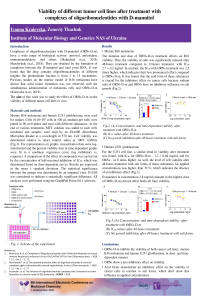
Aim. Studies on the murine B16 melanoma animal model have shown that solid tumor formation was not observed with the simultaneous administration of melanoma cells and complexes of oligoribonucleotides with D-mannitol (ORNs-D-m). The aim of this work was to study the effect of ORNs-D-m and similar compounds on the viability of different tumor cell lines.
Materials and methods. Murine B16 melanoma and human U251 glioblastoma were investigated. Oligoribonucleotides (ORNs), ORNs-D-m (both in the acid form), and their sodium salts were applied for the treatment. The growth inhibition of tumor cells was assessed with methyl thiazolyl tetrazolium (MTT). A comparison of the effect of compounds was carried out by the concentration of half-maximal inhibition of IC50.
Results. The duration and dose of ORNs-D-m treatment effects on B16 viability. Thus, the IC50 after 48-hours treatment was equal to 2.7 ± 0.2 mg/ml, while with ORNs treatment, IC50 was in the range of 6.9 ± 0.4 mg/ml. For the U251 cell line, a similar trend in viability after treatment was found, with IC50 for ORNs-D-m – 1.2 ± 0.04 mg/ml, for ORNs - 10.1 ± 0.2 mg/ml. For comparison, salt forms either showed no inhibitory effect on B16 or influenced at significantly higher concentrations compared to acid forms on U251.
Conclusions. ORNs-D-m inhibits the viability of B16 and U251 tumor cell lines. ORNs have a less inhibitory effect on viability. The acid form of ORNs-D-m has a more apparent effect on cell viability compared to the salt form.
Keywords
acid and salt forms
ORNs-D-m
tumor cell viability
Poster
kraievska-ecmc-6.pdf
Computational study to develop new bromodomain-containing protein 9 inhibitors
Analysis of the hydrogen bond network for binding sites identification